

Possibilities of Cause-and-Effect Simulation in the Study of System Climate-Ocean-Sediments
217
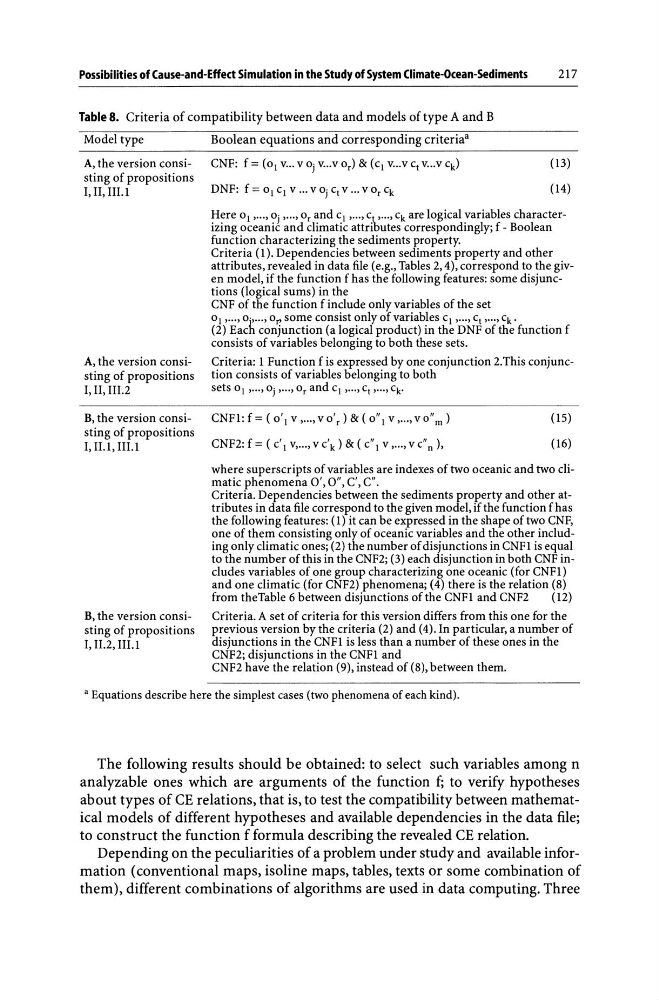
Table 8. Criteria of compatibility between data and models of type A and B
Model type
Boolean equations and corresponding criteria"
A, the version cons iCNF: f = (01 v ... V OJ v ... v Or) & (c1 v ... v Ct v ... v ck)
sting of propositions
(13)
(14)
I, II, I1L1
DNF: f = 0 1 c1 v ... V OJ ct v ... V Or Ck
A, the version consisting of propositions
I, II, III.2
Here 0 1 , .•. , OJ , ... , Or and c 1 , .•. , c t , ••• , ck are logical variables characterizing oceanic and climatic attributes correspondingly; f - Boolean
function characterizing the sediments property.
Criteria (1). Dependencies between sediments property and other
attributes, revealed in data file (e.g., Tables 2,4), correspond to the given model, if the function f has the following features: some disjunctions (logical sums) in the
CNF of the function f include only variables of the set
0 1 , .•• , OJ' ... ' or> some consist only of variables c1 , •.• , ct , •.. , Ck .
(2) Each conjunction (a logical product) in the DNF of the function f
consists of variables belonging to both these sets.
Criteria: 1 Function f is expressed by one conjunction 2.This conjunction consists of variables belonging to both
sets 01 , .•• , OJ , ... , Or and Cl , ... , ct , ••• , ckB, the version cons iCNF1: f = (0' 1 v, ... , V o'r) & (0" 1 v, ... , vo"m)
(15)
(16)
sting of propositions
1,11.1,111.1
CNF2: f = ( c'l v, ... , v c'k) & (c" 1 V , ••• , V C" n)'
B, the version consisting of propositions
1,11.2, III. 1
where superscripts of variables are indexes of two oceanic and two climatic phenomena 0', 0", C', C".
Criteria. Dependencies between the sediments property and other attributes in data file correspond to the given model, if the function fhas
the following features: (1) it can be expressed in the shape of two CNF,
one of them consisting only of oceanic variables and the other including only climatic ones; (2) the number of disjunctions in CNF1 is equal
to the number of this in the CNF2; (3) each disjunction in both CNF includes variables of one group characterizing one oceanic (for CNFl)
and one climatic (for CNF2) phenomena; (4) there is the relation (8)
from theTable 6 between disjunctions of the CNF1 and CNF2
(12)
Criteria. A set of criteria for this version differs from this one for the
previous version by the criteria (2) and (4). In particular, a number of
disjunctions in the CNF1 is less than a number of these ones in the
CNF2; disjunctions in the CNF1 and
CNF2 have the relation (9), instead of (8), between them.
a Equations describe here the simplest cases (two phenomena of each kind).
The following results should be obtained: to select such variables among n
analyzable ones which are arguments of the function f; to verify hypotheses
about types of CE relations, that is, to test the compatibility between mathematical models of different hypotheses and available dependencies in the data file;
to construct the function f formula describing the revealed CE relation.
Depending on the peculiarities of a problem under study and available information (conventional maps, isoline maps, tables, texts or some combination of
them), different combinations of algorithms are used in data computing. Three
217
Table 8. Criteria of compatibility between data and models of type A and B
Model type
Boolean equations and corresponding criteria"
A, the version cons iCNF: f = (01 v ... V OJ v ... v Or) & (c1 v ... v Ct v ... v ck)
sting of propositions
(13)
(14)
I, II, I1L1
DNF: f = 0 1 c1 v ... V OJ ct v ... V Or Ck
A, the version consisting of propositions
I, II, III.2
Here 0 1 , .•. , OJ , ... , Or and c 1 , .•. , c t , ••• , ck are logical variables characterizing oceanic and climatic attributes correspondingly; f - Boolean
function characterizing the sediments property.
Criteria (1). Dependencies between sediments property and other
attributes, revealed in data file (e.g., Tables 2,4), correspond to the given model, if the function f has the following features: some disjunctions (logical sums) in the
CNF of the function f include only variables of the set
0 1 , .•• , OJ' ... ' or> some consist only of variables c1 , •.• , ct , •.. , Ck .
(2) Each conjunction (a logical product) in the DNF of the function f
consists of variables belonging to both these sets.
Criteria: 1 Function f is expressed by one conjunction 2.This conjunction consists of variables belonging to both
sets 01 , .•• , OJ , ... , Or and Cl , ... , ct , ••• , ckB, the version cons iCNF1: f = (0' 1 v, ... , V o'r) & (0" 1 v, ... , vo"m)
(15)
(16)
sting of propositions
1,11.1,111.1
CNF2: f = ( c'l v, ... , v c'k) & (c" 1 V , ••• , V C" n)'
B, the version consisting of propositions
1,11.2, III. 1
where superscripts of variables are indexes of two oceanic and two climatic phenomena 0', 0", C', C".
Criteria. Dependencies between the sediments property and other attributes in data file correspond to the given model, if the function fhas
the following features: (1) it can be expressed in the shape of two CNF,
one of them consisting only of oceanic variables and the other including only climatic ones; (2) the number of disjunctions in CNF1 is equal
to the number of this in the CNF2; (3) each disjunction in both CNF includes variables of one group characterizing one oceanic (for CNFl)
and one climatic (for CNF2) phenomena; (4) there is the relation (8)
from theTable 6 between disjunctions of the CNF1 and CNF2
(12)
Criteria. A set of criteria for this version differs from this one for the
previous version by the criteria (2) and (4). In particular, a number of
disjunctions in the CNF1 is less than a number of these ones in the
CNF2; disjunctions in the CNF1 and
CNF2 have the relation (9), instead of (8), between them.
a Equations describe here the simplest cases (two phenomena of each kind).
The following results should be obtained: to select such variables among n
analyzable ones which are arguments of the function f; to verify hypotheses
about types of CE relations, that is, to test the compatibility between mathematical models of different hypotheses and available dependencies in the data file;
to construct the function f formula describing the revealed CE relation.
Depending on the peculiarities of a problem under study and available information (conventional maps, isoline maps, tables, texts or some combination of
them), different combinations of algorithms are used in data computing. Three