

216
AB
B*
AC
S. V. Sirotinskaya
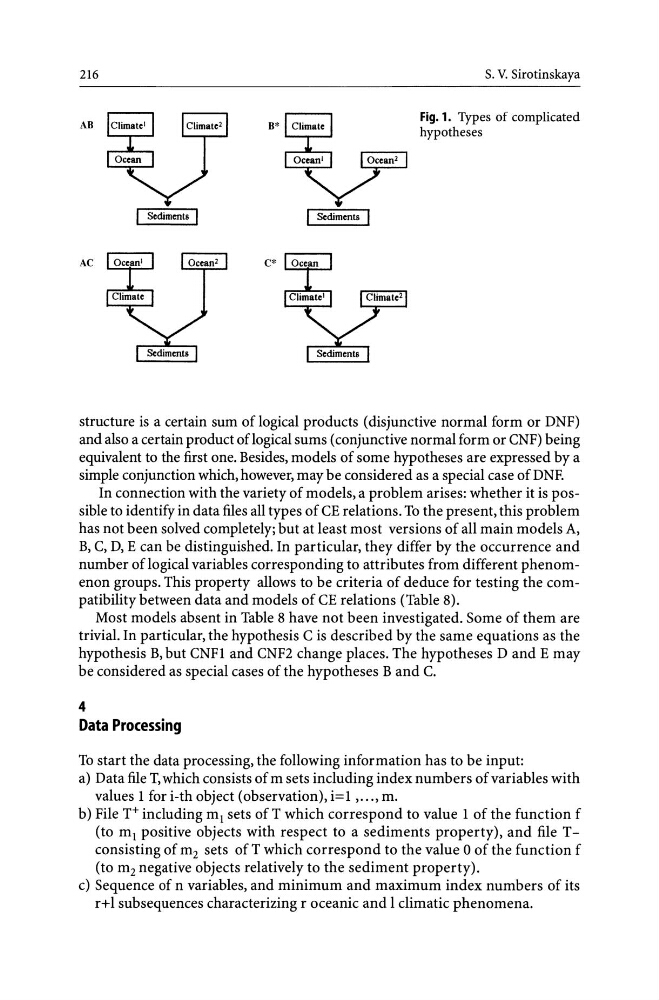
Fig. 1. Types of complicated
hypotheses
structure is a certain sum of logical products (disjunctive normal form or DNF)
and also a certain product of logical sums (conjunctive normal form or CNF) being
equivalent to the first one. Besides, models of some hypotheses are expressed by a
simple conjunction which, however, may be considered as a special case of DNF.
In connection with the variety of models, a problem arises: whether it is possible to identify in data files all types of CE relations. To the present, this problem
has not been solved completely; but at least most versions of all main models A,
B, C, D, E can be distinguished. In particular, they differ by the occurrence and
number of logical variables corresponding to attributes from different phenomen on groups. This property allows to be criteria of deduce for testing the compatibility between data and models of CE relations (Table 8).
Most models absent in Table 8 have not been investigated. Some of them are
trivial. In particular, the hypothesis C is described by the same equations as the
hypothesis B, but CNFI and CNF2 change places. The hypotheses D and E may
be considered as special cases of the hypotheses Band C.
4
Data Processing
To start the data processing, the following information has to be input:
a) Data file T, which consists of m sets including index numbers of variables with
values 1 for i-th object (observation),i=l , ... ,m.
b) File T+ including m 1 sets of T which correspond to value 1 of the function f
(to m l positive objects with respect to a sediments property), and file Tconsisting of m 2 sets of T which correspond to the value 0 of the function f
(to m 2 negative objects relatively to the sediment property).
c) Sequence of n variables, and minimum and maximum index numbers of its
r+l subsequences characterizing r oceanic and I climatic phenomena.
AB
B*
AC
S. V. Sirotinskaya
Fig. 1. Types of complicated
hypotheses
structure is a certain sum of logical products (disjunctive normal form or DNF)
and also a certain product of logical sums (conjunctive normal form or CNF) being
equivalent to the first one. Besides, models of some hypotheses are expressed by a
simple conjunction which, however, may be considered as a special case of DNF.
In connection with the variety of models, a problem arises: whether it is possible to identify in data files all types of CE relations. To the present, this problem
has not been solved completely; but at least most versions of all main models A,
B, C, D, E can be distinguished. In particular, they differ by the occurrence and
number of logical variables corresponding to attributes from different phenomen on groups. This property allows to be criteria of deduce for testing the compatibility between data and models of CE relations (Table 8).
Most models absent in Table 8 have not been investigated. Some of them are
trivial. In particular, the hypothesis C is described by the same equations as the
hypothesis B, but CNFI and CNF2 change places. The hypotheses D and E may
be considered as special cases of the hypotheses Band C.
4
Data Processing
To start the data processing, the following information has to be input:
a) Data file T, which consists of m sets including index numbers of variables with
values 1 for i-th object (observation),i=l , ... ,m.
b) File T+ including m 1 sets of T which correspond to value 1 of the function f
(to m l positive objects with respect to a sediments property), and file Tconsisting of m 2 sets of T which correspond to the value 0 of the function f
(to m 2 negative objects relatively to the sediment property).
c) Sequence of n variables, and minimum and maximum index numbers of its
r+l subsequences characterizing r oceanic and I climatic phenomena.