

192
w. Ritzrau . H. Fohrmann
where the subscript ds denotes differential settling.
By increasing turbulent shear towards the seafloor, particle aggregation due
to turbulent encounter becomes more important and can dominate the aggregate interactions. For aggregates much smaller than the Kolmogorov scale, the
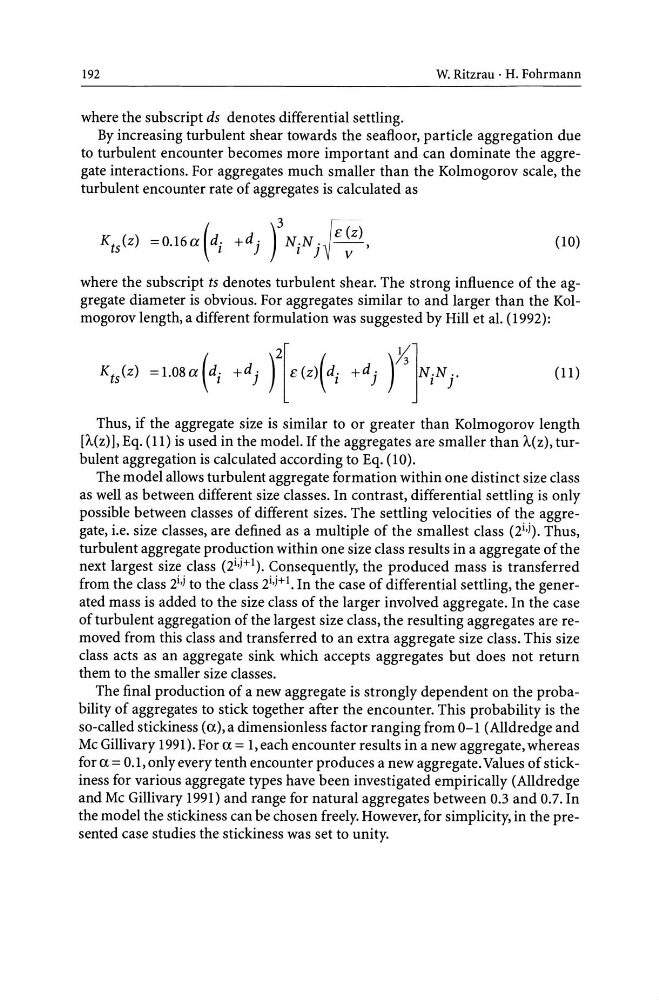
turbulent encounter rate of aggregates is calculated as
Kts(z) =0.16a(d i +d j tNiNjf~Z),
(10)
where the subscript ts denotes turbulent shear. The strong influence of the aggregate diameter is obvious. For aggregates similar to and larger than the Kolmogorov length, a different formulation was suggested by Hill et al. (1992):
(ll)
Thus, if the aggregate size is similar to or greater than Kolmogorov length
[A(Z)]' Eq. (11) is used in the model. If the aggregates are smaller than A(Z), turbulent aggregation is calculated according to Eq. (10).
The model allows turbulent aggregate formation within one distinct size class
as well as between different size classes. In contrast, differential settling is only
possible between classes of different sizes. The settling velocities of the aggregate, i.e. size classes, are defined as a multiple of the smallest class (2 i ,i). Thus,
turbulent aggregate production within one size class results in a aggregate of the
next largest size class (2 i ,i+ 1 ). Consequently, the produced mass is transferred
from the class 2 i ,i to the class 2 i ,i+l. In the case of differential settling, the generated mass is added to the size class of the larger involved aggregate. In the case
of turbulent aggregation of the largest size class, the resulting aggregates are removed from this class and transferred to an extra aggregate size class. This size
class acts as an aggregate sink which accepts aggregates but does not return
them to the smaller size classes.
The final production of a new aggregate is strongly dependent on the probability of aggregates to stick together after the encounter. This probability is the
so-called stickiness (ex), a dimensionless factor ranging from 0-1 (Alldredge and
Mc Gillivary 1991). For ex = l,each encounter results in a new aggregate, whereas
for ex = 0.1, only every tenth encounter produces a new aggregate. Values of stickiness for various aggregate types have been investigated empirically (Alldredge
and Mc Gillivary 1991) and range for natural aggregates between 0.3 and 0.7. In
the model the stickiness can be chosen freely. However, for simplicity, in the presented case studies the stickiness was set to unity.
w. Ritzrau . H. Fohrmann
where the subscript ds denotes differential settling.
By increasing turbulent shear towards the seafloor, particle aggregation due
to turbulent encounter becomes more important and can dominate the aggregate interactions. For aggregates much smaller than the Kolmogorov scale, the
turbulent encounter rate of aggregates is calculated as
Kts(z) =0.16a(d i +d j tNiNjf~Z),
(10)
where the subscript ts denotes turbulent shear. The strong influence of the aggregate diameter is obvious. For aggregates similar to and larger than the Kolmogorov length, a different formulation was suggested by Hill et al. (1992):
(ll)
Thus, if the aggregate size is similar to or greater than Kolmogorov length
[A(Z)]' Eq. (11) is used in the model. If the aggregates are smaller than A(Z), turbulent aggregation is calculated according to Eq. (10).
The model allows turbulent aggregate formation within one distinct size class
as well as between different size classes. In contrast, differential settling is only
possible between classes of different sizes. The settling velocities of the aggregate, i.e. size classes, are defined as a multiple of the smallest class (2 i ,i). Thus,
turbulent aggregate production within one size class results in a aggregate of the
next largest size class (2 i ,i+ 1 ). Consequently, the produced mass is transferred
from the class 2 i ,i to the class 2 i ,i+l. In the case of differential settling, the generated mass is added to the size class of the larger involved aggregate. In the case
of turbulent aggregation of the largest size class, the resulting aggregates are removed from this class and transferred to an extra aggregate size class. This size
class acts as an aggregate sink which accepts aggregates but does not return
them to the smaller size classes.
The final production of a new aggregate is strongly dependent on the probability of aggregates to stick together after the encounter. This probability is the
so-called stickiness (ex), a dimensionless factor ranging from 0-1 (Alldredge and
Mc Gillivary 1991). For ex = l,each encounter results in a new aggregate, whereas
for ex = 0.1, only every tenth encounter produces a new aggregate. Values of stickiness for various aggregate types have been investigated empirically (Alldredge
and Mc Gillivary 1991) and range for natural aggregates between 0.3 and 0.7. In
the model the stickiness can be chosen freely. However, for simplicity, in the presented case studies the stickiness was set to unity.