

SEDLOB and PATLOB
1/1' ' ' '
.500(1
..tOOO
.3S00
oJOOO
·2500
·2000
·1500 ·1000
·500
-:MO
depth [m]
135
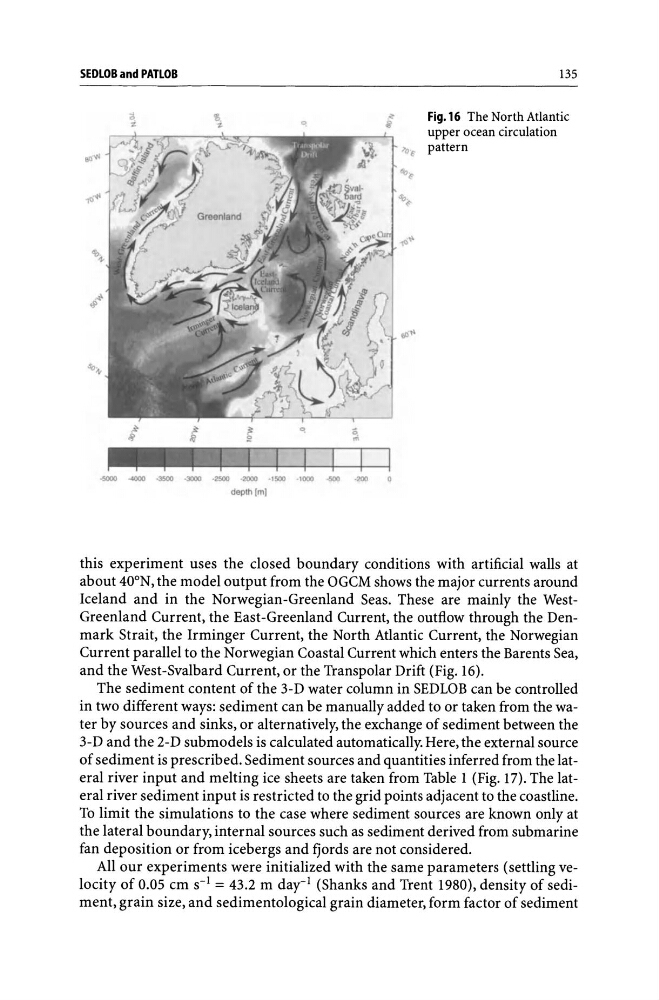
Fig.16 The North Atlantic
upper ocean circulation
?o~ pattern
Il:>~
this experiment uses the closed boundary conditions with artificial walls at
about 40 o N, the model output from the OGCM shows the major currents around
Iceland and in the Norwegian-Greenland Seas. These are mainly the WestGreenland Current, the East-Greenland Current, the outflow through the Denmark Strait, the Irminger Current, the North Atlantic Current, the Norwegian
Current parallel to the Norwegian Coastal Current which enters the Barents Sea,
and the West-Svalbard Current, or the Transpolar Drift (Fig. 16).
The sediment content of the 3-D water column in SEDLOB can be controlled
in two different ways: sediment can be manually added to or taken from the water by sources and sinks, or alternatively, the exchange of sediment between the
3-D and the 2-D submodels is calculated automatically. Here, the external source
of sediment is prescribed. Sediment sources and quantities inferred from the lateral river input and melting ice sheets are taken from Table 1 (Fig. 17). The lateral river sediment input is restricted to the grid points adjacent to the coastline.
To limit the simulations to the case where sediment sources are known only at
the lateral boundary, internal sources such as sediment derived from submarine
fan deposition or from icebergs and fjords are not considered.
All our experiments were initialized with the same parameters (settling velocity of 0.05 cm s-1 = 43.2 m day-1 (Shanks and Trent 1980), density of sediment, grain size, and sedimentological grain diameter, form factor of sediment
1/1' ' ' '
.500(1
..tOOO
.3S00
oJOOO
·2500
·2000
·1500 ·1000
·500
-:MO
depth [m]
135
Fig.16 The North Atlantic
upper ocean circulation
?o~ pattern
Il:>~
this experiment uses the closed boundary conditions with artificial walls at
about 40 o N, the model output from the OGCM shows the major currents around
Iceland and in the Norwegian-Greenland Seas. These are mainly the WestGreenland Current, the East-Greenland Current, the outflow through the Denmark Strait, the Irminger Current, the North Atlantic Current, the Norwegian
Current parallel to the Norwegian Coastal Current which enters the Barents Sea,
and the West-Svalbard Current, or the Transpolar Drift (Fig. 16).
The sediment content of the 3-D water column in SEDLOB can be controlled
in two different ways: sediment can be manually added to or taken from the water by sources and sinks, or alternatively, the exchange of sediment between the
3-D and the 2-D submodels is calculated automatically. Here, the external source
of sediment is prescribed. Sediment sources and quantities inferred from the lateral river input and melting ice sheets are taken from Table 1 (Fig. 17). The lateral river sediment input is restricted to the grid points adjacent to the coastline.
To limit the simulations to the case where sediment sources are known only at
the lateral boundary, internal sources such as sediment derived from submarine
fan deposition or from icebergs and fjords are not considered.
All our experiments were initialized with the same parameters (settling velocity of 0.05 cm s-1 = 43.2 m day-1 (Shanks and Trent 1980), density of sediment, grain size, and sedimentological grain diameter, form factor of sediment