

132
.I'";
,
B. J. Haupt· K. Stattegger . D. Seidov
- -- ---~ .........
~~~~~~.A.A ~c:::;:::
7
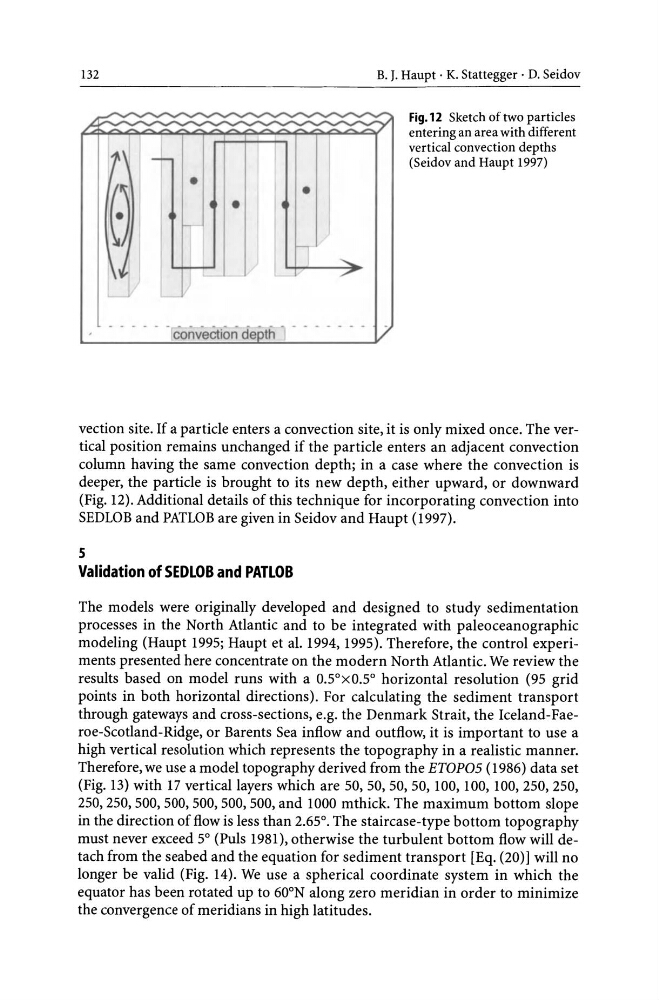
Fig.12 Sketch of two particles
entering an area with different
vertical convection depths
(Seidov and Haupt 1997)
-
t)
•
•
•
~
r
" - -
[/
........
-'
, _ I
- - - - - -[ConvectiOn deDlh . - - - - - - - Ll
vection site. If a particle enters a convection site, it is only mixed once. The vertical position remains unchanged if the particle enters an adjacent convection
column having the same convection depth; in a case where the convection is
deeper, the particle is brought to its new depth, either upward, or downward
(Fig. 12). Additional details of this technique for incorporating convection into
SEDLOB and PATLOB are given in Seidov and Haupt (1997).
s
Validation of SEDLOB and PAlLOB
The models were originally developed and designed to study sedimentation
processes in the North Atlantic and to be integrated with paleoceanographic
modeling (Haupt 1995; Haupt et al. 1994, 1995). Therefore, the control experiments presented here concentrate on the modern North Atlantic. We review the
results based on model runs with a 0.5°xO.5° horizontal resolution (95 grid
points in both horizontal directions). For calculating the sediment transport
through gateways and cross-sections, e.g. the Denmark Strait, the Iceland-Faeroe-Scotland-Ridge, or Barents Sea inflow and outflow, it is important to use a
high vertical resolution which represents the topography in a realistic manner.
Therefore, we use a model topography derived from the ETOP05 (1986) data set
(Fig. 13) with 17 vertical layers which are 50,50,50,50,100,100,100,250,250,
250,250, 500, 500, 500, 500, 500, and 1000 mthick. The maximum bottom slope
in the direction of flow is less than 2.65°. The staircase-type bottom topography
must never exceed 5° (PuIs 1981), otherwise the turbulent bottom flow will detach from the seabed and the equation for sediment transport [Eq. (20)] will no
longer be valid (Fig. 14). We use a spherical coordinate system in which the
equator has been rotated up to 60 0 N along zero meridian in order to minimize
the convergence of meridians in high latitudes.
.I'";
,
B. J. Haupt· K. Stattegger . D. Seidov
- -- ---~ .........
~~~~~~.A.A ~c:::;:::
7
Fig.12 Sketch of two particles
entering an area with different
vertical convection depths
(Seidov and Haupt 1997)
-
t)
•
•
•
~
r
" - -
[/
........
-'
, _ I
- - - - - -[ConvectiOn deDlh . - - - - - - - Ll
vection site. If a particle enters a convection site, it is only mixed once. The vertical position remains unchanged if the particle enters an adjacent convection
column having the same convection depth; in a case where the convection is
deeper, the particle is brought to its new depth, either upward, or downward
(Fig. 12). Additional details of this technique for incorporating convection into
SEDLOB and PATLOB are given in Seidov and Haupt (1997).
s
Validation of SEDLOB and PAlLOB
The models were originally developed and designed to study sedimentation
processes in the North Atlantic and to be integrated with paleoceanographic
modeling (Haupt 1995; Haupt et al. 1994, 1995). Therefore, the control experiments presented here concentrate on the modern North Atlantic. We review the
results based on model runs with a 0.5°xO.5° horizontal resolution (95 grid
points in both horizontal directions). For calculating the sediment transport
through gateways and cross-sections, e.g. the Denmark Strait, the Iceland-Faeroe-Scotland-Ridge, or Barents Sea inflow and outflow, it is important to use a
high vertical resolution which represents the topography in a realistic manner.
Therefore, we use a model topography derived from the ETOP05 (1986) data set
(Fig. 13) with 17 vertical layers which are 50,50,50,50,100,100,100,250,250,
250,250, 500, 500, 500, 500, 500, and 1000 mthick. The maximum bottom slope
in the direction of flow is less than 2.65°. The staircase-type bottom topography
must never exceed 5° (PuIs 1981), otherwise the turbulent bottom flow will detach from the seabed and the equation for sediment transport [Eq. (20)] will no
longer be valid (Fig. 14). We use a spherical coordinate system in which the
equator has been rotated up to 60 0 N along zero meridian in order to minimize
the convergence of meridians in high latitudes.