

SEDLOB and PAlLOB
127
A growth or decay of the initial signal can be obtained by scaling the antidiffusion velocity u by a factor Sc:
Uscale = Sc U
(30)
The best result was achieved using a scaling factor of 1 S; Sc S; 1.08 after Smolarkiewicz (1983). With Sc = 0 the above described scheme is identical to the
normal upwind scheme without antidiffusion. Three experiments with different
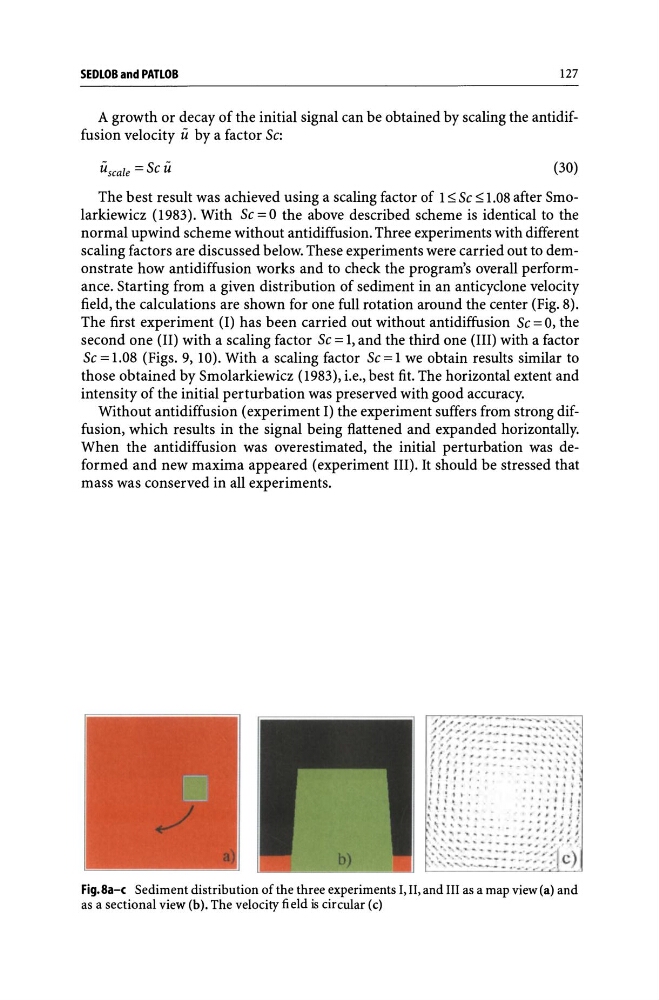
scaling factors are discussed below. These experiments were carried out to demonstrate how anti diffusion works and to check the program's overall performance. Starting from a given distribution of sediment in an anticyclone velocity
field, the calculations are shown for one full rotation around the center (Fig. 8).
The first experiment (I) has been carried out without antidiffusion Sc = 0, the
second one (II) with a scaling factor Sc = 1, and the third one (III) with a factor
Sc = 1.08 (Figs. 9, 10). With a scaling factor Sc = 1 we obtain results similar to
those obtained by Smolarkiewicz (1983), i.e., best fit. The horizontal extent and
intensity of the initial perturbation was preserved with good accuracy.
Without antidiffusion (experiment I) the experiment suffers from strong diffusion, which results in the signal being flattened and expanded horizontally.
When the antidiffusion was overestimated, the initial perturbation was deformed and new maxima appeared (experiment III). It should be stressed that
mass was conserved in all experiments.
Fig.8a-c Sediment distribution of the three experiments I, II, and III as a map view (a) and
as a sectional view (b). The velocity field is circular (c)
127
A growth or decay of the initial signal can be obtained by scaling the antidiffusion velocity u by a factor Sc:
Uscale = Sc U
(30)
The best result was achieved using a scaling factor of 1 S; Sc S; 1.08 after Smolarkiewicz (1983). With Sc = 0 the above described scheme is identical to the
normal upwind scheme without antidiffusion. Three experiments with different
scaling factors are discussed below. These experiments were carried out to demonstrate how anti diffusion works and to check the program's overall performance. Starting from a given distribution of sediment in an anticyclone velocity
field, the calculations are shown for one full rotation around the center (Fig. 8).
The first experiment (I) has been carried out without antidiffusion Sc = 0, the
second one (II) with a scaling factor Sc = 1, and the third one (III) with a factor
Sc = 1.08 (Figs. 9, 10). With a scaling factor Sc = 1 we obtain results similar to
those obtained by Smolarkiewicz (1983), i.e., best fit. The horizontal extent and
intensity of the initial perturbation was preserved with good accuracy.
Without antidiffusion (experiment I) the experiment suffers from strong diffusion, which results in the signal being flattened and expanded horizontally.
When the antidiffusion was overestimated, the initial perturbation was deformed and new maxima appeared (experiment III). It should be stressed that
mass was conserved in all experiments.
Fig.8a-c Sediment distribution of the three experiments I, II, and III as a map view (a) and
as a sectional view (b). The velocity field is circular (c)