

126
B. J. Haupt· K. Stattegger . D. Seidov
of these schemes is rather limited because of excessive computer time required.
In addition, a positive definite solution is not guaranteed. Yet any emerging negative values are small enough to be neglected (Smolarkiewicz 1983; Struve 1978).
An appropriate numerical scheme is essential for obtaining "sediment fronts",
produced by sediment slumps, or local sediment clouds, etc. Smolarkiewicz
(1983) introduces an "antidiffusion" with an "anti diffusion velocity" to keep the
fronts sharp in spite of the high artificial diffusion inherent to the upwind
schemes.
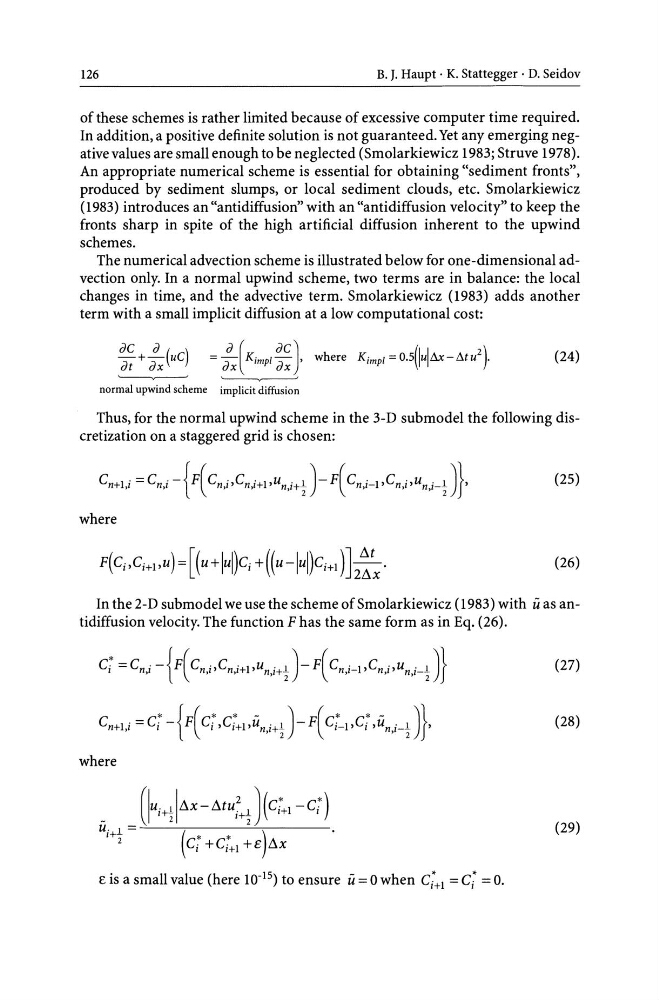
The numerical advection scheme is illustrated below for one-dimensional advection only. In a normal upwind scheme, two terms are in balance: the local
changes in time, and the advective term. Smolarkiewicz (1983) adds another
term with a small implicit diffusion at a low computational cost:
~~ + :)uc) = :x( K imp1 ~~} where K imp1 =O.5(lul~-Mu2).
'-.r---------'
~
(24)
normal upwind scheme implicit diffusion
Thus, for the normal upwind scheme in the 3-D submodel the following discretization on a staggered grid is chosen:
Cn+l,i = Cn,i - {F( Cn,i ,Cn,i+l>Un,i+1 ) - F( Cn,i-l>Cn,i 'Un,i-1)}'
where
(25)
(26)
In the 2-D submodel we use the scheme ofSmolarkiewicz (1983) with u as antidiffusion velocity. The function F has the same form as in Eq. (26).
(27)
Cn+l,i = C; - {F( C; ,C;+I ,u n ,i+1) - F( C;_I ,C; ,u n ,i-1 )},
(28)
where
(29)
£ is a small value (here 10- 15 ) to ensure u = 0 when C~I = c;' = o.
B. J. Haupt· K. Stattegger . D. Seidov
of these schemes is rather limited because of excessive computer time required.
In addition, a positive definite solution is not guaranteed. Yet any emerging negative values are small enough to be neglected (Smolarkiewicz 1983; Struve 1978).
An appropriate numerical scheme is essential for obtaining "sediment fronts",
produced by sediment slumps, or local sediment clouds, etc. Smolarkiewicz
(1983) introduces an "antidiffusion" with an "anti diffusion velocity" to keep the
fronts sharp in spite of the high artificial diffusion inherent to the upwind
schemes.
The numerical advection scheme is illustrated below for one-dimensional advection only. In a normal upwind scheme, two terms are in balance: the local
changes in time, and the advective term. Smolarkiewicz (1983) adds another
term with a small implicit diffusion at a low computational cost:
~~ + :)uc) = :x( K imp1 ~~} where K imp1 =O.5(lul~-Mu2).
'-.r---------'
~
(24)
normal upwind scheme implicit diffusion
Thus, for the normal upwind scheme in the 3-D submodel the following discretization on a staggered grid is chosen:
Cn+l,i = Cn,i - {F( Cn,i ,Cn,i+l>Un,i+1 ) - F( Cn,i-l>Cn,i 'Un,i-1)}'
where
(25)
(26)
In the 2-D submodel we use the scheme ofSmolarkiewicz (1983) with u as antidiffusion velocity. The function F has the same form as in Eq. (26).
(27)
Cn+l,i = C; - {F( C; ,C;+I ,u n ,i+1) - F( C;_I ,C; ,u n ,i-1 )},
(28)
where
(29)
£ is a small value (here 10- 15 ) to ensure u = 0 when C~I = c;' = o.