

124
B. J. Haupt· K. Stattegger . D. Seidov
Sediment can be eroded or deposited according to Gross and Dade (1991) and
Tetzlaff (1989)
dhsed 0
- - < erosIOn
dt
dhsed 0 d
..
- - >
epOSltion.
dt
(21)
This technique makes the simulation of the process of redistribution of the already deposited sediment possible (Frohlich and Matthews 1991). Sediment is
neither eroded nor deposited when an equilibrium between the sediment transport and the sediment load exists. The equilibrium is checked at every time step
in our model.
2.7
Coupling of SEDLOB's submodels
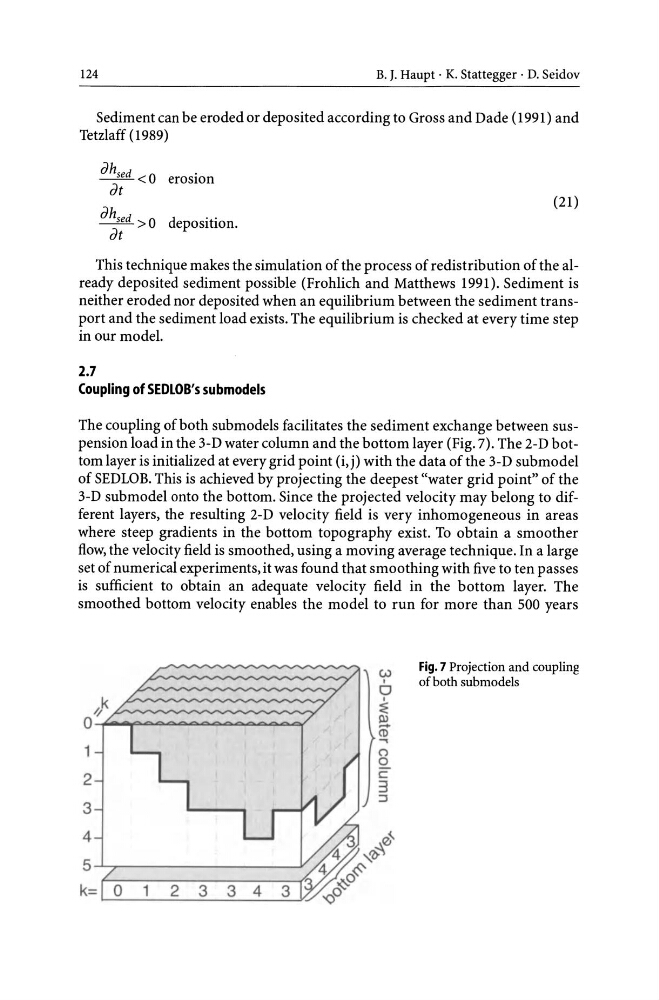
The coupling of both submodels facilitates the sediment exchange between suspension load in the 3-D water column and the bottom layer (Fig. 7). The 2-D bottom layer is initialized at every grid point (i,j) with the data of the 3-D submodel
of SEDLOB. This is achieved by projecting the deepest "water grid point" of the
3-D submodel onto the bottom. Since the projected velocity may belong to different layers, the resulting 2-D velocity field is very inhomogeneous in areas
where steep gradients in the bottom topography exist. To obtain a smoother
flow, the velocity field is smoothed, using a moving average technique. In a large
set of numerical experiments, it was found that smoothing with five to ten passes
is sufficient to obtain an adequate velocity field in the bottom layer. The
smoothed bottom velocity enables the model to run for more than 500 years
2
3
4
5~~----------------~
k=~ __ ~~~~~~ __ ~
(')
o
c
3
:::J
Fig. 7 Projection and coupling
of both submodels
B. J. Haupt· K. Stattegger . D. Seidov
Sediment can be eroded or deposited according to Gross and Dade (1991) and
Tetzlaff (1989)
dhsed 0
- - < erosIOn
dt
dhsed 0 d
..
- - >
epOSltion.
dt
(21)
This technique makes the simulation of the process of redistribution of the already deposited sediment possible (Frohlich and Matthews 1991). Sediment is
neither eroded nor deposited when an equilibrium between the sediment transport and the sediment load exists. The equilibrium is checked at every time step
in our model.
2.7
Coupling of SEDLOB's submodels
The coupling of both submodels facilitates the sediment exchange between suspension load in the 3-D water column and the bottom layer (Fig. 7). The 2-D bottom layer is initialized at every grid point (i,j) with the data of the 3-D submodel
of SEDLOB. This is achieved by projecting the deepest "water grid point" of the
3-D submodel onto the bottom. Since the projected velocity may belong to different layers, the resulting 2-D velocity field is very inhomogeneous in areas
where steep gradients in the bottom topography exist. To obtain a smoother
flow, the velocity field is smoothed, using a moving average technique. In a large
set of numerical experiments, it was found that smoothing with five to ten passes
is sufficient to obtain an adequate velocity field in the bottom layer. The
smoothed bottom velocity enables the model to run for more than 500 years
2
3
4
5~~----------------~
k=~ __ ~~~~~~ __ ~
(')
o
c
3
:::J
Fig. 7 Projection and coupling
of both submodels