

SEDLOB and PAlLOB
i Initialisation with T, S, u, v, w, convection depth, and topography
I from any OGCM and grain size, form factor, sediment density,
porosity, sedimentological grain diameter, and sinking velocity
\II
Calculation of critical velocities ,
Vern" =Vem,,(V,jl,d,PF,Ps,FF,g) I
Vcm,b = Vcm,b(V,jl,d,PF,PS,g) I
\11
Calculation of bed load and suspended transport
qB = qB(V" Vc,b, V, /1, d, D*, PF, ps,p', FF, g, P)
qs = qs (V" Vc,b, V, Yo, /1, d, D*, PF, ps, p', FF, g, P)
\1/
I Vertical convection due to hydrostatic instability I
W
Calculation of 3 - D - and 2 - D - sediment transport
~=-V'(VC)+Q
I
~=-VH '(VbotC)+Q
\1/
r
Calculation of new topography
i1lkL +VH,q=O
Y at
y = porosity of sediment particles
\17
\ Data output: sediment layer thickness
and quantities of suspended material
I
\1/
I Integration time limit reache:l
yes
no
I
\11
r
End of run
=:=J
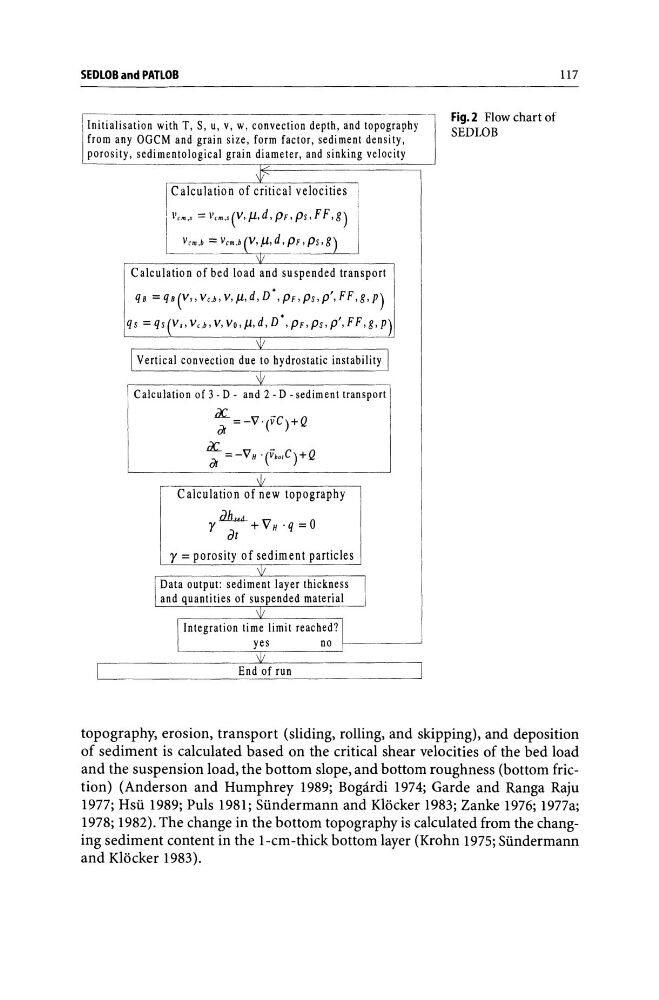
Fig.2 Flow chart of
SEDLOB
117
topography, erosion, transport (sliding, rolling, and skipping), and deposition
of sediment is calculated based on the critical shear velocities of the bed load
and the suspension load, the bottom slope, and bottom roughness (bottom friction) (Anderson and Humphrey 1989; Bogardi 1974; Garde and Ranga Raju
1977; Hsii 1989; PuIs 1981; Siindermann and Klocker 1983; Zanke 1976; 1977a;
1978; 1982). The change in the bottom topography is calculated from the changing sediment content in the l-cm-thick bottom layer (Krohn 1975; Siindermann
and Klocker 1983).
i Initialisation with T, S, u, v, w, convection depth, and topography
I from any OGCM and grain size, form factor, sediment density,
porosity, sedimentological grain diameter, and sinking velocity
\II
Calculation of critical velocities ,
Vern" =Vem,,(V,jl,d,PF,Ps,FF,g) I
Vcm,b = Vcm,b(V,jl,d,PF,PS,g) I
\11
Calculation of bed load and suspended transport
qB = qB(V" Vc,b, V, /1, d, D*, PF, ps,p', FF, g, P)
qs = qs (V" Vc,b, V, Yo, /1, d, D*, PF, ps, p', FF, g, P)
\1/
I Vertical convection due to hydrostatic instability I
W
Calculation of 3 - D - and 2 - D - sediment transport
~=-V'(VC)+Q
I
~=-VH '(VbotC)+Q
\1/
r
Calculation of new topography
i1lkL +VH,q=O
Y at
y = porosity of sediment particles
\17
\ Data output: sediment layer thickness
and quantities of suspended material
I
\1/
I Integration time limit reache:l
yes
no
I
\11
r
End of run
=:=J
Fig.2 Flow chart of
SEDLOB
117
topography, erosion, transport (sliding, rolling, and skipping), and deposition
of sediment is calculated based on the critical shear velocities of the bed load
and the suspension load, the bottom slope, and bottom roughness (bottom friction) (Anderson and Humphrey 1989; Bogardi 1974; Garde and Ranga Raju
1977; Hsii 1989; PuIs 1981; Siindermann and Klocker 1983; Zanke 1976; 1977a;
1978; 1982). The change in the bottom topography is calculated from the changing sediment content in the l-cm-thick bottom layer (Krohn 1975; Siindermann
and Klocker 1983).