

116
B. J. Haupt· K. Stattegger . D. Seidov
2
The Sediment Transport Model SEDLOB
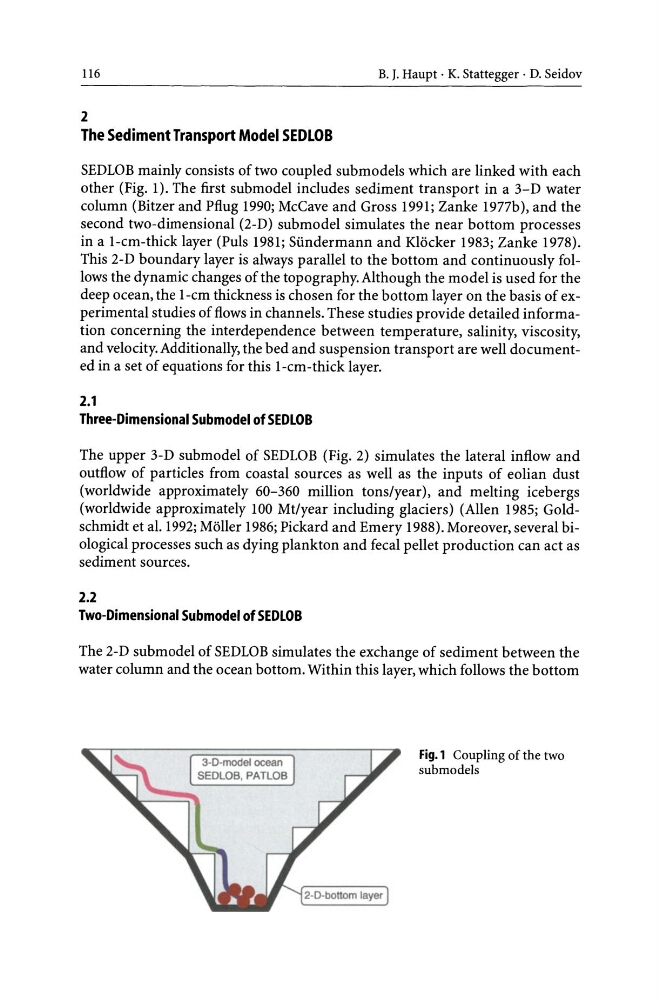
SEDLOB mainly consists of two coupled submodels which are linked with each
other (Fig. 1). The first submodel includes sediment transport in a 3-D water
column (Bitzer and Pflug 1990; McCave and Gross 1991; Zanke 1977b), and the
second two-dimensional (2-D) submodel simulates the near bottom processes
in a l-cm-thick layer (PuIs 1981; Siindermann and Klocker 1983; Zanke 1978).
This 2-D boundary layer is always parallel to the bottom and continuously follows the dynamic changes of the topography. Although the model is used for the
deep ocean, the l-cm thickness is chosen for the bottom layer on the basis of experimental studies of flows in channels. These studies provide detailed information concerning the interdependence between temperature, salinity, viscosity,
and velocity. Additionally, the bed and suspension transport are well documented in a set of equations for this l-cm -thick layer.
2.1
Three-Dimensional Submodel of SEDLOB
The upper 3-D submodel of SEDLOB (Fig. 2) simulates the lateral inflow and
outflow of particles from coastal sources as well as the inputs of eolian dust
(worldwide approximately 60-360 million tons/year), and melting icebergs
(worldwide approximately 100 Mt/year including glaciers) (Allen 1985; Goldschmidt et al.1992; Moller 1986; Pickard and Emery 1988). Moreover, several biological processes such as dying plankton and fecal pellet production can act as
sediment sources.
2.2
Two-Dimensional Submodel of SEDLOB
The 2-D submodel of SEDLOB simulates the exchange of sediment between the
water column and the ocean bottom. Within this layer, which follows the bottom
2· D-bonom layer
Fig.l Coupling of the two
sub models
B. J. Haupt· K. Stattegger . D. Seidov
2
The Sediment Transport Model SEDLOB
SEDLOB mainly consists of two coupled submodels which are linked with each
other (Fig. 1). The first submodel includes sediment transport in a 3-D water
column (Bitzer and Pflug 1990; McCave and Gross 1991; Zanke 1977b), and the
second two-dimensional (2-D) submodel simulates the near bottom processes
in a l-cm-thick layer (PuIs 1981; Siindermann and Klocker 1983; Zanke 1978).
This 2-D boundary layer is always parallel to the bottom and continuously follows the dynamic changes of the topography. Although the model is used for the
deep ocean, the l-cm thickness is chosen for the bottom layer on the basis of experimental studies of flows in channels. These studies provide detailed information concerning the interdependence between temperature, salinity, viscosity,
and velocity. Additionally, the bed and suspension transport are well documented in a set of equations for this l-cm -thick layer.
2.1
Three-Dimensional Submodel of SEDLOB
The upper 3-D submodel of SEDLOB (Fig. 2) simulates the lateral inflow and
outflow of particles from coastal sources as well as the inputs of eolian dust
(worldwide approximately 60-360 million tons/year), and melting icebergs
(worldwide approximately 100 Mt/year including glaciers) (Allen 1985; Goldschmidt et al.1992; Moller 1986; Pickard and Emery 1988). Moreover, several biological processes such as dying plankton and fecal pellet production can act as
sediment sources.
2.2
Two-Dimensional Submodel of SEDLOB
The 2-D submodel of SEDLOB simulates the exchange of sediment between the
water column and the ocean bottom. Within this layer, which follows the bottom
2· D-bonom layer
Fig.l Coupling of the two
sub models