

14.3 Hydrocarbon Habitats
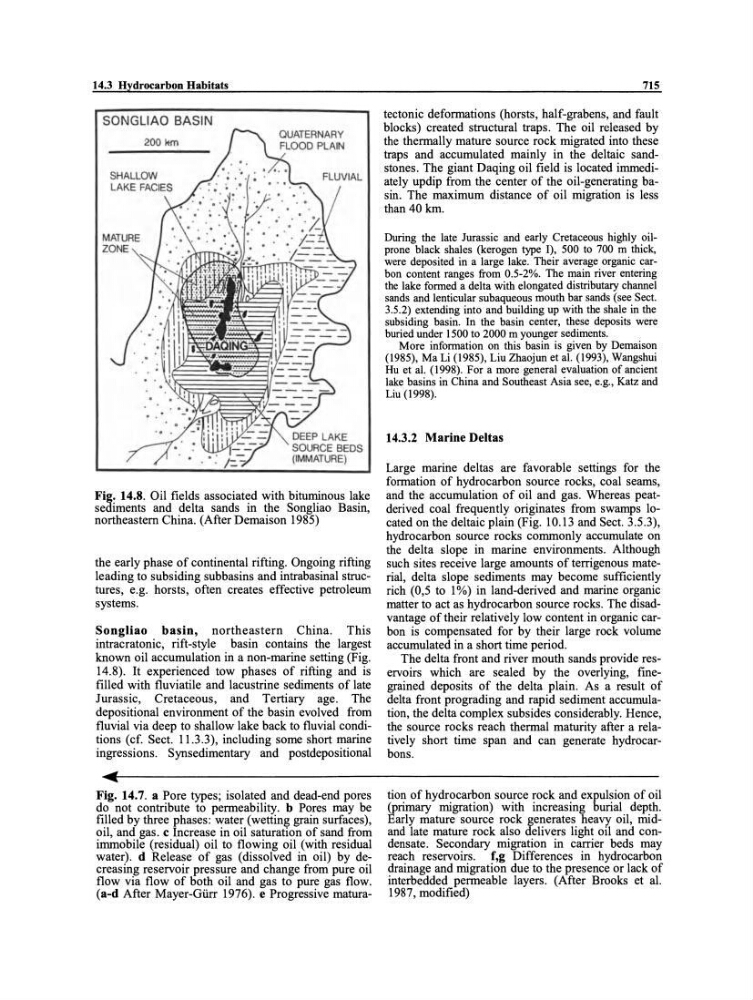
SONG LI AO BASIN
200 km
. .
DEEP LAKE
SOURCE BEDS
(IMMATURE)
Fig. 14.8. Oil fields associated with bituminous lake
sediments and delta sands in the Songliao Basin,
northeastern China. (After Demaison 1985)
the early phase of continental rifting. Ongoing rifting
leading to subsiding subbasins and intrabasinal structures, e.g. horsts, often creates effective petroleum
systems.
Songliao basin, northeastern China. This
intracratonic, rift-style basin contains the largest
known oil accumulation in a non-marine setting (Fig.
14.8). It experienced tow phases of rifting and is
filled with fluviatile and lacustrine sediments of late
Jurassic, Cretaceous, and Tertiary age. The
depositional environment of the basin evolved from
fluvial via deep to shallow lake back to fluvial conditions (cf. Sect. 11.3.3), including some short marine
ingressions. Synsedimentary and postdepositional
Fig. 14.7. a Pore types; isolated and dead-end pores
do not contribute to permeability. b Pores may be
filled by three phases: water (wetting grain surfaces),
oil, and gas. c Increase in oil saturation of sand from
immobile (residual) oil to flowing oil (with residual
water). d Release of gas (dissolved in oil) by decreasing reservoir pressure and change from pure oi!
flow via flow of both oil and gas to pure gas flow.
(a-d After Mayer-Gürr 1976). e Progressive matura715
tectonic deformations (horsts, half-grabens, and fault
blocks) created structural traps. The oil released by
the thermally mature source rock migrated into these
traps and accumulated mainly in the deltaic sandstones. The giant Daqing oil field is located immediately updip from the center of the oil-generating basin. The maximum distance of oil migration is less
than 40 km.
During the late Jurassic and early Cretaceous highly oilprone black shales (kerogen type I), 500 to 700 m thick,
were deposited in a large lake. Their average organic carbon content ranges from 0.5-2%. The main river entering
the lake formed a delta with elongated distributary channel
sands and lenticular subaqueous mouth bar sands (see Sect.
3.5.2) extending into and building up with the shale in the
subsiding basin. In the basin center, these deposits were
buried under 1500 to 2000 m younger sediments.
More information on this basin is given by Demaison
(1985), Ma Li (1985), Liu Zhaojun et al. (1993), Wangshui
Ru et al. (1998). For a more general evaluation of ancient
lake basins in China and Southeast Asia see, e.g., Katz and
Liu (1998).
14.3.2 Marine Deltas
Large marine deltas are favorable settings for the
formation of hydrocarbon source rocks, co al seams,
and the accumulation of oil and gas. Whereas peatderived coal frequently originates from swamps 10cated on the deltaic plain (Fig. 10.13 and Sect. 3.5.3),
hydrocarbon source rocks commonly accumulate on
the delta slope in marine environments. Although
such sites receive large amounts of terrigenous material, delta slope sediments may become sufficiently
rich (0,5 to 1%) in land-derived and marine organic
matter to act as hydrocarbon source rocks. The disadvantage of their relatively low content in organic carbon is compensated for by their large rock volume
accumulated in a short time period.
The delta front and river mouth sands provide reservoirs which are sealed by the overlying, finegrained deposits of the delta plain. As a result of
delta front prograding and rapid sediment accumulation, the delta complex subsides considerably. Hence,
the source rocks reach thermal maturity after a relatively short time span and can generate hydrocarbons.
tion of hydrocarbon source rock and expulsion of oil
(primary migration) with increasing burial depth.
Early mature source rock generates heavy oil, midand late mature rock also delivers light oil and condensate. Secondary migration in carrier beds may
reach reservoirs. f,g Differences in hydrocarbon
drainage and migration due to the presence or lack of
interbedded permeable layers. (After Brooks et al.
1987, modified)