

712
PRIMARY PRODUCTIVITY
(HIGHLY VARIABLE,
: TERRESTRIAL
PLANT DEBRIS)
.. NEW PRODUCTIVITY ..
3-30%
(LEFT OVER AT
~------~
WATER DEPTH
OF 100 m)
OXIC BASIN
PRESERVED IN SEDIMENT
'" O. 1 % /
BELOW ZONE OF BENTHIC
d
DEGRADATI()N
.
.. ,
ANOXIC BASIN
Chapter 14 Hydrocarbons and Coal
",,10%
~ "'5%
,
/
1
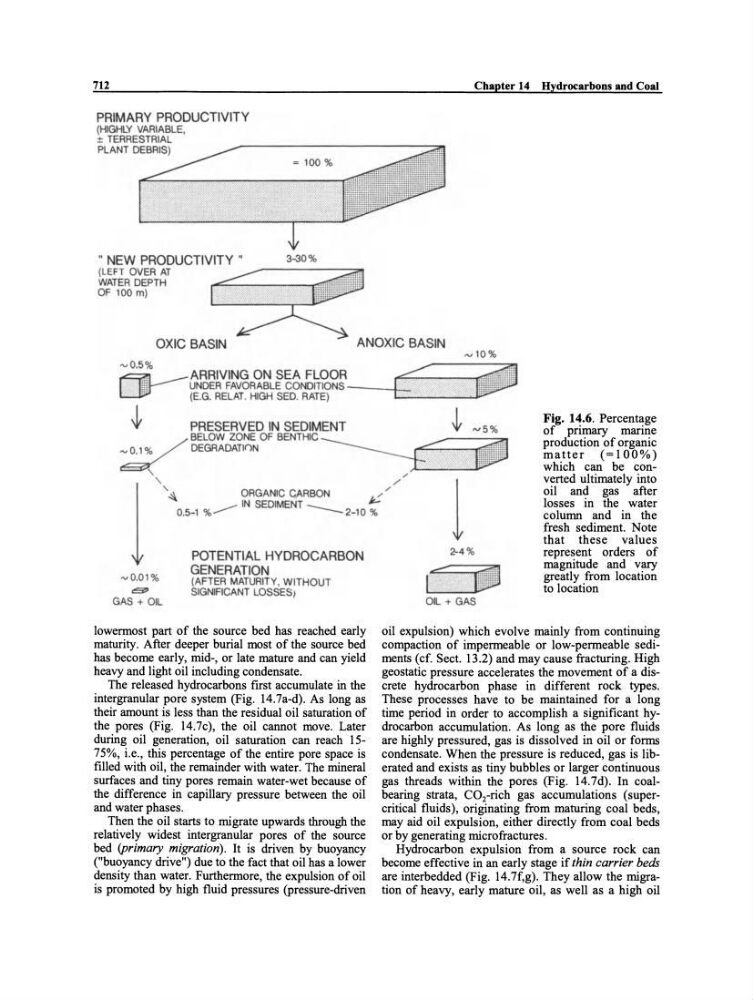
Fig. 14.6. Percentage
of primary marine
production of organic
matter (=100%)
which can be converted ultimately into
oil and gas after
losses in the water
column and in the
fresh sediment. Note
that these values
represent orders of
magnitude and vary
greatly from location
to location
'~
ORGANIC G.ARBON
I. '" '"
__ IN SEDIMENT _ _
-
'" 0.01 %
~
GAS + OlL
0.5-1 %-2-10 %
POTENTIAL HYDROCARBON
GENERATION
(AFTER MATURITY, WITHOUT
SIGNIFICANT LOSSES,
lowermost part of the source bed has reached early
maturity. After deeper burial most of the source bed
has become early, mid-, or late mature and can yield
heavy and light oil including condensate.
The released hydrocarbons first accumulate in the
intergranular pore system (Fig. 14.7a-d). As long as
their amount is less than the residual oil saturation of
the pores (Fig. 14.7c), the oil cannot move. Later
during oil generation, oil saturation can reach 1575%, i.e., this percentage of the entire pore space is
fi1led with oil, the remainder with water. The mineral
surfaces and tiny pores remain water-wet because of
the difference in capillary pressure between the oil
and water phases.
Then the oil starts to migrate upwards through the
relatively widest intergranular pores of the source
bed (primary migration). It is driven by buoyancy
("buoyancy drive") due to the fact that oil has a lower
density than water. Furthermore, the expulsion of oil
is promoted by high fluid pressures (pressure-driven
2-4%
OlL + GAS
oil expulsion) which evolve mainly from continuing
compaction of impermeable or low-permeable sediments (cf. Sect. 13.2) and may cause fracturing. High
geostatic pressure accelerates the movement of a discrete hydrocarbon phase in different rock types.
These processes have to be maintained for a long
time period in order to accomplish a significant hydrocarbon accumulation. As long as the pore fluids
are highly pressured, gas is dissolved in oil or forms
condensate. When the pressure is reduced, gas is liberated and exists as tiny bubbles or larger continuous
gas threads within the pores (Fig. 14.7d). In coalbearing strata, CO 2 -rich gas accumulations (supercritical fluids), originating from maturing coal beds,
may aid oil expulsion, either directly from coal beds
or by generating microfractures.
Hydrocarbon expulsion from a source rock can
become effective in an early stage if thin carrier beds
are interbedded (Fig. 14.7f,g). Theyallow the migration of heavy, early mature oil, as weil as a high oil