

14.1 Source Rocks, Kerogen TyPes
DESTRUCTIVE
PROCESSES
BAC TERIAL
AEROBIC
OXIDATION
LARGE
BENTHIC
SCAVENGERS
SULFATE AND
OXIC
NITRATE REDUCING - -'---'''- - ''.
BACTERIA
METHANE FERMENT ·
ING BACTERIA
SEDIMENTATION
RATES
LOW ... <ö----- HIGH
707
SUB-OXIC
ANOXIC
ER
LOW ... ~~~~~~~DTYPES INERTINITE VITRINITE VITR
EXIN.
EXINITE
lIPTINITE
HYDROGARBON
POTENTIAL
GAS-PRONE TO
NON SOURCE
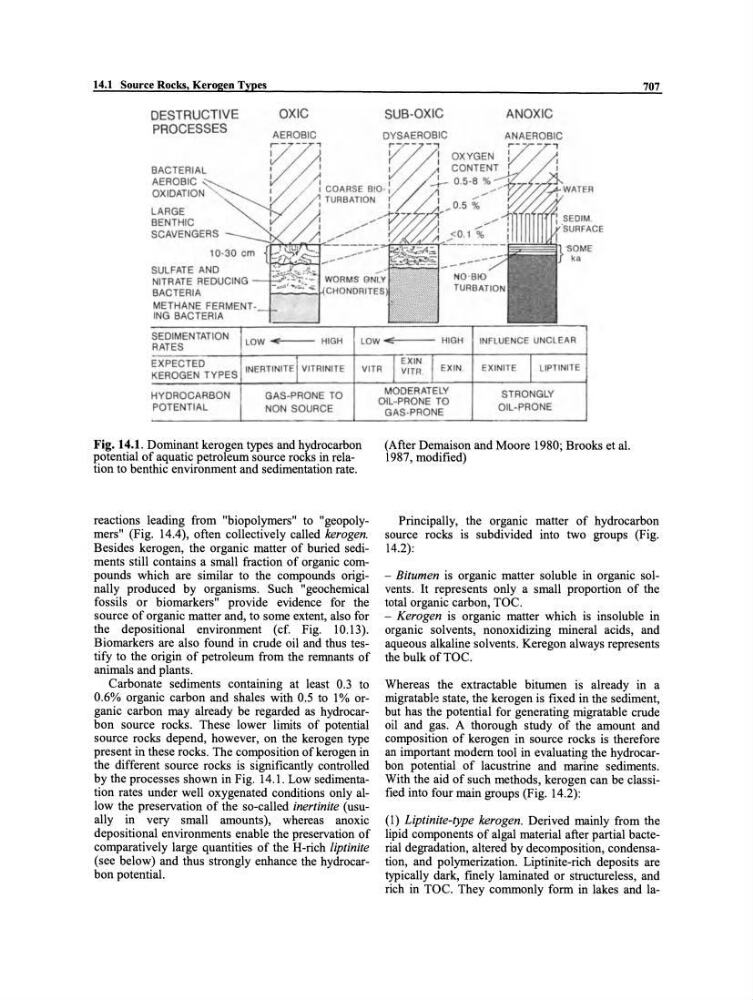
Fig. 14.1. Dominant kerogen types and hydrocarbon
potential of aquatic petroleum source rocks in relation to benthic environment and sedimentation rate.
reactions leading from "biopolymers" to "geopolymers" (Fig. 14.4), often collectively called kerogen.
Besides kerogen, the organic matter of buried sediments still contains a small fraction of organic compounds which are similar to the compounds originally produced by organisms. Such "geochemical
fossils or biomarkers" provide evidence for the
source of organic matter and, to some extent, also for
the depositional environment (cf. Fig. 10.13).
Biomarkers are also found in crude oil and thus testify to the origin of petroleum from the remnants of
animals and plants.
Carbonate sediments containing at least 0.3 to
0.6% organic carbon and shales with 0.5 to 1% organic carbon may already be regarded as hydrocarbon source rocks. These lower limits of potential
source rocks depend, however, on the kerogen type
present in these rocks. The composition of kerogen in
the different source rocks is significantly controlled
by the processes shown in Fig. 14.1. Low sedimentation rates under well oxygenated conditions only allow the preservation of the so-callcd inertinite (usually in very small amounts), whereas anoxie
depositional environments enable the preservation of
comparatively large quantities of the H-rich liptinite
(see below) and thus strongly enhance the hydrocarbon potential.
MOOERATELY
OlL- PRONE TE>
GAS· PRONE
STRONGLY
OIL- PRONE
(After Demaison and Moore 1980; Brooks et al.
1987, modified)
Principally, the organic matter of hydrocarbon
source rocks is subdivided into two groups (Fig.
14.2):
- Bitumen is organie matter soluble in organie solvents. It represents only a small proportion of the
total organic carbon, TOC.
- Kerogen is organic matter which is insoluble in
organic solvents, nonoxidizing mineral acids, and
aqueous alkaline solvents. Keregon always represents
the bulk of TOC.
Whereas the extractable bitumen is already in a
migratable state, the kerogen is fixed in the sediment,
but has the potential for generating migratable crude
oil and gas. A thorough study of the amount and
composition of kerogen in source rocks is therefore
an important modem tool in evaluating the hydrocarbon potential of lacustrine and marine sediments.
With the aid of such methods, kerogen can be classified into four main groups (Fig. 14.2):
(1) Liptinite-type kerogen. Derived mainly from the
lipid components of algal material after partial bacterial degradation, altered by decomposition, condensation, and polymerization. Liptinite-rich deposits are
typically dark, finely laminated or structureless, and
rich in TOC. They commonly form in lakes and 1a-