

13.7 Thermal History
E
:.
J:
I0..
W
o
6
a
AGE B.P. (Ma )
SUBSIDENCE
CURVE FOR BASE
OF JURASSIC
- - - -
699
c
AGE B.P. (Ma)
200
100
0
Or---.---.----r--~--~
100
INCREASING
I
I UPLIFT
'E-BURIAL DEPT H ~
~ AND ""
DENUDATION
TEMPERATURE (OC)
b
LATE JURASSIC
E
:.
J:
I0..
W
o
PR ESENT
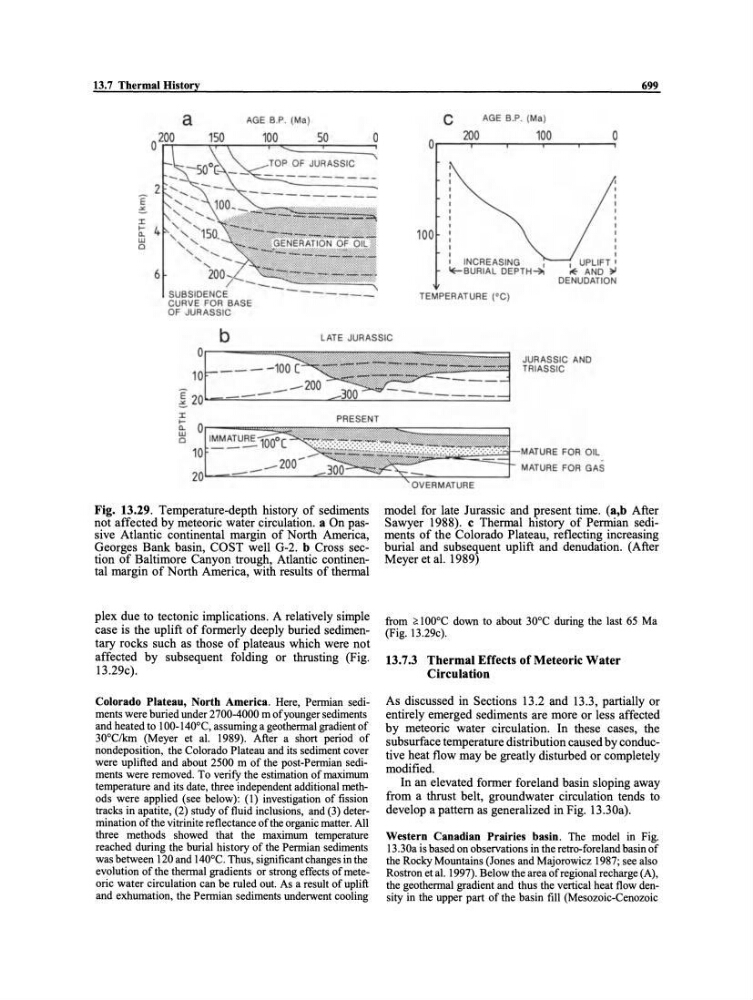
Fig. 13.29. Temperature-depth history of sediments
not affected by meteoric water circulation. a On passive Atlantic continental margin of North America,
Georges Bank basin, COST weH G-2. b Cross section of Baltimore Canyon trough, Atlantic continental margin of North America, with results of thermal
plex due to tectonic implications. A relatively simple
case is the uplift of formerly deeply buried sedimentary rocks such as those of plateaus which were not
affected by subsequent folding or thrusting (Fig.
13.29c).
Colorado Plateau, North America. Here, Permian sediments were buried under 2700-4000 m ofyounger sediments
and heated to 1 00-140°C, assuming a geothermal gradient of
30°CIkm (Meyer et al. 1989). After a short period of
nondeposition, the Colorado Plateau and its sediment cover
were uplifted and about 2500 m of the post-Permian sediments were removed. To verify the estimation ofmaximum
temperature and its date, three independent additional methods were applied (see below): (1) investigation of fission
tracks in apatite, (2) study of fluid inc1usions, and (3) determination ofthe vitrinite refleetanee ofthe organie matter. All
three methods showed that the maximum temperature
reaehed during the burial history of the Permian sediments
was between 120 and 140°C. Thus, signifieant ehanges in the
evolution ofthe thermal gradients or strong effeets ofmeteorie water eireulation ean be ruled out. As a result ofuplift
and exhumation, the Permian sediments underwent eooling
OVERMATURE
JURASSIC AND
TRIASSIC
model for late Jurassic and present time. (a,b After
Sawyer 1988). c Thermal history of Permian sediments of the Colorado Plateau, reflecting increasing
burial and subsequent uplift and denudation. (After
Meyer et a1. 1989)
from ~ 100°C down to about 30°C during the last 65 Ma
(Fig. 13.2ge).
13.7.3 Thermal Effects ofMeteoric Water
Circulation
As discussed in Sections 13.2 and 13.3, partiaHy or
entirely emerged sediments are more or less affected
by meteoric water circulation. In these cases, the
subsurface temperature distribution caused by conductive heat flow may be greatly disturbed or completely
modified.
In an elevated former fore land basin sloping away
from a thrust belt, groundwater circulation tends to
develop a pattern as generalized in Fig. 13.30a).
Western Canadian Prairies basin. The model in Fig.
13.30a is based on observations in the retro-foreland basin of
the Roeky Mountains (Jones and Majorowiez 1987; see also
Rostron et al. 1997). Below the area of regional recharge (A),
the geothermal gradient and thus the vertieal heat flow density in the upper part of the basin fill (Mesozoie-Cenozoie
E
:.
J:
I0..
W
o
6
a
AGE B.P. (Ma )
SUBSIDENCE
CURVE FOR BASE
OF JURASSIC
- - - -
699
c
AGE B.P. (Ma)
200
100
0
Or---.---.----r--~--~
100
INCREASING
I
I UPLIFT
'E-BURIAL DEPT H ~
~ AND ""
DENUDATION
TEMPERATURE (OC)
b
LATE JURASSIC
E
:.
J:
I0..
W
o
PR ESENT
Fig. 13.29. Temperature-depth history of sediments
not affected by meteoric water circulation. a On passive Atlantic continental margin of North America,
Georges Bank basin, COST weH G-2. b Cross section of Baltimore Canyon trough, Atlantic continental margin of North America, with results of thermal
plex due to tectonic implications. A relatively simple
case is the uplift of formerly deeply buried sedimentary rocks such as those of plateaus which were not
affected by subsequent folding or thrusting (Fig.
13.29c).
Colorado Plateau, North America. Here, Permian sediments were buried under 2700-4000 m ofyounger sediments
and heated to 1 00-140°C, assuming a geothermal gradient of
30°CIkm (Meyer et al. 1989). After a short period of
nondeposition, the Colorado Plateau and its sediment cover
were uplifted and about 2500 m of the post-Permian sediments were removed. To verify the estimation ofmaximum
temperature and its date, three independent additional methods were applied (see below): (1) investigation of fission
tracks in apatite, (2) study of fluid inc1usions, and (3) determination ofthe vitrinite refleetanee ofthe organie matter. All
three methods showed that the maximum temperature
reaehed during the burial history of the Permian sediments
was between 120 and 140°C. Thus, signifieant ehanges in the
evolution ofthe thermal gradients or strong effeets ofmeteorie water eireulation ean be ruled out. As a result ofuplift
and exhumation, the Permian sediments underwent eooling
OVERMATURE
JURASSIC AND
TRIASSIC
model for late Jurassic and present time. (a,b After
Sawyer 1988). c Thermal history of Permian sediments of the Colorado Plateau, reflecting increasing
burial and subsequent uplift and denudation. (After
Meyer et a1. 1989)
from ~ 100°C down to about 30°C during the last 65 Ma
(Fig. 13.2ge).
13.7.3 Thermal Effects ofMeteoric Water
Circulation
As discussed in Sections 13.2 and 13.3, partiaHy or
entirely emerged sediments are more or less affected
by meteoric water circulation. In these cases, the
subsurface temperature distribution caused by conductive heat flow may be greatly disturbed or completely
modified.
In an elevated former fore land basin sloping away
from a thrust belt, groundwater circulation tends to
develop a pattern as generalized in Fig. 13.30a).
Western Canadian Prairies basin. The model in Fig.
13.30a is based on observations in the retro-foreland basin of
the Roeky Mountains (Jones and Majorowiez 1987; see also
Rostron et al. 1997). Below the area of regional recharge (A),
the geothermal gradient and thus the vertieal heat flow density in the upper part of the basin fill (Mesozoie-Cenozoie