

698
Cf)
Cf)
W
Z
w
C,!)
«
Cl
w
z
o
N
I
()
z
«
DEPTH SEDI -
POROSITY (%)
MENT TEMPERATURE
(km)
TYPE
(Oe)
'" 0 .5
3-5
SOFT
TO
FIRM
CLAY
MUD
CLAY -
STONE.
MUD -
STONE.
MARLSTONE
SHALE
SLATE
3
100-150°
Chapter 13 Diagenesis
TRA NSFORMATION OF CLAY MINERALS
U)
U)
(!)
cj
...J
o
>
+
REPLACED
MAINLY SY
CHLORITE,
Na-FELDSPAR
AND
QUARTZ
5-10
IW
PHYL=F
LlTE
",200°
REPLACED SY
ILLlTE, CHLORITE,
AND QUARTZ
ä
W
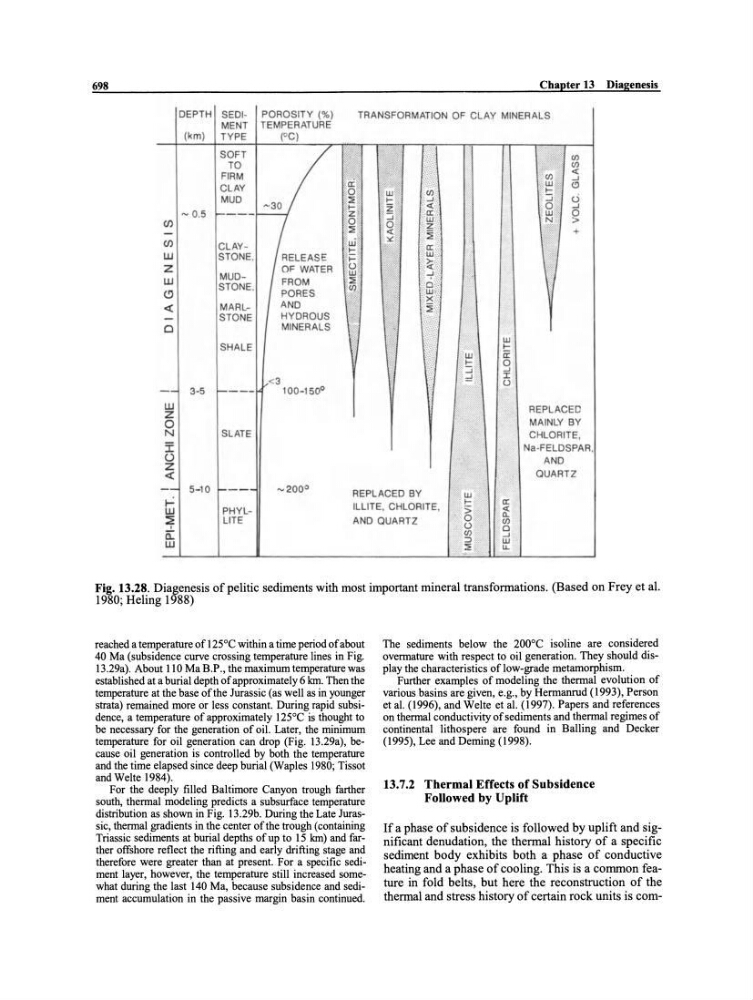
Fig. 13.28. Diagenesis of pelitic sediments with most important mineral transformations. (Based on Frey et al.
1980; Heling 1988)
reached a temperature of 125°C within a time period of about
40 Ma (subsidence curve crossing temperature lines in Fig.
l3.29a). About 110 Ma B.P., the maximum temperature was
established at a burial depth of approximately 6 km. Then the
temperature at the base ofthe Jurassie (as weil as in younger
strata) remained more or less constant. During rapid subsidence, a temperature of approximately 125°C is thought to
be necessary for the generation of oil. Later, the minimum
temperature for oil generation can drop (Fig. l3.29a), because oil generation is controlled by both the temperature
and the time elapsed since deep burial (Waples 1980; Tissot
and Weite 1984).
For the deeply filled Baltimore Canyon trough farther
south, thermal modeling predicts a subsurface temperature
distribution as shown in Fig. 13.29b. During the Late Jurassie, thermal gradients in the center of the trough (containing
Triassie sediments at burial depths ofup to 15 km) and farther offshore reflect the rifting and early drifting stage and
therefore were greater than at present. For a specific sediment layer, however, the temperature still increased somewhat during the last 140 Ma, because subsidence and sediment accumulation in the passive margin basin continued.
The sediments below the 200°C isoline are considered
overmature with respect to oil generation. They should display the characteristics of low-grade metamorphism.
Further examples of modeling the thermal evolution of
various basins are given, e.g., by Hermanrud (1993), Person
et al. (1996), and Weite et al. (1997). Papers and references
on thermal conductivity of sediments and thermal regimes of
continental lithospere are found in Balling and Decker
(1995), Lee and Deming (1998).
13.7.2 Thermal Effects of Subsidence
Followed by Uplift
If a phase of subsidence is followed by uplift and significant denudation, the thermal history of a specific
sediment body exhibits both a phase of conductive
heating and a phase of cooling. This is a common feature in fold belts, but here the reconstruction of the
thermal and stress history of certain rock units is com-
Cf)
Cf)
W
Z
w
C,!)
«
Cl
w
z
o
N
I
()
z
«
DEPTH SEDI -
POROSITY (%)
MENT TEMPERATURE
(km)
TYPE
(Oe)
'" 0 .5
3-5
SOFT
TO
FIRM
CLAY
MUD
CLAY -
STONE.
MUD -
STONE.
MARLSTONE
SHALE
SLATE
3
100-150°
Chapter 13 Diagenesis
TRA NSFORMATION OF CLAY MINERALS
U)
U)
(!)
cj
...J
o
>
+
REPLACED
MAINLY SY
CHLORITE,
Na-FELDSPAR
AND
QUARTZ
5-10
IW
PHYL=F
LlTE
",200°
REPLACED SY
ILLlTE, CHLORITE,
AND QUARTZ
ä
W
Fig. 13.28. Diagenesis of pelitic sediments with most important mineral transformations. (Based on Frey et al.
1980; Heling 1988)
reached a temperature of 125°C within a time period of about
40 Ma (subsidence curve crossing temperature lines in Fig.
l3.29a). About 110 Ma B.P., the maximum temperature was
established at a burial depth of approximately 6 km. Then the
temperature at the base ofthe Jurassie (as weil as in younger
strata) remained more or less constant. During rapid subsidence, a temperature of approximately 125°C is thought to
be necessary for the generation of oil. Later, the minimum
temperature for oil generation can drop (Fig. l3.29a), because oil generation is controlled by both the temperature
and the time elapsed since deep burial (Waples 1980; Tissot
and Weite 1984).
For the deeply filled Baltimore Canyon trough farther
south, thermal modeling predicts a subsurface temperature
distribution as shown in Fig. 13.29b. During the Late Jurassie, thermal gradients in the center of the trough (containing
Triassie sediments at burial depths ofup to 15 km) and farther offshore reflect the rifting and early drifting stage and
therefore were greater than at present. For a specific sediment layer, however, the temperature still increased somewhat during the last 140 Ma, because subsidence and sediment accumulation in the passive margin basin continued.
The sediments below the 200°C isoline are considered
overmature with respect to oil generation. They should display the characteristics of low-grade metamorphism.
Further examples of modeling the thermal evolution of
various basins are given, e.g., by Hermanrud (1993), Person
et al. (1996), and Weite et al. (1997). Papers and references
on thermal conductivity of sediments and thermal regimes of
continental lithospere are found in Balling and Decker
(1995), Lee and Deming (1998).
13.7.2 Thermal Effects of Subsidence
Followed by Uplift
If a phase of subsidence is followed by uplift and significant denudation, the thermal history of a specific
sediment body exhibits both a phase of conductive
heating and a phase of cooling. This is a common feature in fold belts, but here the reconstruction of the
thermal and stress history of certain rock units is com-