

13.2 Compaction, Flow Mechanisms
665
a
~
4~
. I'
l'
SUBSURFACE FLOW REGIMES
c
COMPAcnON
FLOW
~
~
METEORIC
FLOW
(FRESHWATER
FLUSHING)
~
~
I
I
OVERPRESSUREO
THERMOBARIC
FLOW (:t C02 ,
CH 4 , H2 S)
.". -
HEAT CONVEcnON
REGIONAL
METEORIC FLOW
GROUNOWATER
RECHARGE
LOCAl
METEORIC "LOW
METEORIC FLOW,
INOUCEO BY
SEA LEVEL FALL
d
\-----'" -,"" ~ . . ~ .. ""
/')-..
__
_--...
I
I ,...,....,._
_
_I
T-r-t-p
r~:::~
/ .J --;.~f---i'
I .......................... -...........
..-"" l~ .. ..
~.
-
/':.---- . .
I
/
I
; - I I
I
I
/ I / J
I
I / / /
;'
I
I
/' ,/
I
I
I
CLASTIC WEOGE
I
I
COMPAcnON FLOW
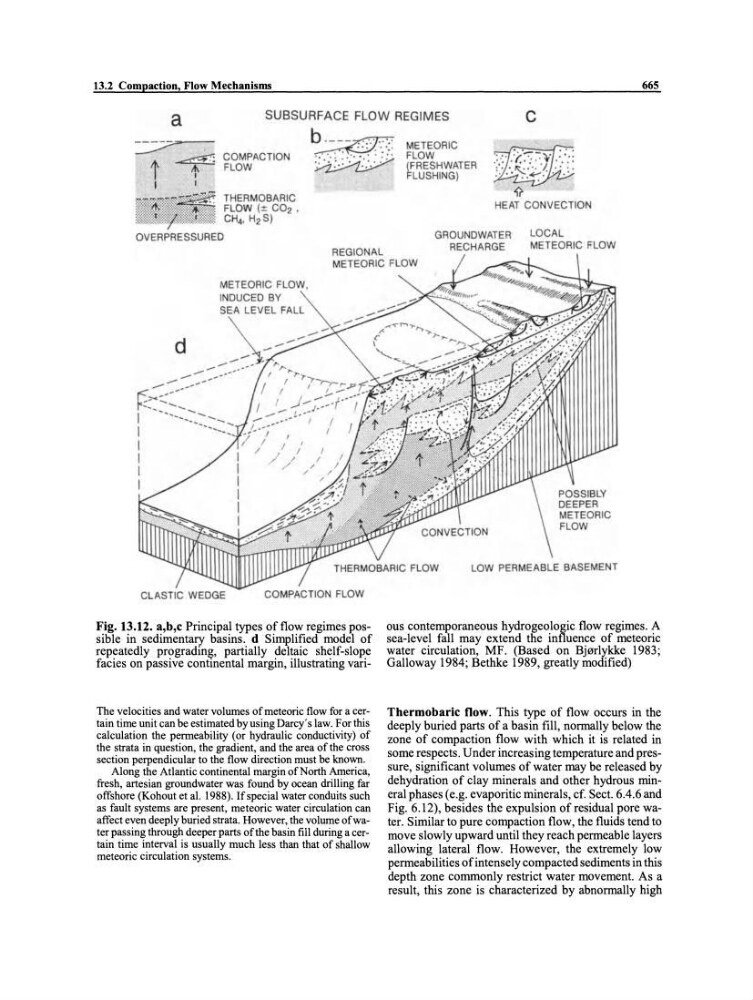
Fig. 13.12. a,b,c Prineipal types of flow regimes possible in sedimentary basins. d Simplified model of
repeatedly prograding, partially deltaie shelf-slope
faeies on passive eontinental margin, illustrating variThe velocities and water volumes of meteoric flow for a certain time unit can be estimated byusingDarcy's law. Forthis
calculation the perrneability (or hydraulic conductivity) of
the strata in question, the gradient, and the area of the cross
section perpendicular to the flow direction must be known.
Along the Atlantic continental margin ofNorth America,
fresh, artesian groundwater was found by ocean driIling far
offshore (Kohout et aI. 1988). If special water conduits such
as fault systems are present, meteoric water circulation can
affect even deeply buried strata. However, the volume ofwater passing through deeper parts ofthe basin tiII during a certain time interval is usuaIly much less than that of shaIlow
meteoric circulation systems.
POSSIBLY
OEEPER
METEORIC
FLOW
lOW PERMEABLE BASEMENT
ous eontemporaneous hydrogeologie flow regimes. A
sea-level fall may extend the influence of meteoric
water circulation, MF. (Based on Bj0rlykke 1983;
Galloway 1984; Bethke 1989, greatly modified)
Thermobaric flow. This type of flow oecurs in the
deeply buried parts of a basin fill, normally below the
zone of eompaction flow with which it is related in
some respects. Under increasing temperature and pressure, significant volumes of water may be released by
dehydration of c1ay minerals and other hydrous mineral phases (e.g. evaporitic minerals, cf. Sect. 6.4.6 and
Fig. 6.12), besides the expulsion ofresidual pore water. Similar to pure compaction flow, the fluids tend to
move slowly upward until they reach permeable layers
allowing lateral flow. However, the extremely low
permeabilities ofintensely compacted sediments in this
depth zone commonly restrict water movement. As a
result, this zone is charaeterized by abnormally high