

664
a o
E
2S 2
N
I
I0..
UJ 3
Cl
...J
«
a:
::> 4
co
5
b
PRESSURE
200
400
600
800
1000 bar
100 MPa
2.0 g/cm 2
"
BULK DENSITY OF SEDIMENT
I
ZONE
OF OVERPRESSURE
I
---Ph ---~
I
: I
HYDROSTATIC
PRESSURE
, / (INCREASING WITH BURIAL DEPTH)
2.3
LlTHOSTATIC (GEOSTATIC) PRESSURE
/
GRADIENT ('" 0.225 bar /rn)
Pe
u, EXCESS, PORE PRESSURE
PI /P\, GEOSTATIC RATIO
GRADIENT (0.1 bar/ rn)
pE' / EFFECTIVE OVERBURDEN PRESSURE (Pf -u)
c
FRACTURE
PORE PRESSURE,
PRESSURE SOLUTION
LlTHOSTAIC PRESSURE
Sl' MINIMUM PRINCIPAL STRESS
MEAN EFFECTIVE STRESS
.A
AT GRAIN CONTACTS:
PE'g: PE' "0
AREA OF GRAIN CONTACTS, a, PER UNIT AREA , A
d
DECREASING THICKNESS
SOLUTION SEAMS
)
INCREASING a, BUT DECREASING Peg
Chapter 13 Diagenesis
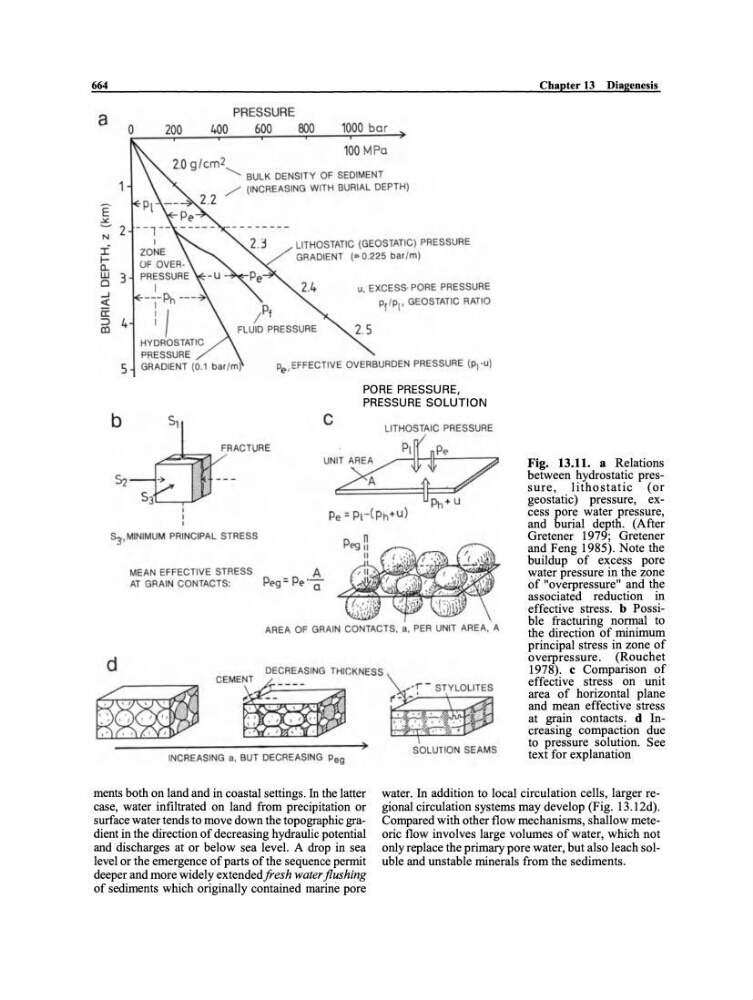
Fig. 13.11. a Relations
between hydrostatie pressure, lithostatie (or
geostatie) pressure, exeess pore water pressure,
and burial depth. (After
Gretener 1979; Gretener
and Feng 1985). Note the
buildup of exeess pore
water pressure in the zone
of "overpressure" and the
assoeiated reduetion in
effeetive stress. b Possihle fraeturing nonnal to
the direetion of minimum
prineipal stress in zone of
overpressure. (Rouehet
1978). c Comparison of
effeetive stress on unit
area of horizontal plane
and mean effeetive stress
at grain eontaets. d Inereasing eompaetion due
to pressure solution. See
text for explanation
ments both on land and in eoastal settings. In the latter
ease, water infiltrated on land from preeipitation or
surfaee water tends to move down the topographie gradient in the direetion of deereasing hydraulic potential
and discharges at or below sea level. A drop in sea
level or the emergenee of parts of the sequenee permit
deeper and more wide1y extendedfresh water jlushing
of sediments whieh originally eontained marine pore
water. In addition to loeal eireulation eells, larger regional eireulation systems may develop (Fig. 13.l2d).
Compared with other flow meehanisms, shallow meteorie flow involves large volumes of water, whieh not
only replaee the primary pore water, hut also leaeh soluble and unstable minerals from the sediments.