

13.2 Compaction, Flow Mechanisms
661
d
FLOW REFRACTION
f
PERMEABLE SAND
e
DIFFERENTIAL COMPACTION
r. ", .:' :' :' :.:.:,:,;...,.
~ 1':::,:,:::::::::i:::::::
::~::: . ,,::::::: ~
. ~ , :
.. ' .
Il:!! M ~ ~ :M ~~-~~~ ... ~~.'
h
LOW -PERMEABLE MUD, UNDERCONSOLIDATED (OV ER PRESSURED)
COMPACTION FLOW
a
b
c
TIME , t
1- - - - -/". t NEW lNCAEMENT
I
I,' tl; I OF SEDIMENT
'f\
LAYEA -1
' ".
I
J
, I
ah
/,' '"",- I
-7----f- ~I
. I
1
I
/ , '
1;'
h,
I
I: s I
h
n---.L.z~-{'- _ d ___ ~ _ _
f1
I
1
I
I
I
I
I PORE WATER
.. 1 ____ AI. - - .... ~
I
I
OF
ER 2
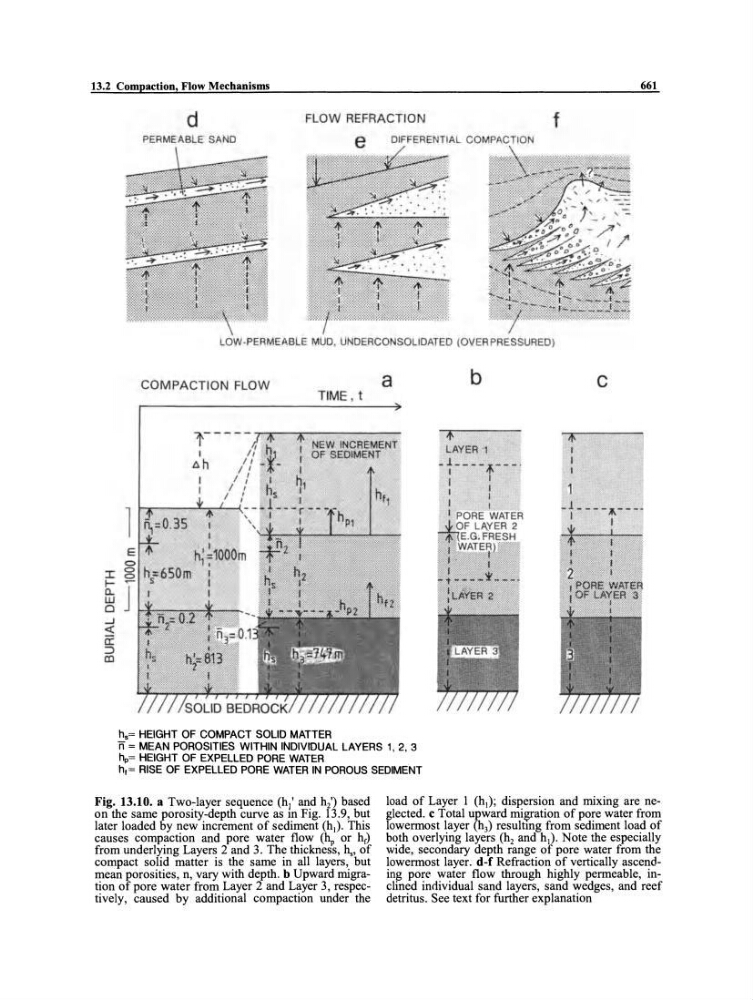
hs= HEIGHT OF COMPACT SOLID MATTER
n = MEAN POROSITIES WITHIN INDIVIDUAL LAYERS 1,2,3
hp= HEIGHT OF EXPELLED PORE WATER
h, = RISE OF EXPELLED PORE WATER IN POROUS SEDIMENT
Fig. 13.10. a Two-Iayer sequence (h/ and h z ') based
on the same porosity-depth curve as m Fig. 13.9, but
later loaded by new increment of sediment (h l ). This
causes compaction and pore water flow (~ or hf)
from underlying Layers 2 and 3. The thickness, 11., of
compact solid matter is the same in all layers, but
mean porosities, n, vary with depth_ b Upward migration of pore water from Layer 2 and Layer 3, respectively, caused by additional compaction under the
load of Layer 1 (h l ); dispersion and mixing are neglected. c Total up'ward mi~ration of pore water from
lowermost layer (h 3 ) resultmg from sediment load of
both overlying layers (hz and h l ). Note the especially
wide, secondary depth range of pore water from the
lowermost layer. d-f Refraction of vertically ascending pore water flow through highly permeable, inclined individual sand layers, sand wedges, and reef
detritus. See text for further explanation