

654
Chapter 13 Diagenesis
POROSITY, n
04
0.5
1
200
PELAGIC
CARBONATE
DIATOMAC. OOZE
(> 50%)
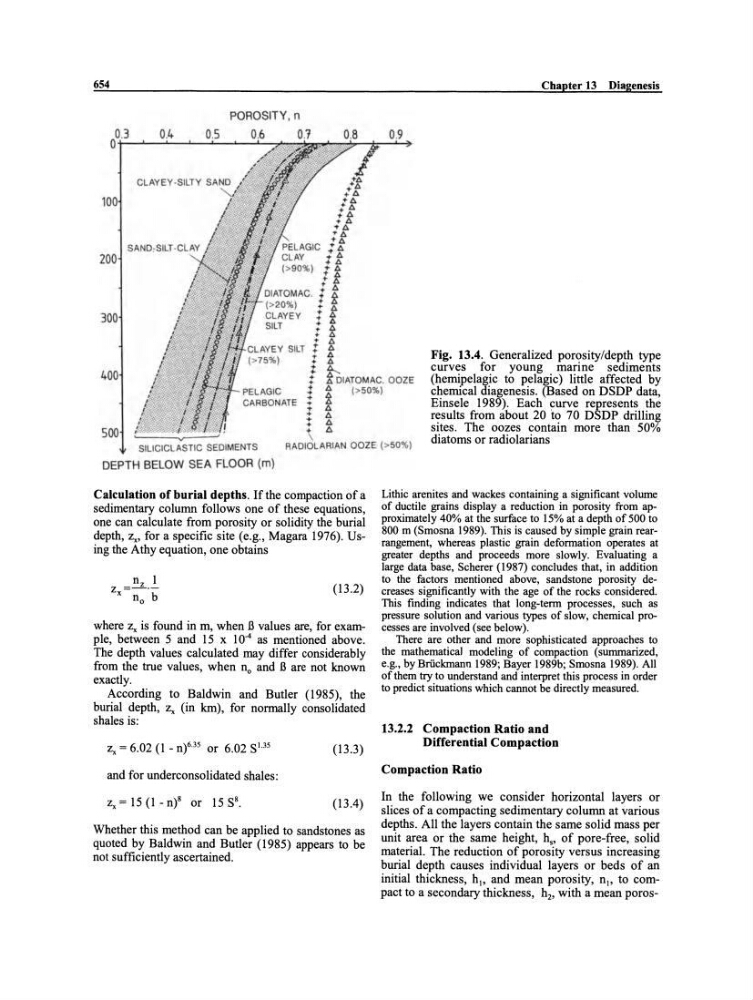
Fig. 13.4. Generalized porosity/depth type
curves for young marine sediments
(hemi'pelagic to pelagic) little affected by
cherrucal diagenesis. (Based on DSDP data,
Einseie 1989). Each curve represents the
results from about 20 to 70 DSDP drilling
sites. The oozes contain more than 50%
diatoms or radiolarians
SILICICLASTIC SEDIMENTS
DEPTH BELOW SEA FLOOR (m)
Calculation of burial depths. If the compaction of a
sedimentary column follows one of these equations,
one can calculate from porosity or solidity the burial
depth, z" for a specific site (e.g., Magara 1976). Using the Athy equation, one obtains
(13.2)
where Zx is found in m, when ß values are, for exampIe, between 5 and 15 x 10-4 as mentioned above.
The depth values calculated may differ considerably
from the true values, when n o and ß are not known
exactly.
According to Baldwin and Butler (1985), the
burial depth, Zx (in km), for normally consolidated
shales is:
Zx = 6.02 (I - n)635 or 6.02 Sl.35
(13.3)
and for underconsolidated shales:
(13.4)
Whether this method can be applied to sandstones as
quoted by Baldwin and Butler (1985) appears to be
not sufficiently ascertained.
Lithic arenites and wackes containing a significant volume
of ductile grains displaya reduction in porosity from approximately 40% at the surface to 15% at a depth of 500 to
800 m (Smosna 1989). This is caused by simple grain rearrangement, whereas plastic grain deformation operates at
greater depths and proceeds more slowly. Evaluating a
large data base, Scherer (1987) conc1udes that, in addition
to the factors mentioned above, sandstone porosity decreases significantly with the age of the rocks considered.
This finding indicates that long-term processes, such as
pressure solution and various types of slow, chemical proces ses are involved (see below).
There are other and more sophisticated approaches to
the rnathematical modeling of compaction (summarized,
e.g., by Brückmann 1989; Bayer 1989b; Smosna 1989). All
of them try to understand and interpret this process in order
to predict situations which cannot be directly measured.
13.2.2 Compaction Ratio and
Differential Compaction
Compaction Ratio
In the following we consider horizontal layers or
slices of a compacting sedimentary column at various
depths. All the layers contain the same solid mass per
unit area or the same height, h s ' of pore-free, solid
material. The reduction of porosity versus increasing
burial depth causes individual layers or beds of an
initial thickness, h l , and mean porosity, n l , to compact to a secondary thickness, h z , with a mean poros-