

652
a MECHANICAL COMPACTION
POROSITY . n
o
o~~~~~~~~
0.2
0.4
0.6
0.8
b MECHANICAL AND
CHEMIOA L COMPACTION
POROSITY . n
Cbapter 13 Diagenesis
o
o+---~----~--~--~~~
0.2
0.4
0.6
0.8
SHALLOW -BURIAL
CEMENTATION
1000
1000
,
SANDY
TURBIDITE
: - - SANDSTONE
,
DEEP-BURIAL
PRESSURE SOLUTION
AND CEMENTATION
2000
m
I
I
I
I
2000
m
CLAY MINERAL
"MATURATlON" AND
DEHYDRATION
DEPTH , Z
c
POROSITY. n
o
o+---~----~--~--~
0.2
0.4
0.6
0.8
200
1000
d
---,------"7'
EROSION .. "'"' ....
o+---~----~~irT"'~~~
1000
m
I
I
"'
/' REDE PO/"
SITION
"
,"- NORMAL
/
CONSOLIOATION
I
OVERCONSOLIOATION
o
600
m
DEPTH
0
100
m
DEPTH
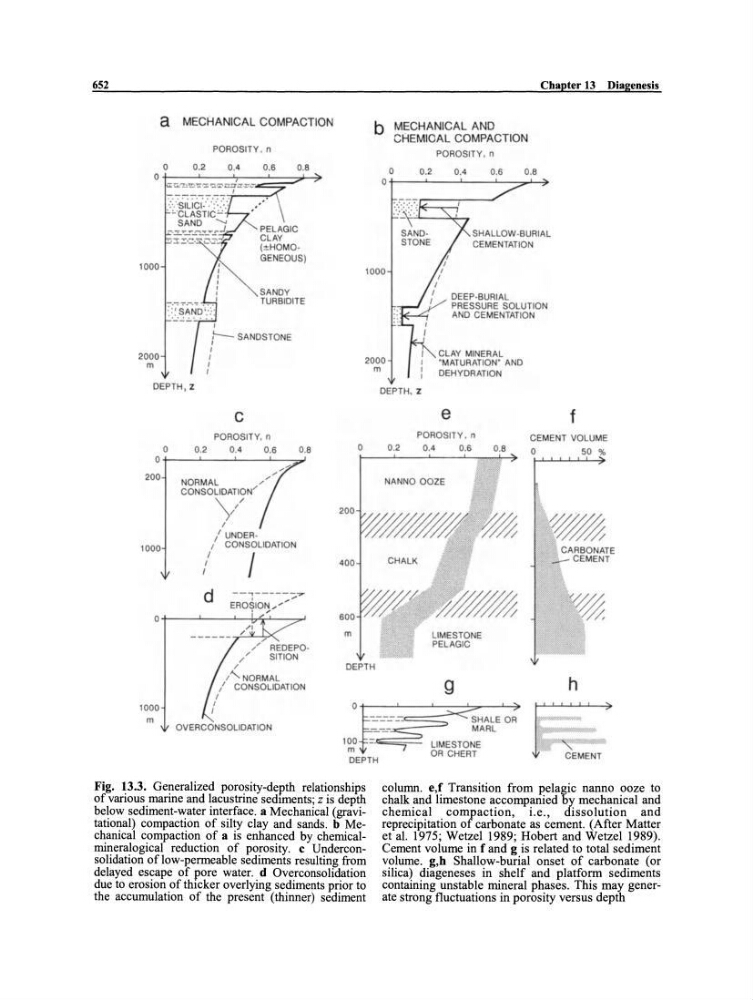
Fig. 13.3. Generalized porosity-depth relationships
of various marine and lacustrine sedIments; z is depth
below sediment-water interface. a Mechanical (gravitational) compaction of silty clay and sands. b Mechanical compaction of a is enhanced by chemicalmineralogical reduction of porosity. c Underconsolidation of low-permeable sediments resulting from
delayed escape of pore water. d Overconsolidation
due to erosion of thicker overlying sediments prior to
the accumulation of the present (thinner) sediment
DEPTH, Z
e
f
POROSITY . n
CEMENT VOLUME
0.2
0.4
0.6
0.8
o
50
NANNO OOZE
LIMESTONE
PELAGIC
9
h
SHALE OR
MARL
LIMESTONE
OR CHERT
colurnn. e,f Transition from pelagic nanno ooze to
chalk and limestone accompanied by mechanical and
chemical compaction, i.e., dissolution and
reprecipitation of carbonate as cement. (After Matter
et al. 1975; Wetzel 1989; Hobert and Wetzel 1989).
Cement volume in fand g is related to total sediment
volume. g,h Shallow-burial onset of carbonate (or
silica) diageneses in shelf and platform sediments
containing unstable mineral phases. This may generate strong fluctuations in porosity versus depth