

13.1 General Aspects
SEDIMENT
BUILDUP
651
_ _ _ _ _ _ _ _ ~~ ~V~~ _ _ _ _ S~~L~:;7LL
./" SEDIMENTATION RATE ______
".. . ':':" .' ...,.,.,.rrrl.."..":'f
HIGH L6w
ZE'RO
EROSION
HIGH
' , ' .' .' . '
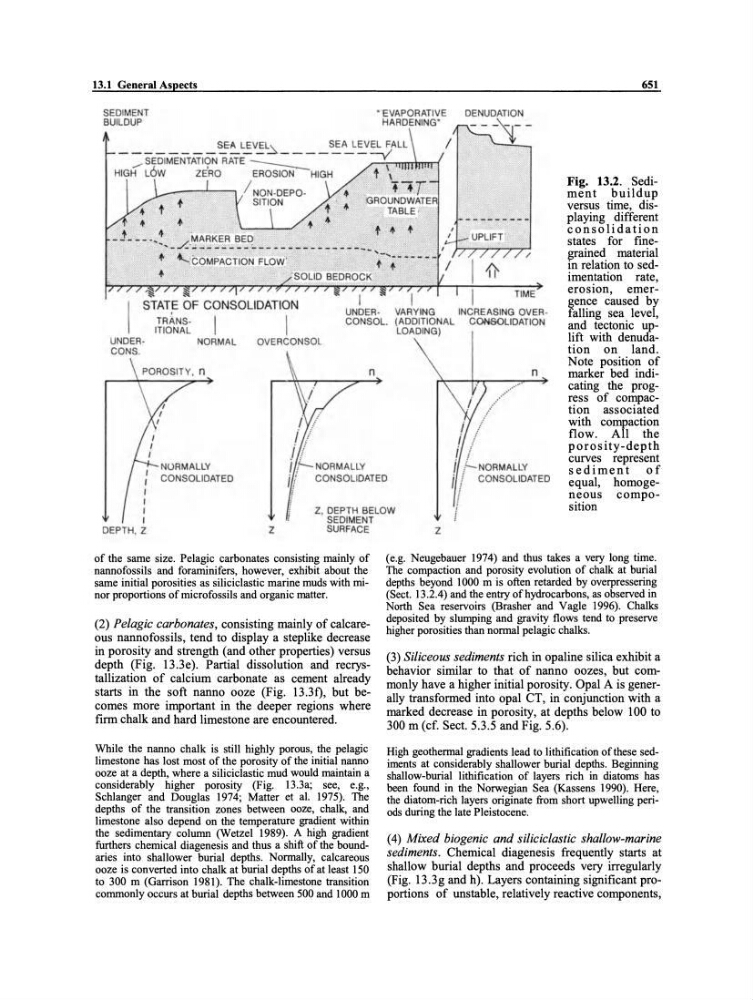
Fig. 13.2. Sediment buildup
versus time, displaying different
consolidation
states for finegrained material
in relation to sedimentation rate,
erosion, emergence eaused by
falling sea level,
and tectonic uplift with denudation on land.
Note position of
marker bed indicating the progress of compaction assoeiated
with compaction
flow. All the
porosity-depth
curves represent
sediment of
equal, homo geneous eomposition
/ NON-DEPOSITION
I
I
TIME
STATE OF CONSOLIDATION
TRANSITIONAL
I
I
UNDERCONSOL.
VARYING
INCREASING OVER -
{ADDITIONAL
CON8QUDATION
UNDERCONS.
NORMAL
OVERCONSOL
i //
i ./
i !
i' ;1-- NORMALLY
LOADINGj
n
I
,
,
NORMALLY
CONSOLIDATED
ij CONSOLIDATED
I
I
I
DEPTH. Z
z
Z, DEPTH BELOW
SEDIMENT
SURFACE
z
of the same size. Pelagic carbonates consisting mainly of
nannofossils and foraminifers, however, exhibit about the
same initial porosities as siliciclastic marine muds witb minor proportions ofmicrofossils and organic matter.
(2) Pelagic carbonates, consisting mainly of calcareous nannofossils, tend to displaya steplike decrease
in porosity and strength (and other properties) versus
depth (Fig. 13.3e). Partial dissolution and recrystallization of calcium carbonate as eement already
starts in the soft nanno ooze (Fig. 13.3t), but becomes more important in the deeper regions where
firm ehalk and hard limestone are encountered.
While tbe nanno chalk is still highly porous, the pelagic
limestone has lost most of the porosity of the initial nanno
ooze at a depth, where a siliciclastic mud would rnaintain a
considerably higher porosity (Fig. 13.3a; see, e.g.,
Schlanger and Douglas 1974; Matter et al. 1975). The
depths of the transition zones between ooze, chalk, and
limestone also depend on tbe temperature gradient within
the sedimentary column (Wetzel 1989). A high gradient
furthers chemical diagenesis and thus a shift of the boundaries into shallower burial depths. Norrnally, calcareous
ooze is converted into chalk at burial depths of at least 150
to 300 m (Garrison 1981). The chalk-limestone transition
commonly occurs at burial depths between 500 and 1000 m
(e.g. Neugebauer 1974) and thus takes a very long time.
The compaction and porosity evolution of chalk at burial
depths beyond 1000 m is often retarded by overpressering
(Sect. 13.2.4) and the entry ofhydrocarbons, as observed in
North Sea reservoirs (Brasher and Vagle 1996). Chalks
deposited by slumping and gravity flows tend to preserve
higher porosities than normal pelagic chalks.
(3) Siliceous sediments rieh in opaline silica exhibit a
behavior similar to that of nanno oozes, but commonly have a higher initial porosity. Opal A is generally transformed into opal CT, in conjunction with a
marked decrease in porosity, at depths below 100 to
300 m (cf. Sect. 5.3.5 and Fig. 5.6).
High geothermal gradients lead to lithification of these sediments at considerably shallower burial depths. Beginning
shallow-burial lithification of layers rich in diatoms has
been found in the Norwegian Sea (Kassens 1990). Here,
the diatom-rich layers originate from short upwelling periods during the late Pleistocene.
(4) Mixed biogenic and siliäclastic shallow-marine
sediments. Chemica1 diagenesis frequently starts at
shallow burial depths and proceeds very irregularly
(Fig. 13.3g and h). Layers containing significant proportions of unstable, relatively reactive components,
SEDIMENT
BUILDUP
651
_ _ _ _ _ _ _ _ ~~ ~V~~ _ _ _ _ S~~L~:;7LL
./" SEDIMENTATION RATE ______
".. . ':':" .' ...,.,.,.rrrl.."..":'f
HIGH L6w
ZE'RO
EROSION
HIGH
' , ' .' .' . '
Fig. 13.2. Sediment buildup
versus time, displaying different
consolidation
states for finegrained material
in relation to sedimentation rate,
erosion, emergence eaused by
falling sea level,
and tectonic uplift with denudation on land.
Note position of
marker bed indicating the progress of compaction assoeiated
with compaction
flow. All the
porosity-depth
curves represent
sediment of
equal, homo geneous eomposition
/ NON-DEPOSITION
I
I
TIME
STATE OF CONSOLIDATION
TRANSITIONAL
I
I
UNDERCONSOL.
VARYING
INCREASING OVER -
{ADDITIONAL
CON8QUDATION
UNDERCONS.
NORMAL
OVERCONSOL
i //
i ./
i !
i' ;1-- NORMALLY
LOADINGj
n
I
,
,
NORMALLY
CONSOLIDATED
ij CONSOLIDATED
I
I
I
DEPTH. Z
z
Z, DEPTH BELOW
SEDIMENT
SURFACE
z
of the same size. Pelagic carbonates consisting mainly of
nannofossils and foraminifers, however, exhibit about the
same initial porosities as siliciclastic marine muds witb minor proportions ofmicrofossils and organic matter.
(2) Pelagic carbonates, consisting mainly of calcareous nannofossils, tend to displaya steplike decrease
in porosity and strength (and other properties) versus
depth (Fig. 13.3e). Partial dissolution and recrystallization of calcium carbonate as eement already
starts in the soft nanno ooze (Fig. 13.3t), but becomes more important in the deeper regions where
firm ehalk and hard limestone are encountered.
While tbe nanno chalk is still highly porous, the pelagic
limestone has lost most of the porosity of the initial nanno
ooze at a depth, where a siliciclastic mud would rnaintain a
considerably higher porosity (Fig. 13.3a; see, e.g.,
Schlanger and Douglas 1974; Matter et al. 1975). The
depths of the transition zones between ooze, chalk, and
limestone also depend on tbe temperature gradient within
the sedimentary column (Wetzel 1989). A high gradient
furthers chemical diagenesis and thus a shift of the boundaries into shallower burial depths. Norrnally, calcareous
ooze is converted into chalk at burial depths of at least 150
to 300 m (Garrison 1981). The chalk-limestone transition
commonly occurs at burial depths between 500 and 1000 m
(e.g. Neugebauer 1974) and thus takes a very long time.
The compaction and porosity evolution of chalk at burial
depths beyond 1000 m is often retarded by overpressering
(Sect. 13.2.4) and the entry ofhydrocarbons, as observed in
North Sea reservoirs (Brasher and Vagle 1996). Chalks
deposited by slumping and gravity flows tend to preserve
higher porosities than normal pelagic chalks.
(3) Siliceous sediments rieh in opaline silica exhibit a
behavior similar to that of nanno oozes, but commonly have a higher initial porosity. Opal A is generally transformed into opal CT, in conjunction with a
marked decrease in porosity, at depths below 100 to
300 m (cf. Sect. 5.3.5 and Fig. 5.6).
High geothermal gradients lead to lithification of these sediments at considerably shallower burial depths. Beginning
shallow-burial lithification of layers rich in diatoms has
been found in the Norwegian Sea (Kassens 1990). Here,
the diatom-rich layers originate from short upwelling periods during the late Pleistocene.
(4) Mixed biogenic and siliäclastic shallow-marine
sediments. Chemica1 diagenesis frequently starts at
shallow burial depths and proceeds very irregularly
(Fig. 13.3g and h). Layers containing significant proportions of unstable, relatively reactive components,