

608
a
MAINLAND
SEDIMENT SOURCE
Chapter 12 Basin Evolution and Sediments
OVERTHRUST
CALCAREOUS
FLYSCH
(ABOVE CCD)
SLOPE BASIN
(ABOVE eeO)
c
.... ~ ::.~,~ n INCREASING
.. .,.+ ...... Y THICKNESS
'''+ OF BASIN
+t
FILL
b
FORELAND
INTERN AL ZONE
<
OLiSTOSTROMES FLYSCH LlTHOLOGY
czf&. (WILDFLYSCH) SANDY -SHALY
-:'=~.:-~ ~:.4 SHALE~ CALCAREOUS
~
flf--- CONGLOM.
BASE OF
I
-
':.°oo~ ~. f:. -=-: :~
FLYSCH:
'
:::-:::-:- ~.:--="';
r 0 - / 0 0 SANDY
I
-- - - - -
;;;~ 0
t
SHALLOW- :
~ Jiiß
MARINE
I
PELAGIC
~~::::
'.- -TO HEMI:
TO HEMI- .2#iE
PELAGIC ~- PELAGIC - - - - - - - -
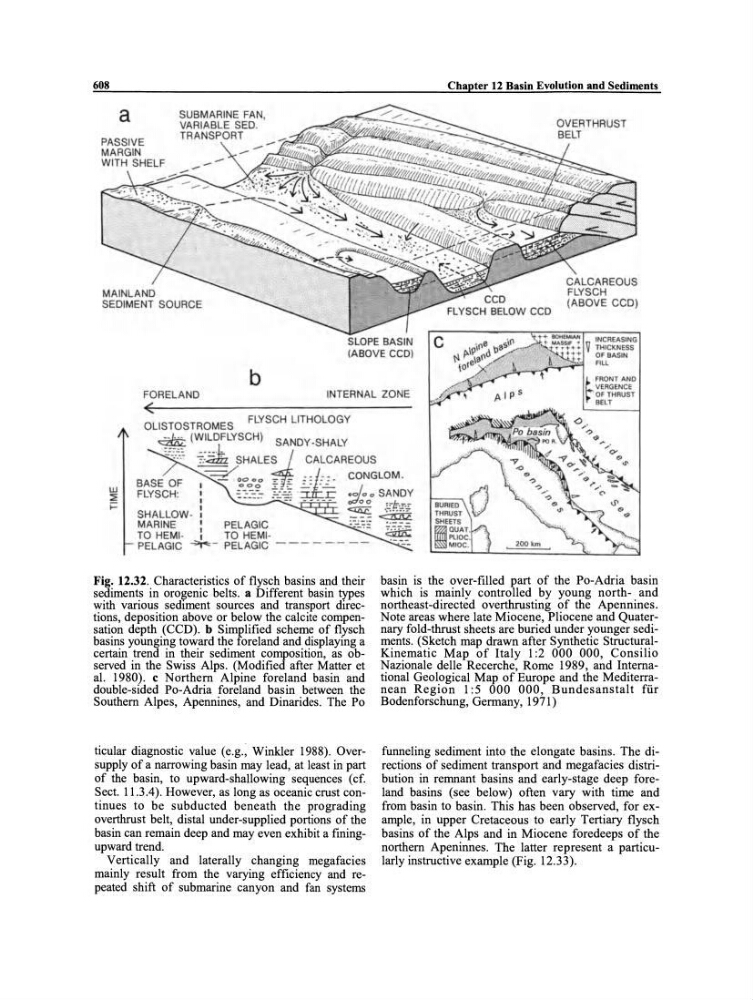
Fig. 12.32. Characteristics of flysch basins and their
sediments in orogenic belts. a Different basin types
with various sediment sources and transport directions, deposition above or below the calcite compensation depth (CCD). b Simplified scheme of flysch
basins younging toward the foreland and displaying a
certain trend in their sediment composition, as observed in the Swiss Alps. (Modified after Matter et
al. 1980). c N orthern Alpine foreland basin and
double-sided Po-Adria foreland basin between the
Southern Alpes, Apennines, and Dinarides. The Po
ticular diagnostic value (e.g., Winkler 1988). Oversupply of a narrowing basin may lead, at least in part
of the basin, to upward-shallowing sequences (cf.
Sect. 11.3.4). However, as long as oceanic crust continues to be subducted beneath the prograding
overthrust belt, distal under-supplied portions of the
basin can remain deep and may even exhibit a finingupward trend.
Vertically and laterally changing megafacies
mainly result from the varying efficiency and repeated shift of submarine canyon and fan systems
200 km
basin is the over-filled part of the Po-Adria basin
which is mainly controlled by young north- and
northeast-directed overthrusting of the Apennines.
Note areas where late Miocene, Pliocene and Quaternary fold-thrust sheets are buried under younger sediments. (Sketch rnap drawn after Synthetic StructuralKinematic Map of Italy 1:2 000 000, Consilio
Nazionale delle Recerche, Romc 1989, and International Geological Map of Europe and the Mediterranean Region 1:5 000 000, Bundesanstalt für
Bodenforschung, Germany, 1971)
funneling sediment into the elongate basins. The directions of sediment transport and megafacies distribution in remnant basins and early-stage deep foreland basins (see below) often vary with time and
from basin to basin. This has been observed, for example, in upper Cretaceous to early Tertiary flysch
basins of the Alps and in Miocene foredeeps of the
northern Apeninnes. The latter represent a particularly instructive example (Fig. 12.33).