

12.6 Remnant Basins, Flysch
CONTINENTAL
(FRESHWATER)
MOLASSE
as shale-dominated sequences with distal finegrained turbidites. In places marly and calcareous
flysch facies also occur (Fig. 12.32a,b). Most of
these deposits accumulate in deep water, but not all
of them indicate water depths below calcite compensation, depending on the degree of basin fill and temporal and spatial fluctuations of the CCD (cf. Sect.
5.3.2).
Flysch sediments deposited along the front of an
accretionary wedge or leading edge of the overriding
plate are successively incorporated into the overrid607
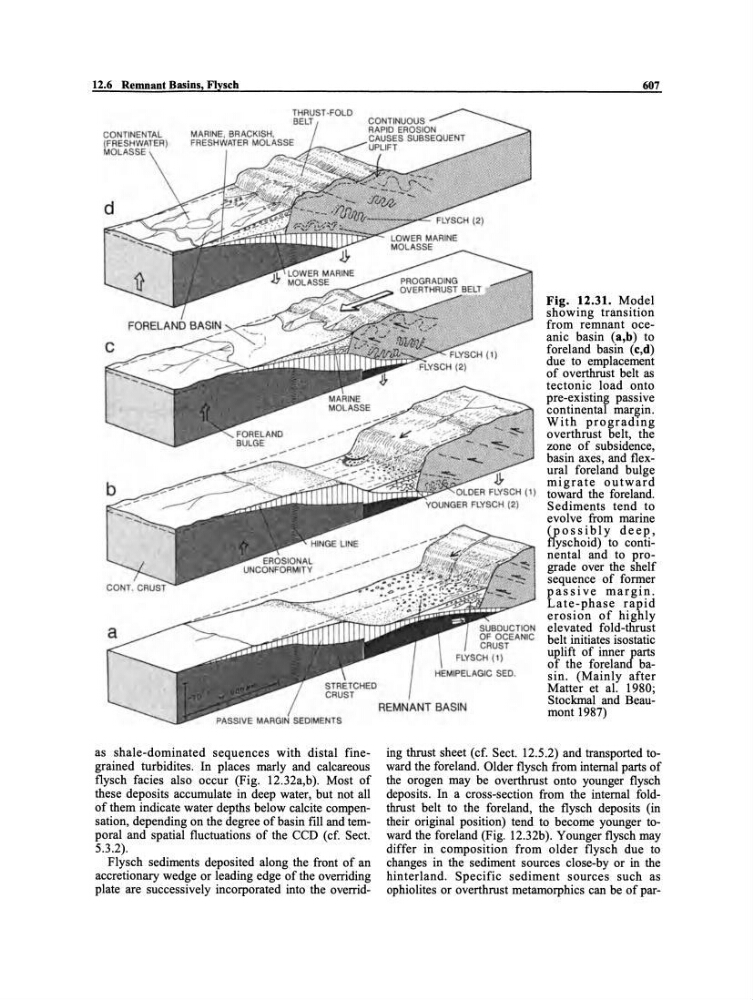
Fig. 12.31. Model
showing transition
from remnant oceanic basin (a,b) to
fore land basin (c,d)
due to emplacement
of overthrust belt as
tectonic load onto
pre-~xisting passi.ve
contmental maq~m.
With progradmg
overthrust belt, the
zone of subsidence,
basin axes, and flexural foreland bulge
migrate outward
toward the foreland.
Sediments tend to
evolve from marine
(possibly deep,
flyschoid) to continental and to prograde over the shelf
sequence of former
passive margin.
Late-phase rapid
erosion of highly
elevated fold-thrust
belt initiates isostatic
uplift of inner parts
of the foreland basin. (Mainly after
Matter et al. 1980;
Stockmal and Beaumont 1987)
ing thrust sheet (cf. Sect. 12.5.2) and transported toward the foreland. Older flysch from internal parts of
the orogen may be overthrust onto younger flysch
deposits. In a cross-section from the internal foldthrust belt to the foreland, the flysch deposits (in
their original position) tend to become younger toward the foreland (Fig. 12.32b). Younger flysch may
differ in composition from older flysch due to
changes in the sediment sources close-by or in the
hinterland. Specific sediment sources such as
ophiolites or overthrust metamorphics can be of par-