

2.2 Fluvial Sediments
chute channel
with lag
chute bars
b
,
FLOODPLAIN ,/ ~wale
DEPOSITS " flll
I
,
I
,
,
,
c
1 Sp
h
I
St
Sh
lag
!
channel scours
and.lag
i
,
d
1
h
1
t
chute
bar
Sp 1
t
lower
point
bar
1
POINT BAR
"
older lateral
accretion
complex
'e
......... --r-~ ./ levee
. , " filled
,/ 9 oxbow lake
1
Sr
contorted
,
climbing
_g:~ l
ripples
r ~
Sh
Sp
Sh+ St,sm
E'===r"'" root s
roots
peat 1
lamin.
silt
and mud
+ Corg
~~~
2-15
m
45
top of
older
point bar
laminated
silt and
mud
1
IDEAL
POINT BAR
SEQUENCE
POINT BAR
WITH CHUTE
BAR
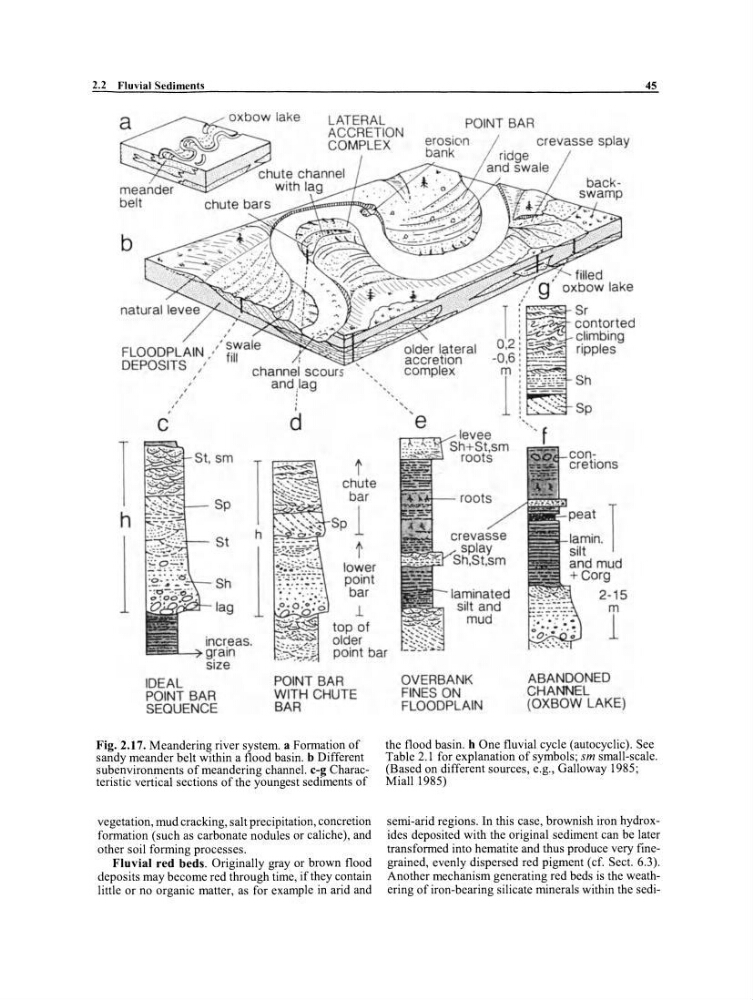
Fig. 2.17. Meandering river system. a Formation of
sandy meander belt within a flood basin. b Different
subenvironments of meandering channel. c-g Characteristic vertical seetions of the youngest sediments of
vegetation, mud cracking, salt precipitation, concretion
formation (such as carbonate nodules or caliche), and
other soil forming processes.
Fluvial red beds. Originally gray or brown flood
deposits may become red through time, ifthey contain
little or no organic matter, as for example in arid and
OVEABANK
FINES ON
FLOODPLAIN
ABANDONED
CHANNEL
(OXBOW LAKE)
the flood basin. hOne fluvial cycle (autocyclic). See
Table 2.1 for explanation of symbols; sm small-scale.
(Based on different sourees, e.g., Galloway 1985;
Miall1985)
semi-arid regions. In this casc, brownish iron hydroxides deposited with the original sediment can be later
transformed into hematite and thus produce very finegrained, evenly dispersed red pigment (cf. Sect. 6.3).
Another mechanism generating red beds is the weathering of iron-bearing silicate minerals within the sedi-
chute channel
with lag
chute bars
b
,
FLOODPLAIN ,/ ~wale
DEPOSITS " flll
I
,
I
,
,
,
c
1 Sp
h
I
St
Sh
lag
!
channel scours
and.lag
i
,
d
1
h
1
t
chute
bar
Sp 1
t
lower
point
bar
1
POINT BAR
"
older lateral
accretion
complex
'e
......... --r-~ ./ levee
. , " filled
,/ 9 oxbow lake
1
Sr
contorted
,
climbing
_g:~ l
ripples
r ~
Sh
Sp
Sh+ St,sm
E'===r"'" root s
roots
peat 1
lamin.
silt
and mud
+ Corg
~~~
2-15
m
45
top of
older
point bar
laminated
silt and
mud
1
IDEAL
POINT BAR
SEQUENCE
POINT BAR
WITH CHUTE
BAR
Fig. 2.17. Meandering river system. a Formation of
sandy meander belt within a flood basin. b Different
subenvironments of meandering channel. c-g Characteristic vertical seetions of the youngest sediments of
vegetation, mud cracking, salt precipitation, concretion
formation (such as carbonate nodules or caliche), and
other soil forming processes.
Fluvial red beds. Originally gray or brown flood
deposits may become red through time, ifthey contain
little or no organic matter, as for example in arid and
OVEABANK
FINES ON
FLOODPLAIN
ABANDONED
CHANNEL
(OXBOW LAKE)
the flood basin. hOne fluvial cycle (autocyclic). See
Table 2.1 for explanation of symbols; sm small-scale.
(Based on different sourees, e.g., Galloway 1985;
Miall1985)
semi-arid regions. In this casc, brownish iron hydroxides deposited with the original sediment can be later
transformed into hematite and thus produce very finegrained, evenly dispersed red pigment (cf. Sect. 6.3).
Another mechanism generating red beds is the weathering of iron-bearing silicate minerals within the sedi-