

516
Chapter 11 Sediment Supply, Subsidence, and Basin Fill
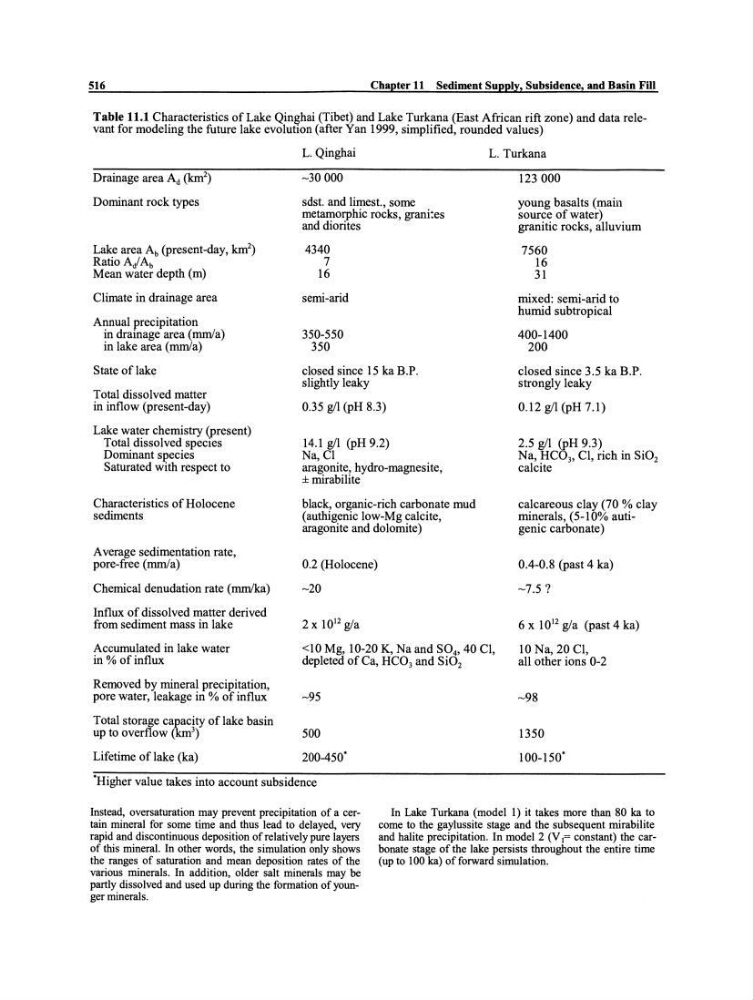
Table 11.1 Characteristics ofLake Qinghai (Tibet) and Lake Turkana (East African rift zone) and data relevant for modeling the future lake evolutIOn (after Yan 1999, simplified, rounded values)
L. Qinghai
L. Turkana
Drainage area A d (km 2 )
Dominant rock types
Lake area Ab (present-day, km 2 )
Ratio AiAb
Mean water depth (m)
Climate in drainage area
Annual precipitation
in dramage area (mm/a)
in lake area (mm/a)
State oflake
Total dissolved matter
in inflow (present-day)
Lake water chemistry (present)
Total dissolved species
Dominant species
Saturated with respect to
Characteristics of Holocene
sediments
Average sedimentation rate,
pore-free (mm/a)
Chemical denudation rate (mm/ka)
Influx of dissolved matter derived
from sediment mass in lake
Accumulated in lake water
in % of influx
Removed by mineral precipitation,
pore water, leakage in % ofinflux
Total storage capacity of lake basin
up to overflow (km 3 )
Lifetime of lake (ka)
-30000
sdst. and limest., some
metamorphic rocks, grani~es
and diorites
4340
7
16
semi-arid
350-550
350
closed since 15 ka B.P.
slightly leaky
0.35 g/l (pH 8.3)
14.1 g/l (pH 9.2)
Na,CI
aragonite, hydro-magnesite,
± mirabilite
black, organic-rich carbonate mud
(authigenic low-Mg calcite,
aragonite and dolomite)
0.2 (Holocene)
-20
2 X 10 12 g/a
<10 Mg, 10-20 K, Na and S04' 40 Cl,
depleted of Ca, HC0 3 and Si0 2
-95
500
200-450*
*Higher value takes into account subsidence
123000
young basalts (main
source of water)
granitic rocks, alluvium
7560
16
31
mixed: semi-arid to
humid subtropical
400-1400
200
c10sed since 3.5 ka B.P.
strongly leaky
0.12 g/l (pH 7.1)
2.5 g/l (pH 9.3)
Na, HC0 3 , Cl, rich in Si0 2
calcite
calcareous c1ay (70 % c1ay
minerals, (5-10% autigenic carbonate)
0.4-0.8 (past 4 ka)
-7.5 ?
6 x 10 12 g/a (past 4 ka)
10 Na, 20 Cl,
all other ions 0-2
~98
1350
100-150*
Instead, oversaturation may prevent precipitation of a certain mineral for some time and thus lead to delayed, very
rapid and discontinuous deposition of relati vely pure layers
of this mineral. In other words, the simulation only shows
the ranges of saturation and mean deposition rates of the
various minerals. In addition, older salt minerals may be
partly dissolved and used up during the formation ofyounger minerals.
In Lake Turkana (modell) it takes more than 80 ka to
come to the gaylussite stage and the subsequent mirabilite
and halite precipitation. In model 2 (V j= constant) the carbonate stage of the lake persists throughout the entire time
(up to 100 ka) offorward simulation.
Chapter 11 Sediment Supply, Subsidence, and Basin Fill
Table 11.1 Characteristics ofLake Qinghai (Tibet) and Lake Turkana (East African rift zone) and data relevant for modeling the future lake evolutIOn (after Yan 1999, simplified, rounded values)
L. Qinghai
L. Turkana
Drainage area A d (km 2 )
Dominant rock types
Lake area Ab (present-day, km 2 )
Ratio AiAb
Mean water depth (m)
Climate in drainage area
Annual precipitation
in dramage area (mm/a)
in lake area (mm/a)
State oflake
Total dissolved matter
in inflow (present-day)
Lake water chemistry (present)
Total dissolved species
Dominant species
Saturated with respect to
Characteristics of Holocene
sediments
Average sedimentation rate,
pore-free (mm/a)
Chemical denudation rate (mm/ka)
Influx of dissolved matter derived
from sediment mass in lake
Accumulated in lake water
in % of influx
Removed by mineral precipitation,
pore water, leakage in % ofinflux
Total storage capacity of lake basin
up to overflow (km 3 )
Lifetime of lake (ka)
-30000
sdst. and limest., some
metamorphic rocks, grani~es
and diorites
4340
7
16
semi-arid
350-550
350
closed since 15 ka B.P.
slightly leaky
0.35 g/l (pH 8.3)
14.1 g/l (pH 9.2)
Na,CI
aragonite, hydro-magnesite,
± mirabilite
black, organic-rich carbonate mud
(authigenic low-Mg calcite,
aragonite and dolomite)
0.2 (Holocene)
-20
2 X 10 12 g/a
<10 Mg, 10-20 K, Na and S04' 40 Cl,
depleted of Ca, HC0 3 and Si0 2
-95
500
200-450*
*Higher value takes into account subsidence
123000
young basalts (main
source of water)
granitic rocks, alluvium
7560
16
31
mixed: semi-arid to
humid subtropical
400-1400
200
c10sed since 3.5 ka B.P.
strongly leaky
0.12 g/l (pH 7.1)
2.5 g/l (pH 9.3)
Na, HC0 3 , Cl, rich in Si0 2
calcite
calcareous c1ay (70 % c1ay
minerals, (5-10% autigenic carbonate)
0.4-0.8 (past 4 ka)
-7.5 ?
6 x 10 12 g/a (past 4 ka)
10 Na, 20 Cl,
all other ions 0-2
~98
1350
100-150*
Instead, oversaturation may prevent precipitation of a certain mineral for some time and thus lead to delayed, very
rapid and discontinuous deposition of relati vely pure layers
of this mineral. In other words, the simulation only shows
the ranges of saturation and mean deposition rates of the
various minerals. In addition, older salt minerals may be
partly dissolved and used up during the formation ofyounger minerals.
In Lake Turkana (modell) it takes more than 80 ka to
come to the gaylussite stage and the subsequent mirabilite
and halite precipitation. In model 2 (V j= constant) the carbonate stage of the lake persists throughout the entire time
(up to 100 ka) offorward simulation.