

11.3 Dynamic Denudation Accumulation Systems
a Types of basin
~------- --,---:-~~
~
...... 1
I~
======! _ _ ---.J
Plan
_____ --' 1 .......
Graben filling
Stage 1
view
b
Fluvial sediments
Stage 2
Pure shear I graben
Simple shear I halfgraben
Detachrnent fault
Pull-apart b.
Transtensional b.
Higher relief I
smaller
drainage areas
Lower relief I
extended
drainage areas
C
Extensional basins
Drainage area
~ = const" -1: Basin area
~
Ab variable
o
1
~ 2
'2
I Ad variable
Ad/Ab t--- ~ - ~--- .
A
L./
DR =
4 1 ,=------ 1 00
2 1
50
DR = 100 'C::=J
50 'c - ----I
:--1 0.75 :
25
25
\ __ _ _______ -{:::J 4
10
Q)
E
i=
8- -0.5- 0.5 -
Spreading rate = const.
,
I
10
499
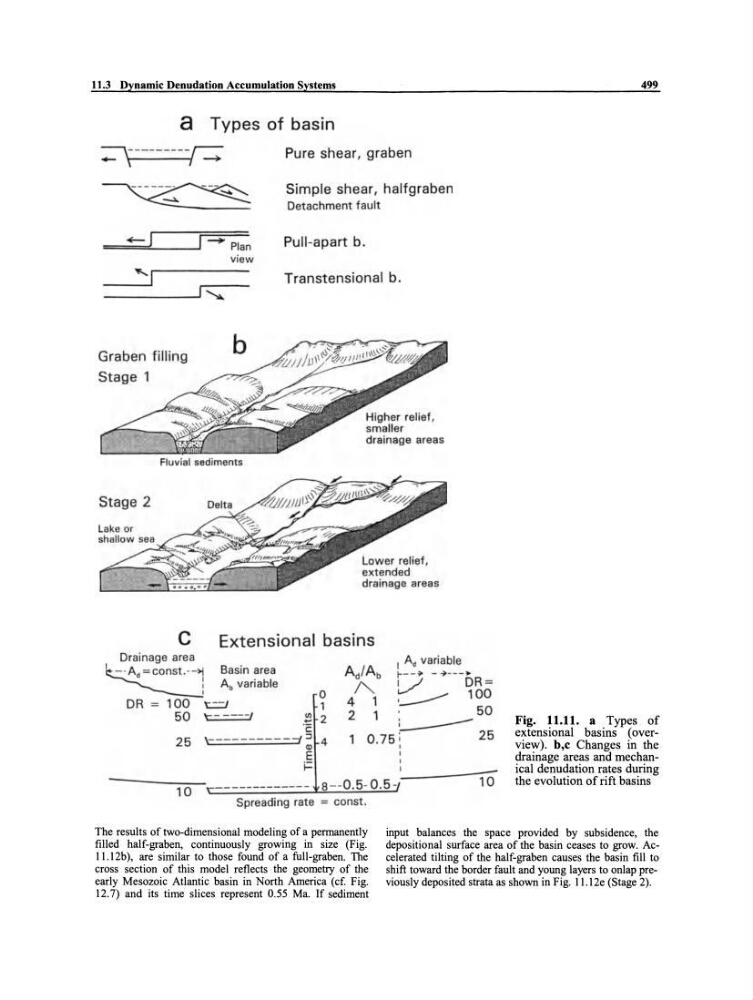
Fig. 11.11. a Types of
extensional basins (overview). b,c Changes in the
drainage areas and mechanical denudation rates during
the evolution of rift basins
The results of two-dimensional modeling of a permanently
filled half-graben, continuously growing in size (Fig.
11.l2b), are similar to those found of a full-graben. The
cross section of this model reflects the geometry of the
early Mesozoic Atlantic basin in North America (cf. Fig.
12.7) and its time slices represent 0.55 Ma. If sediment
input balances the space provided by subsidence, the
depositional surface area of the basin ceases to grow. Accelerated tilting of the half-graben causes the basin fill to
shift toward the border fault and young layers to onlap previously deposited strata as shown in Fig. 11.12e (Stage 2).
a Types of basin
~------- --,---:-~~
~
...... 1
I~
======! _ _ ---.J
Plan
_____ --' 1 .......
Graben filling
Stage 1
view
b
Fluvial sediments
Stage 2
Pure shear I graben
Simple shear I halfgraben
Detachrnent fault
Pull-apart b.
Transtensional b.
Higher relief I
smaller
drainage areas
Lower relief I
extended
drainage areas
C
Extensional basins
Drainage area
~ = const" -1: Basin area
~
Ab variable
o
1
~ 2
'2
I Ad variable
Ad/Ab t--- ~ - ~--- .
A
L./
DR =
4 1 ,=------ 1 00
2 1
50
DR = 100 'C::=J
50 'c - ----I
:--1 0.75 :
25
25
\ __ _ _______ -{:::J 4
10
Q)
E
i=
8- -0.5- 0.5 -
Spreading rate = const.
,
I
10
499
Fig. 11.11. a Types of
extensional basins (overview). b,c Changes in the
drainage areas and mechanical denudation rates during
the evolution of rift basins
The results of two-dimensional modeling of a permanently
filled half-graben, continuously growing in size (Fig.
11.l2b), are similar to those found of a full-graben. The
cross section of this model reflects the geometry of the
early Mesozoic Atlantic basin in North America (cf. Fig.
12.7) and its time slices represent 0.55 Ma. If sediment
input balances the space provided by subsidence, the
depositional surface area of the basin ceases to grow. Accelerated tilting of the half-graben causes the basin fill to
shift toward the border fault and young layers to onlap previously deposited strata as shown in Fig. 11.12e (Stage 2).