

498
Chapter 11 Sediment Supply, Subsidence, and Basin Fill
Ritt basin
a
(Initial subsidence, crustal stretching)
o
10
20
3 0 4 0
o~~==~~--~r----'----~----'---~f----'----~Ma
-, 5"--"'--0.69
•
- - -
- - - - - - - - - -
j
Air-filled
-1-_ ----i;-----_Z
1 84
- - 031
-----2
E
~
Subsidence rates (m/Ma)
.
'-'= r Water-filled
2.15 -';-~-l
Amplification
factor
.!: 4
+-'
C.
a>
Cl 6
8
10
Sediment load-driven subsidence
with increasing density of sediment
(mainly clay and silt)
basin
Fa =2.45
350
b Subsidence in various types of basin
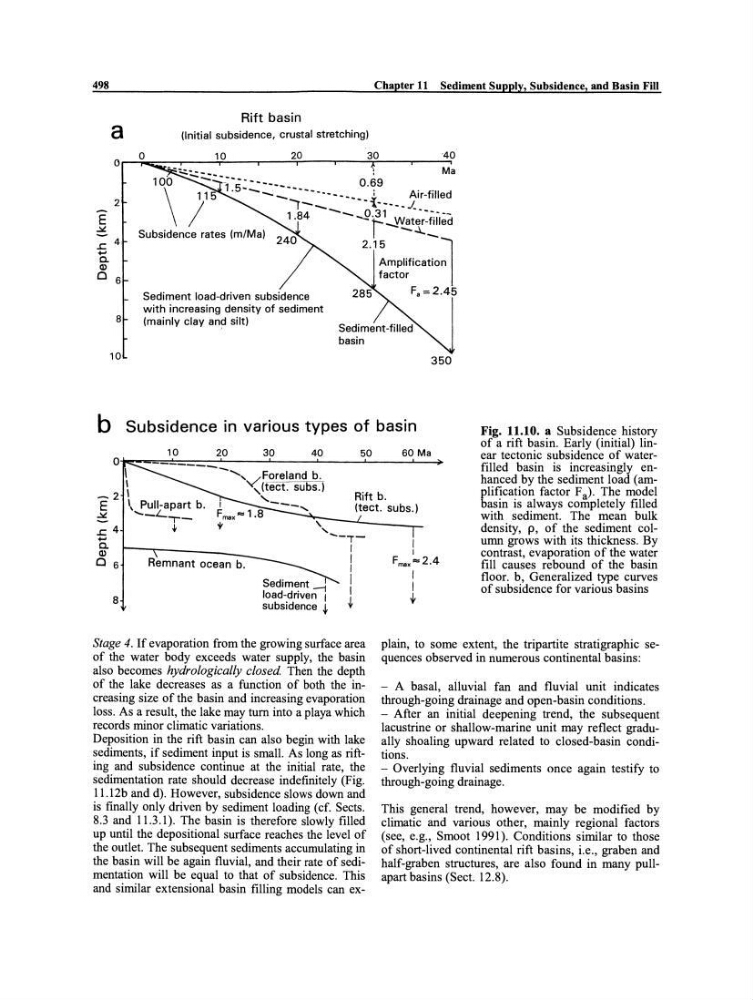
Fig. 11.10. a Subsidence history
of a rift basin. Early (initial) linear teetonic subsidence of waterfilled basin is increasingly enhanced by the sediment load (amplification factor Fa). The model
basin is always completely filled
with sediment. The mean bulk
density, p, of the sediment co 1umn grows with its thickness. By
contrast, evaporation of the water
fill causes rebound of the basin
floor. b, Generalized type curves
of subsidence for various basins
10
20
30
40
50
60 Ma
O~-=-=-~-=_=_==_=_-_~------~----~----~------~~
\
-"vForeland~
~2
E
\
,(tect. subs.)
I, Pull-apart b. I
' - - - ,
Ritt b.
~
. . . . . -L..,.._ F max ... 1.8
(teet. subs.)
- .!:4
+-'
C.
a>
Cl 6
8
.f
t
Remnant ocean b.
,
"Sediment ~
load-driven I
subsidence ~
---,I
I
I
I
I
t
Stage 4. If evaporation from the growing surface area
of the water body exceeds water supply, the basin
also becomes hydrologically closed. Then the depth
of the lake decreases as a function of both the increasing size of the basin and increasing evaporation
loss. As a result, the lake may turn into a playa which
records minor climatic variations.
Deposition in the rift basin can also begin with lake
sediments, if sediment input is small. As long as rifting and subsidence continue at the initial rate, the
sedimentation rate should decrease indefinitely (Fig.
11.12b and d). However, subsidence slows down and
is finally only driven by sediment loading (cf. Sects.
8.3 and 11.3.1). The basin is therefore slowly filled
up until the depositional surface reaches the level of
the outlet. The subsequent sediments accumulating in
the basin will be again fluvial, and their rate of sedimentation will be equal to that of subsidence. This
and similar extensional basin filling models can explain, to some extent, the tripartite stratigraphic sequences observed in numerous continental basins:
- A basal, alluvial fan and fluvial unit indicates
through-going drainage and open-basin conditions.
- After an initial deepening trend, the subsequent
lacustrine or shallow-marine unit may reflect gradually shoaling upward related to closed-basin conditions.
- Overlying fluvial sediments once again testify to
through-going drainage.
This general trend, however, may be modified by
climatic and various other, mainly regional factors
(see, e.g., Smoot 1991). Conditions sirnilar to those
of short-lived continental rift basins, i.e., graben and
half-graben structures, are also found in many pullapart basins (Sect. 12.8).
Chapter 11 Sediment Supply, Subsidence, and Basin Fill
Ritt basin
a
(Initial subsidence, crustal stretching)
o
10
20
3 0 4 0
o~~==~~--~r----'----~----'---~f----'----~Ma
-, 5"--"'--0.69
•
- - -
- - - - - - - - - -
j
Air-filled
-1-_ ----i;-----_Z
1 84
- - 031
-----2
E
~
Subsidence rates (m/Ma)
.
'-'= r Water-filled
2.15 -';-~-l
Amplification
factor
.!: 4
+-'
C.
a>
Cl 6
8
10
Sediment load-driven subsidence
with increasing density of sediment
(mainly clay and silt)
basin
Fa =2.45
350
b Subsidence in various types of basin
Fig. 11.10. a Subsidence history
of a rift basin. Early (initial) linear teetonic subsidence of waterfilled basin is increasingly enhanced by the sediment load (amplification factor Fa). The model
basin is always completely filled
with sediment. The mean bulk
density, p, of the sediment co 1umn grows with its thickness. By
contrast, evaporation of the water
fill causes rebound of the basin
floor. b, Generalized type curves
of subsidence for various basins
10
20
30
40
50
60 Ma
O~-=-=-~-=_=_==_=_-_~------~----~----~------~~
\
-"vForeland~
~2
E
\
,(tect. subs.)
I, Pull-apart b. I
' - - - ,
Ritt b.
~
. . . . . -L..,.._ F max ... 1.8
(teet. subs.)
- .!:4
+-'
C.
a>
Cl 6
8
.f
t
Remnant ocean b.
,
"Sediment ~
load-driven I
subsidence ~
---,I
I
I
I
I
t
Stage 4. If evaporation from the growing surface area
of the water body exceeds water supply, the basin
also becomes hydrologically closed. Then the depth
of the lake decreases as a function of both the increasing size of the basin and increasing evaporation
loss. As a result, the lake may turn into a playa which
records minor climatic variations.
Deposition in the rift basin can also begin with lake
sediments, if sediment input is small. As long as rifting and subsidence continue at the initial rate, the
sedimentation rate should decrease indefinitely (Fig.
11.12b and d). However, subsidence slows down and
is finally only driven by sediment loading (cf. Sects.
8.3 and 11.3.1). The basin is therefore slowly filled
up until the depositional surface reaches the level of
the outlet. The subsequent sediments accumulating in
the basin will be again fluvial, and their rate of sedimentation will be equal to that of subsidence. This
and similar extensional basin filling models can explain, to some extent, the tripartite stratigraphic sequences observed in numerous continental basins:
- A basal, alluvial fan and fluvial unit indicates
through-going drainage and open-basin conditions.
- After an initial deepening trend, the subsequent
lacustrine or shallow-marine unit may reflect gradually shoaling upward related to closed-basin conditions.
- Overlying fluvial sediments once again testify to
through-going drainage.
This general trend, however, may be modified by
climatic and various other, mainly regional factors
(see, e.g., Smoot 1991). Conditions sirnilar to those
of short-lived continental rift basins, i.e., graben and
half-graben structures, are also found in many pullapart basins (Sect. 12.8).