

11.3 Dynamic Denudation Accumulation Systems
495
SOURCE AREA, A d a
" ,r~, ~ \ /\-7
-, H
- "BASIN AREA, Ab = 2 A d
~lri=1~;:
"-~
~,~ PR = 2.5 ;;
_ .. . ..i.l. "'"
\ , ._.
_~~_
SEA LEVEL
WATER EXCHANGE
-"'-----------------~
i 1.0 TECTONIC
";" \ '7,'-Y\ ;-; TRANSPORT
AFTER TECTONIC ZONE
UPLIFT
I
SUBSIDENCE
---* ~Ö~4-SY -\~\iÄTER-LäÄö ----STRETCHED CONT. CRUST
AFTER ISOST ATIC
ADJUSTMENT
D, = 5'~H, = 2
.... _--_._ .............. - .. ..
·
.
·
.
·
.
·
.
SUB = h • Ps-Pw
s Pm - Pw
Ps' = 2.50
Pm = 3.33
Pw = 1 .00 P in g/cm 3
c
BEFORE
AFTER
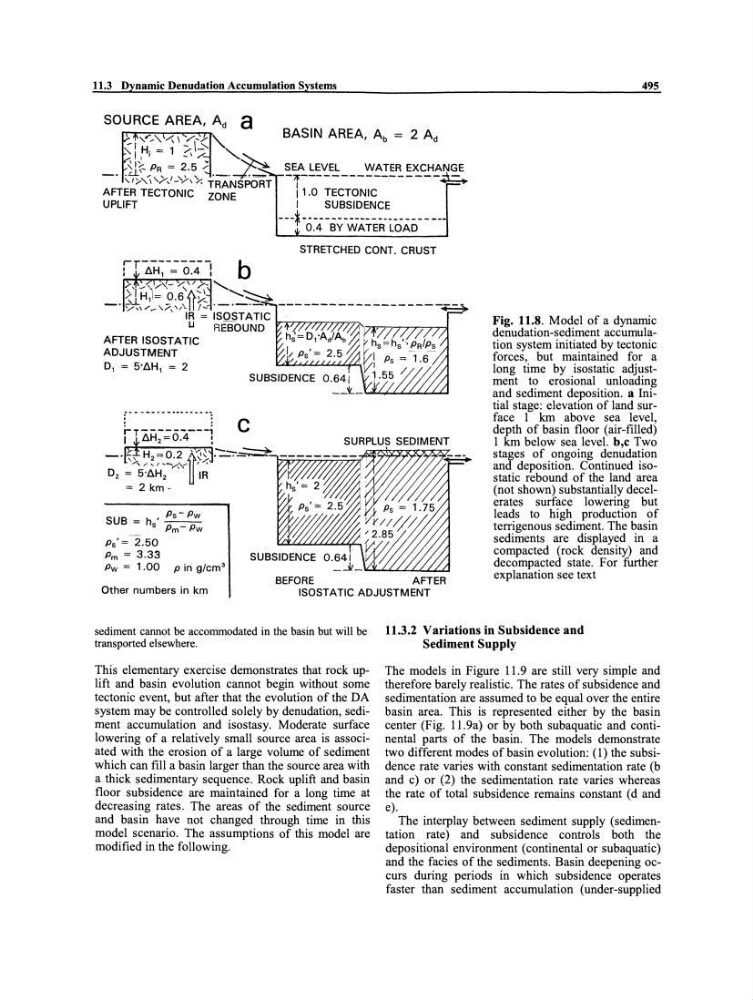
Fig. 11.8. Model of a dynamic
denudation-sediment accumulation system initiated by tectonic
forces, but maintained for a
long time by isostatic adjustment to erosional unloading
and sediment deposition. a Initial stage: elevation of land surface I km above sea level,
depth of basin floor (air-filled)
I km below sea level. b,c Two
stages of ongoing denudation
and deposition. Continued isostatic rebound of the land area
(not shown) substantially decelerates surface lowering but
leads to high production of
terrigenous sediment. The basin
sediments are displayed in a
compacted (rock density) and
decompacted state. For further
explanation see text
Other numbers in km
ISOSTATIC ADJUSTMENT
sediment cannot be accommodated in the basin but will be
transported elsewhere.
This elementary exercise demonstrates that rock uplift and basin evolution cannot begin without some
tectonic event, but after that the evolution of the DA
system may be controlled solely by denudation, sediment accumulation and isostasy. Moderate surface
lowering of a relatively small source area is associated with the erosion of a large volume of sediment
which can fill a basin larger than the source area with
a thick sedimentary sequence. Rock uplift and basin
floor subsidence are maintained for a long time at
decreasing rates. The areas of the sediment source
and basin have not changed through time in this
model scenario. The assumptions of this model are
modified in the following.
11.3.2 Variations in Subsidence and
Sediment Supply
The models in Figure 11.9 are still very simple and
therefore barely realistic. The rates of subsidence and
sedimentation are assumed to be equal over the entire
basin area. This is represented either by the basin
center (Fig. 11.9a) or by both subaquatic and continental parts of the basin. The models demonstrate
two different modes of basin evolution: (1) the sub sidence rate varies with constant sedimentation rate (b
and c) or (2) the sedimentation rate varies whereas
the rate of total subsidence remains constant (d and
e).
The interplay between sediment supply (sedimentation rate) and subsidence controls both the
depositional environment (continental or subaquatic)
and the facies of the sediments. Basin deepening occurs during periods in which subsidence operates
faster than sediment accumulation (under-supplied
495
SOURCE AREA, A d a
" ,r~, ~ \ /\-7
-, H
- "BASIN AREA, Ab = 2 A d
~lri=1~;:
"-~
~,~ PR = 2.5 ;;
_ .. . ..i.l. "'"
\ , ._.
_~~_
SEA LEVEL
WATER EXCHANGE
-"'-----------------~
i 1.0 TECTONIC
";" \ '7,'-Y\ ;-; TRANSPORT
AFTER TECTONIC ZONE
UPLIFT
I
SUBSIDENCE
---* ~Ö~4-SY -\~\iÄTER-LäÄö ----STRETCHED CONT. CRUST
AFTER ISOST ATIC
ADJUSTMENT
D, = 5'~H, = 2
.... _--_._ .............. - .. ..
·
.
·
.
·
.
·
.
SUB = h • Ps-Pw
s Pm - Pw
Ps' = 2.50
Pm = 3.33
Pw = 1 .00 P in g/cm 3
c
BEFORE
AFTER
Fig. 11.8. Model of a dynamic
denudation-sediment accumulation system initiated by tectonic
forces, but maintained for a
long time by isostatic adjustment to erosional unloading
and sediment deposition. a Initial stage: elevation of land surface I km above sea level,
depth of basin floor (air-filled)
I km below sea level. b,c Two
stages of ongoing denudation
and deposition. Continued isostatic rebound of the land area
(not shown) substantially decelerates surface lowering but
leads to high production of
terrigenous sediment. The basin
sediments are displayed in a
compacted (rock density) and
decompacted state. For further
explanation see text
Other numbers in km
ISOSTATIC ADJUSTMENT
sediment cannot be accommodated in the basin but will be
transported elsewhere.
This elementary exercise demonstrates that rock uplift and basin evolution cannot begin without some
tectonic event, but after that the evolution of the DA
system may be controlled solely by denudation, sediment accumulation and isostasy. Moderate surface
lowering of a relatively small source area is associated with the erosion of a large volume of sediment
which can fill a basin larger than the source area with
a thick sedimentary sequence. Rock uplift and basin
floor subsidence are maintained for a long time at
decreasing rates. The areas of the sediment source
and basin have not changed through time in this
model scenario. The assumptions of this model are
modified in the following.
11.3.2 Variations in Subsidence and
Sediment Supply
The models in Figure 11.9 are still very simple and
therefore barely realistic. The rates of subsidence and
sedimentation are assumed to be equal over the entire
basin area. This is represented either by the basin
center (Fig. 11.9a) or by both subaquatic and continental parts of the basin. The models demonstrate
two different modes of basin evolution: (1) the sub sidence rate varies with constant sedimentation rate (b
and c) or (2) the sedimentation rate varies whereas
the rate of total subsidence remains constant (d and
e).
The interplay between sediment supply (sedimentation rate) and subsidence controls both the
depositional environment (continental or subaquatic)
and the facies of the sediments. Basin deepening occurs during periods in which subsidence operates
faster than sediment accumulation (under-supplied