

40
DELTA FORESETS
(:: DESRIS FLOWS)
I
LAKE SOTTOM SETS
(CHANGING FAUNA DUE Ta
VARIATIONS IN SALT CONTENT)
CROSS SECTION
Chapter 2 Continental Sediments
LAKE LEVEL
CROSS SECTION
LAKE LEVEL
oE- - - -
/.....---- - - -- - L ____ _ ___ ---').
.e:./"
TI ME
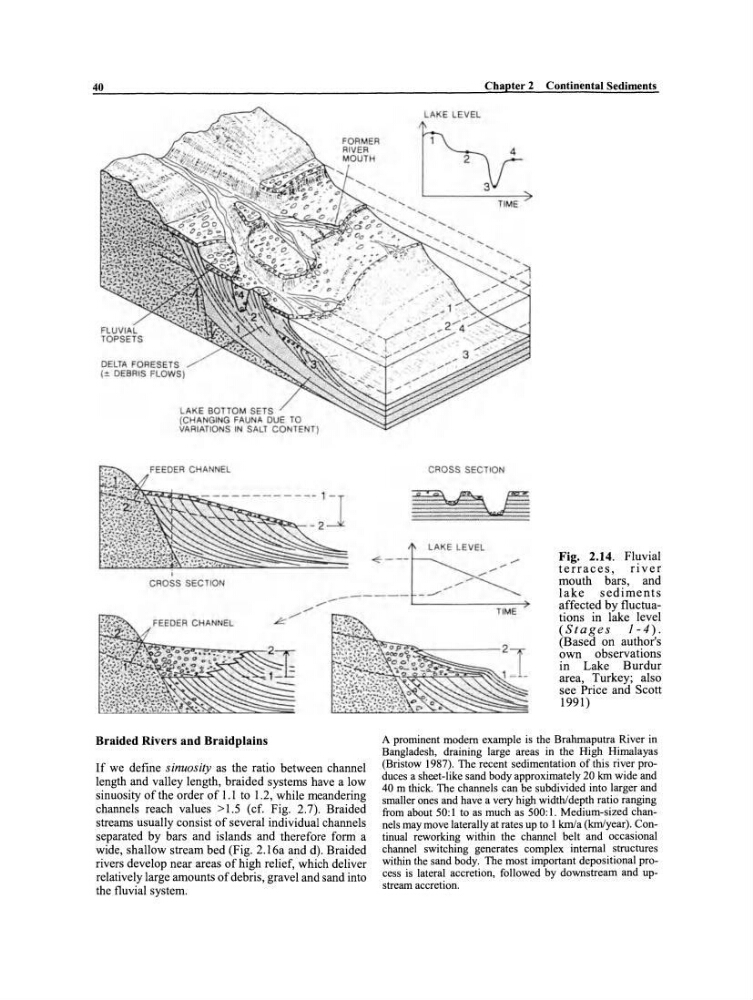
Fig. 2.14. Fluvial
terraces, river
mouth bars, and
lake sediments
affeeted by fluetuations in lake level
(Stages
1-4).
(Based on author's
own observations
in Lake Burdur
area, Turkey; also
see Priee and Seott
1991)
Braided Rivers and Braidplains
If we define sinuosity as the ratio betwecn ehannel
length and valley length, braided systems have a low
sinuosity of the order of 1.1 to 1.2, while meandering
ehannels rcaeh values > 1.5 (cf. Fig. 2.7). Braided
strearns usually eonsist of several individual ehannels
separated by bars and islands and thcrefore form a
wide, shallow stream bed (Fig. 2.16a and d). Braided
rivers develop near areas of high relief, which deli ver
relatively large amounts of debris, gravel and sand into
the fluvial system.
A prominent modern example is the Brahmaputra River in
Bangladesh, draining large areas in the High Himalayas
(Bristow 1987). The recent sedimentation of this river produces a sheet-like sand body approximately 20 km wide and
40 m thick. The channe1s can be subdivided into larger and
smaller ones and have a very high width/depth ratio ranging
from about 50: 1 to as much as 500: I. Medium-sized channels may move laterally at rates up to 1 kmla (kmlyear). Continual reworking within the channcl belt and occasional
channel switching generates complex internal structures
within the sand body. The most important depositional process is lateral accretion, followed by downstream and upstream accretion.
DELTA FORESETS
(:: DESRIS FLOWS)
I
LAKE SOTTOM SETS
(CHANGING FAUNA DUE Ta
VARIATIONS IN SALT CONTENT)
CROSS SECTION
Chapter 2 Continental Sediments
LAKE LEVEL
CROSS SECTION
LAKE LEVEL
oE- - - -
/.....---- - - -- - L ____ _ ___ ---').
.e:./"
TI ME
Fig. 2.14. Fluvial
terraces, river
mouth bars, and
lake sediments
affeeted by fluetuations in lake level
(Stages
1-4).
(Based on author's
own observations
in Lake Burdur
area, Turkey; also
see Priee and Seott
1991)
Braided Rivers and Braidplains
If we define sinuosity as the ratio betwecn ehannel
length and valley length, braided systems have a low
sinuosity of the order of 1.1 to 1.2, while meandering
ehannels rcaeh values > 1.5 (cf. Fig. 2.7). Braided
strearns usually eonsist of several individual ehannels
separated by bars and islands and thcrefore form a
wide, shallow stream bed (Fig. 2.16a and d). Braided
rivers develop near areas of high relief, which deli ver
relatively large amounts of debris, gravel and sand into
the fluvial system.
A prominent modern example is the Brahmaputra River in
Bangladesh, draining large areas in the High Himalayas
(Bristow 1987). The recent sedimentation of this river produces a sheet-like sand body approximately 20 km wide and
40 m thick. The channe1s can be subdivided into larger and
smaller ones and have a very high width/depth ratio ranging
from about 50: 1 to as much as 500: I. Medium-sized channels may move laterally at rates up to 1 kmla (kmlyear). Continual reworking within the channcl belt and occasional
channel switching generates complex internal structures
within the sand body. The most important depositional process is lateral accretion, followed by downstream and upstream accretion.