

2.2 Fluvial Sediments
39
PLANT
1
MUD
~~ ROOTLETS :rOPSETS
PHASE
FLOW
eOARSENING
UPWARD ~~
1c
4
(PHASE 4)
& SI
j '0RESETS r---_~___ ~~~ __ J~~il~~/ --~-rr- ------F;~~,,~-2-eOARSENING
UPWARD
(PHASE 1)
}FORESETS __ ~_
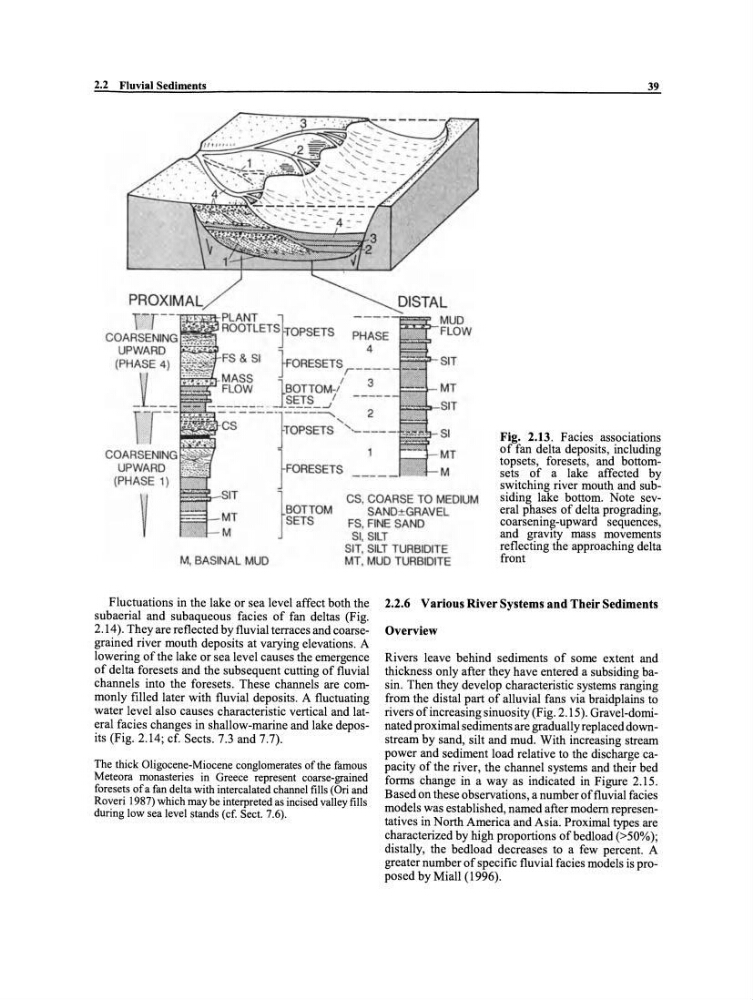
Fig. 2.13. Facies assoclatlOns
of fan delta deposits, including
topsets, foresets, and bottomsets of a lake affected by
switching river mouth and subsiding lake bottom. Note several phases of delta prograding,
coarsening-upward sequences,
and gravity mass movements
reflecting the approaching delta
front
}
es, eOARSE TO MEDIUM
BOTTOM
SAND~GRAVEL
SETS
FS, FINE SAND
SI, SILT
~
SIT, SILT TURBIDITE
M, BASINAL MUD
MT, MUD TURBIDITE
Fluctuations in the lake or sea level affect both the
subaerial and subaqueous facies of fan deltas (Fig.
2.14). Theyare reflected by fluvial terraces and coarsegrained river mouth deposits at varying elevations. A
lowering of the lake or sea level causes the emergence
of delta foresets and the subsequent cutting of fluvial
channels into the foresets. These channels are commonly filled later with fluvial deposits. A fluctuating
water level also causes characteristic vertical and lateral facies changes in shallow-marine and lake deposits (Fig. 2.14; cf. Sects. 7.3 and 7.7).
Tbe thick Oligocene-Miocene conglomerates ofthe famous
Meteora monasteries in Greece represent coarse-grained
foresets ofa fan delta with intercalated channel fiIIs (Ori and
Roveri 1987) which may be interpreted as incised vaIIey fiIIs
during low sea level stands (cf. Sect. 7.6).
2.2.6 Various River Systems and Their Sediments
Overview
Rivers leave behind sediments of some extent and
thickness only after they have entered a subsiding basin. Then they develop characteristic systems ranging
from the distal part of alluvial fans via braidplains to
rivers of increasing sinuosity (Fig. 2.15). Gravel-dominated proximal sediments are gradually replaced downstream by sand, silt and mud. With increasing stream
power and sediment load relative to the discharge capacity of the river, the channel systems and their bed
forrns change in a way as indicated in Figure 2.15.
Based on these observations, a number offluvial facies
models was established, named after modem representatives in North America and Asia. Proximal types are
characterized by high proportions of bedload (>50%);
distally, the bedload decreases to a few percent. A
greater number of specific fluvial facies models is proposed by Miall (1996).
39
PLANT
1
MUD
~~ ROOTLETS :rOPSETS
PHASE
FLOW
eOARSENING
UPWARD ~~
1c
4
(PHASE 4)
& SI
j '0RESETS r---_~___ ~~~ __ J~~il~~/ --~-rr- ------F;~~,,~-2-eOARSENING
UPWARD
(PHASE 1)
}FORESETS __ ~_
Fig. 2.13. Facies assoclatlOns
of fan delta deposits, including
topsets, foresets, and bottomsets of a lake affected by
switching river mouth and subsiding lake bottom. Note several phases of delta prograding,
coarsening-upward sequences,
and gravity mass movements
reflecting the approaching delta
front
}
es, eOARSE TO MEDIUM
BOTTOM
SAND~GRAVEL
SETS
FS, FINE SAND
SI, SILT
~
SIT, SILT TURBIDITE
M, BASINAL MUD
MT, MUD TURBIDITE
Fluctuations in the lake or sea level affect both the
subaerial and subaqueous facies of fan deltas (Fig.
2.14). Theyare reflected by fluvial terraces and coarsegrained river mouth deposits at varying elevations. A
lowering of the lake or sea level causes the emergence
of delta foresets and the subsequent cutting of fluvial
channels into the foresets. These channels are commonly filled later with fluvial deposits. A fluctuating
water level also causes characteristic vertical and lateral facies changes in shallow-marine and lake deposits (Fig. 2.14; cf. Sects. 7.3 and 7.7).
Tbe thick Oligocene-Miocene conglomerates ofthe famous
Meteora monasteries in Greece represent coarse-grained
foresets ofa fan delta with intercalated channel fiIIs (Ori and
Roveri 1987) which may be interpreted as incised vaIIey fiIIs
during low sea level stands (cf. Sect. 7.6).
2.2.6 Various River Systems and Their Sediments
Overview
Rivers leave behind sediments of some extent and
thickness only after they have entered a subsiding basin. Then they develop characteristic systems ranging
from the distal part of alluvial fans via braidplains to
rivers of increasing sinuosity (Fig. 2.15). Gravel-dominated proximal sediments are gradually replaced downstream by sand, silt and mud. With increasing stream
power and sediment load relative to the discharge capacity of the river, the channel systems and their bed
forrns change in a way as indicated in Figure 2.15.
Based on these observations, a number offluvial facies
models was established, named after modem representatives in North America and Asia. Proximal types are
characterized by high proportions of bedload (>50%);
distally, the bedload decreases to a few percent. A
greater number of specific fluvial facies models is proposed by Miall (1996).