

472
Chapter 10 Sedimentation Rates and Organic Matter
20
HIGH PRODUCTIVITY
10
5
:r:
IC)
w 2
~
:>
In
cf.
.:;:::: ::;:;::::::::'".:
J · t~~!j!!M·~ j' n~~~R~~g~~~TY
O. :::::: .... :::::::::::::::.
: : : : : : : : : : : : : : : : : : : : : : .
INCREASING
0.2 ;::;::;::;::;::}:::.
WATER DEPTH
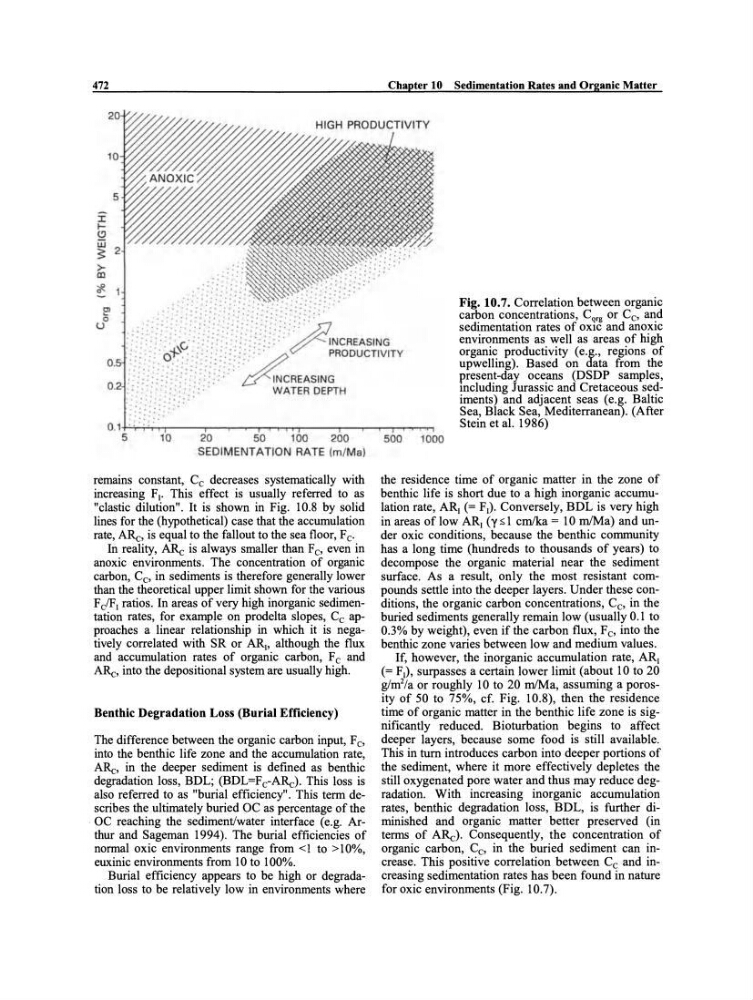
Fig. 10.7. Correlation between organic
carbon concentrations, Cqrg or Ce, and
sedimentation rates of OXIC and anoxic
environments as well as areas of high
organic productivity (e.g., regions of
upwelling). Based on data from the
present-day oceans (DSDP sampies,
mcluding Jurassic and Cretaceous sediments) and adjacent seas (e.g. Baltic
Sea, Black Sea, Mediterranean). (After
Stein et al. 1986)
:}::;::}:~;;::~
0.1 .: .:
5
10
20
50
100
200
500
1000
SEDIMENTATION RATE (rn /Mal
remains constant, Ce decreases systematically with
increasing F]. Ihis effect is usually referred to as
"clastic dilution". It is shown in Fig. 10.8 by solid
lines for the (hypothetical) case that the accumulation
rate, ARe, is equal to the fallout to the sea floor, Fe.
In reality, ARe is always smaller than Fe, even in
anoxic environments. Ihe concentration of organic
carbon, Co in sediments is therefore generally lower
than the theoretical upper limit shown for the various
FelF] ratios. In areas ofvery high inorganic sedimentation rates, for example on prodelta slopes, Ce approaches a linear relationship in which it is negatively correlated with SR or AR], although the flux
and accumulation rates of organic carbon, Fe and
ARe, into the depositional system are usually high.
Benthie Degradation Loss (Burial Efficieney)
Ihe difference between the organic carbon input, F 0
into the benthic life zone and the accumulation rate,
ARe, in the deeper sediment is defined as benthic
degradation loss, BDL; (BDL=FcARe). Ihis loss is
also referred to as "burial efficiency". Ihis term describes the ultimately buried OC as percentage of the
. OC reaching the sediment/water interface (e.g. Arthur and Sageman 1994). Ihe burial efficiencies of
normal oxic environments range from <1 to > 1 0%,
euxinic environments from 10 to 100%.
Burial efficiency appears to be high or degradation loss to be relatively low in environments where
the residence time of organic matter in the zone of
benthic life is short due to a high inorganic accumulation rate, AR] (= F]). Conversely, BDL is very high
in areas of low AR] (y ~ 1 cm/ka = 10 mlMa) and under oxic conditions, because the benthic community
has a long time (hundreds to thousands of years) to
decompose the organic material near the sediment
surface. As a result, only the most resistant compounds settle into the deeper layers. Under these conditions, the organic carbon concentrations, Ce, in the
buried sediments generally remain low (usually 0.1 to
0.3% by weight), even ifthe carbon flux, Fe, into the
benthic zone varies between low and medium values.
If, however, the inorganic accumulation rate, AR]
(= F]), surpasses a certain lower limit (ab out 10 to 20
g/m 2 /a or roughly 10 to 20 mlMa, assuming a porosity of 50 to 75%, cf. Fig. 10.8), then the residence
time of organic matter in the benthic life zone is significantly reduced. Bioturbation begins to affect
deeper layers, because some food is still available.
Ihis in turn introduces carbon into deeper portions of
the sediment, where it more effectively depletes the
still oxygenated pore water and thus may reduce degradation. With increasing inorganic accumulation
rates, benthic degradation loss, BDL, is further diminished and organic matter better preserved (in
terms of ARe). Consequently, the concentration of
organic carbon, Co in the buried sediment can increase. Ihis positive correlation between Ce and increasing sedimentation rates has been found in nature
for oxic environments (Fig. 10.7).
Chapter 10 Sedimentation Rates and Organic Matter
20
HIGH PRODUCTIVITY
10
5
:r:
IC)
w 2
~
:>
In
cf.
.:;:::: ::;:;::::::::'".:
J · t~~!j!!M·~ j' n~~~R~~g~~~TY
O. :::::: .... :::::::::::::::.
: : : : : : : : : : : : : : : : : : : : : : .
INCREASING
0.2 ;::;::;::;::;::}:::.
WATER DEPTH
Fig. 10.7. Correlation between organic
carbon concentrations, Cqrg or Ce, and
sedimentation rates of OXIC and anoxic
environments as well as areas of high
organic productivity (e.g., regions of
upwelling). Based on data from the
present-day oceans (DSDP sampies,
mcluding Jurassic and Cretaceous sediments) and adjacent seas (e.g. Baltic
Sea, Black Sea, Mediterranean). (After
Stein et al. 1986)
:}::;::}:~;;::~
0.1 .: .:
5
10
20
50
100
200
500
1000
SEDIMENTATION RATE (rn /Mal
remains constant, Ce decreases systematically with
increasing F]. Ihis effect is usually referred to as
"clastic dilution". It is shown in Fig. 10.8 by solid
lines for the (hypothetical) case that the accumulation
rate, ARe, is equal to the fallout to the sea floor, Fe.
In reality, ARe is always smaller than Fe, even in
anoxic environments. Ihe concentration of organic
carbon, Co in sediments is therefore generally lower
than the theoretical upper limit shown for the various
FelF] ratios. In areas ofvery high inorganic sedimentation rates, for example on prodelta slopes, Ce approaches a linear relationship in which it is negatively correlated with SR or AR], although the flux
and accumulation rates of organic carbon, Fe and
ARe, into the depositional system are usually high.
Benthie Degradation Loss (Burial Efficieney)
Ihe difference between the organic carbon input, F 0
into the benthic life zone and the accumulation rate,
ARe, in the deeper sediment is defined as benthic
degradation loss, BDL; (BDL=FcARe). Ihis loss is
also referred to as "burial efficiency". Ihis term describes the ultimately buried OC as percentage of the
. OC reaching the sediment/water interface (e.g. Arthur and Sageman 1994). Ihe burial efficiencies of
normal oxic environments range from <1 to > 1 0%,
euxinic environments from 10 to 100%.
Burial efficiency appears to be high or degradation loss to be relatively low in environments where
the residence time of organic matter in the zone of
benthic life is short due to a high inorganic accumulation rate, AR] (= F]). Conversely, BDL is very high
in areas of low AR] (y ~ 1 cm/ka = 10 mlMa) and under oxic conditions, because the benthic community
has a long time (hundreds to thousands of years) to
decompose the organic material near the sediment
surface. As a result, only the most resistant compounds settle into the deeper layers. Under these conditions, the organic carbon concentrations, Ce, in the
buried sediments generally remain low (usually 0.1 to
0.3% by weight), even ifthe carbon flux, Fe, into the
benthic zone varies between low and medium values.
If, however, the inorganic accumulation rate, AR]
(= F]), surpasses a certain lower limit (ab out 10 to 20
g/m 2 /a or roughly 10 to 20 mlMa, assuming a porosity of 50 to 75%, cf. Fig. 10.8), then the residence
time of organic matter in the benthic life zone is significantly reduced. Bioturbation begins to affect
deeper layers, because some food is still available.
Ihis in turn introduces carbon into deeper portions of
the sediment, where it more effectively depletes the
still oxygenated pore water and thus may reduce degradation. With increasing inorganic accumulation
rates, benthic degradation loss, BDL, is further diminished and organic matter better preserved (in
terms of ARe). Consequently, the concentration of
organic carbon, Co in the buried sediment can increase. Ihis positive correlation between Ce and increasing sedimentation rates has been found in nature
for oxic environments (Fig. 10.7).