

426
Chapter 9 Denudation and Mass Transport
10
I i I
I
I
CHEMICAL DENUDATION RATES
IN VARIOUS ROCK TYPES
n:J
.x
-- E
n:J
6
6
4
2
0
600
400
200
I
I
I
I
I
I
t
ROCK SALT
(CONCENTRATION IN
RUNNING WATER 10-20 g/l
GYPSUM AND ANHYDRITE
(CONCENTRATION IN RUNNING
WATER 1-2 9/1)
~E O~----------------------------------CARBONATE ROCKS
80
TEMPERATE WITH HIGH RAINFAll
E 100
t HUMID TROPICS AND
60
HUMID TEMPERATE
•
"NUDE" KARST
40
~ ~ DIFFERENT ROCKS
:iI 19
AND SEDIMENTS
20
~
SUBTROPICAl.,--____ -.-_ _ _ W_IT_H_C_A_R_B_O_N_Ä_:T_E_-,
o
SUBARCTIC -
1
I
GLOBAL MEAN - 10mmIka
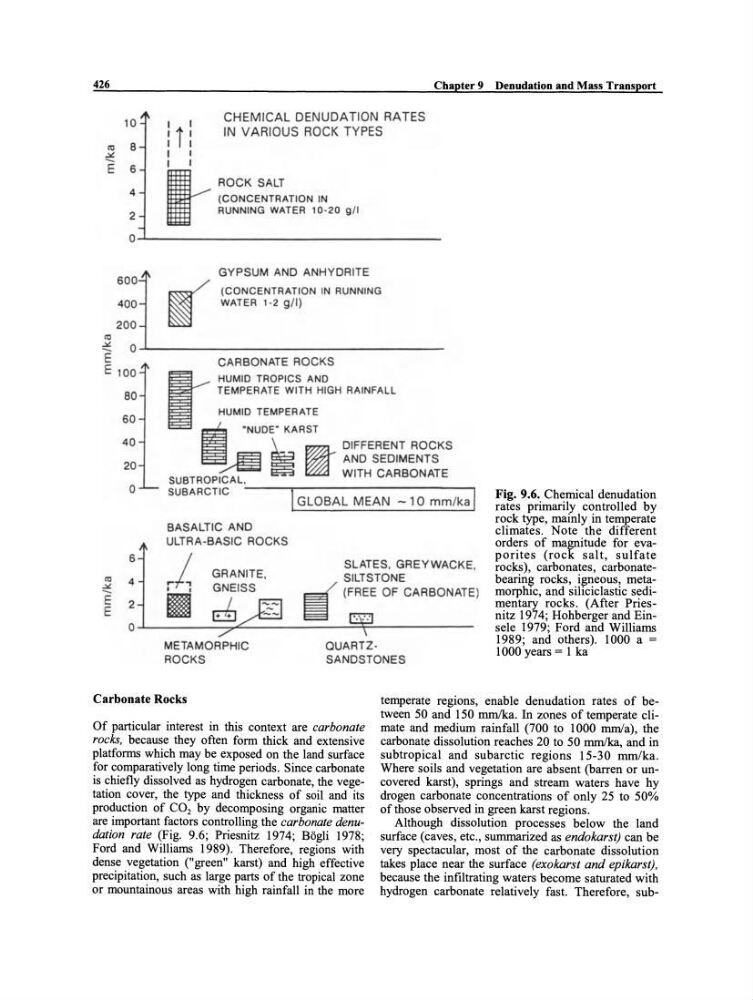
Fig. 9.6. Chemical denudation
rates primarily controlled by
rock type, mainly in temperate
climates. Note the different
orders of magnitude for evaporites (rock salt, sulfate
rocks), carbonates, carbonatebearin~ rocks, i~eous, metamorphlc, and sihciclastic sedimentary rocks. (After Priesnitz 1974; Hohberger and Einsele 1979; Ford and Williams
1989; and others). 1000 a =
1000 years = 1 ka
BASALTIC AND
ULTRA-BASIC ROCKS
6
r/,
n:J
4
.x
-I
E 2
E
0
METAMORPHIC
QUARTZROCKS
SANDSTONES
Carbonate Rocks
Of particular interest in this context are carbonate
rocks, because they often form thick and extensive
platforms which may be exposed on the land surface
for comparatively long time periods. Since carbonate
is chiefly dissolved as hydrogen carbonate, the vegetation cover, the type and thickness of soil and its
production of CO 2 by decomposing organic matter
are important factors controlling the carbonate denudation rate (Fig. 9.6; Priesnitz 1974; Bögli 1978;
Ford and Williams 1989). Therefore, regions with
dense vegetation ("green" karst) and high effective
precipitation, such as large parts of the tropical zone
or mountainous areas with high rainfall in the more
temperate regions, enabledenudation rates of between 50 and 150 mmlka. In zones of temperate climate and medium rainfall (700 to 1000 mmla), the
carbonate dissolution reaches 20 to 50 mmIka, and in
subtropical and subarctic regions 15-30 mmlka.
Where soils and vegetation are absent (barren or uncovered karst), springs and stream waters have hy
drogen carbonate concentrations of only 25 to 50%
of those observed in green karst regions.
Although dissolution processes below the land
surface (caves, etc., summarized as endokarst) can be
very spectacular, most of the carbonate dissolution
takes place near the surface (exokarst and epikarst),
because the infiltrating waters become saturated with
hydrogen carbonate relatively fast. Therefore, sub-
Chapter 9 Denudation and Mass Transport
10
I i I
I
I
CHEMICAL DENUDATION RATES
IN VARIOUS ROCK TYPES
n:J
.x
-- E
n:J
6
6
4
2
0
600
400
200
I
I
I
I
I
I
t
ROCK SALT
(CONCENTRATION IN
RUNNING WATER 10-20 g/l
GYPSUM AND ANHYDRITE
(CONCENTRATION IN RUNNING
WATER 1-2 9/1)
~E O~----------------------------------CARBONATE ROCKS
80
TEMPERATE WITH HIGH RAINFAll
E 100
t HUMID TROPICS AND
60
HUMID TEMPERATE
•
"NUDE" KARST
40
~ ~ DIFFERENT ROCKS
:iI 19
AND SEDIMENTS
20
~
SUBTROPICAl.,--____ -.-_ _ _ W_IT_H_C_A_R_B_O_N_Ä_:T_E_-,
o
SUBARCTIC -
1
I
GLOBAL MEAN - 10mmIka
Fig. 9.6. Chemical denudation
rates primarily controlled by
rock type, mainly in temperate
climates. Note the different
orders of magnitude for evaporites (rock salt, sulfate
rocks), carbonates, carbonatebearin~ rocks, i~eous, metamorphlc, and sihciclastic sedimentary rocks. (After Priesnitz 1974; Hohberger and Einsele 1979; Ford and Williams
1989; and others). 1000 a =
1000 years = 1 ka
BASALTIC AND
ULTRA-BASIC ROCKS
6
r/,
n:J
4
.x
-I
E 2
E
0
METAMORPHIC
QUARTZROCKS
SANDSTONES
Carbonate Rocks
Of particular interest in this context are carbonate
rocks, because they often form thick and extensive
platforms which may be exposed on the land surface
for comparatively long time periods. Since carbonate
is chiefly dissolved as hydrogen carbonate, the vegetation cover, the type and thickness of soil and its
production of CO 2 by decomposing organic matter
are important factors controlling the carbonate denudation rate (Fig. 9.6; Priesnitz 1974; Bögli 1978;
Ford and Williams 1989). Therefore, regions with
dense vegetation ("green" karst) and high effective
precipitation, such as large parts of the tropical zone
or mountainous areas with high rainfall in the more
temperate regions, enabledenudation rates of between 50 and 150 mmlka. In zones of temperate climate and medium rainfall (700 to 1000 mmla), the
carbonate dissolution reaches 20 to 50 mmIka, and in
subtropical and subarctic regions 15-30 mmlka.
Where soils and vegetation are absent (barren or uncovered karst), springs and stream waters have hy
drogen carbonate concentrations of only 25 to 50%
of those observed in green karst regions.
Although dissolution processes below the land
surface (caves, etc., summarized as endokarst) can be
very spectacular, most of the carbonate dissolution
takes place near the surface (exokarst and epikarst),
because the infiltrating waters become saturated with
hydrogen carbonate relatively fast. Therefore, sub-