

8.3 Rift Basin Models and Observed Subsidence
a
OCEANIC
CRUST
409
NOVERTICAL
EXAGGERATION
o
and lower erost were redueed in a way similar to that
shown in Fig. 8.15a,b. In a transeet through this passive margin, post-rift subsidenee inereased seaward
until it reaehed a similar amount (up to 4 km) as the
oeeanie crost at the continental-oceanic erost boundary (cf. Fig. 8.14c and 8.15c; see also Le Pichot and
Sibuet 1982; Chenet et al. 1983). Most of the postrift subsidenee can be attributed to eooling of the
lithosphere, whieh was previowdy thinned during the
rifting phase.
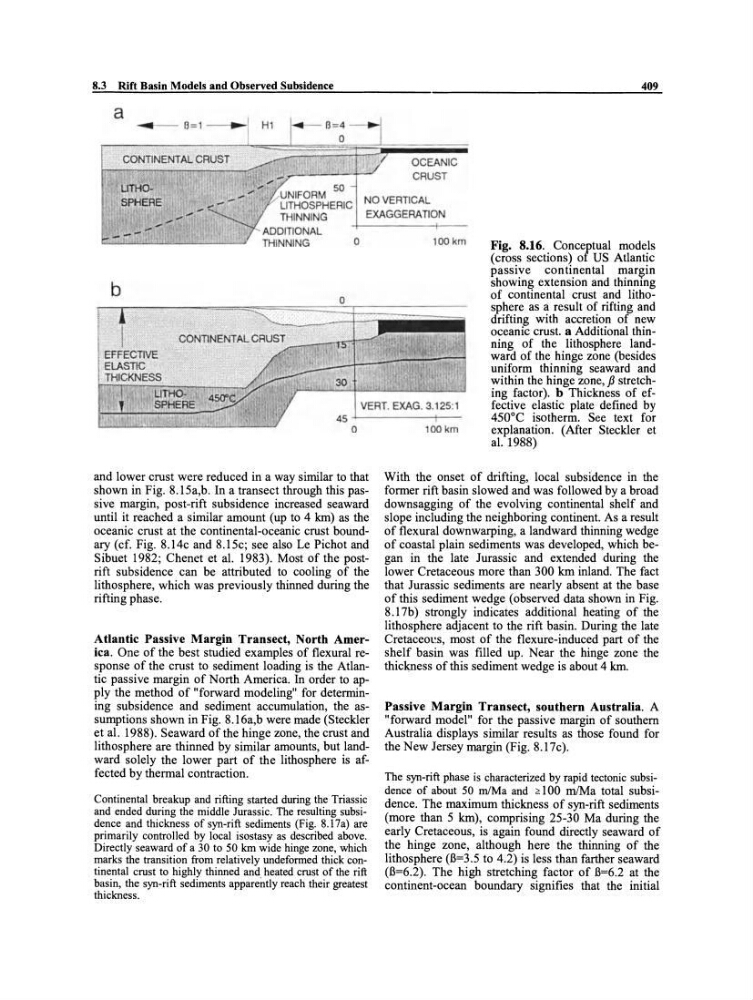
Atlantic Passive Margin Transect, North America. One of the best studied examples of flexural response of the erost to sediment loading is the Atlantie passive margin of North Ameriea. In order to apply the method of "forward modeling" for determining subsidenee and sediment aeeumulation, the assumptions shown in Fig. 8.16a,b were made (Steekler
et al. 1988). Seaward of the hinge zone, the erost and
lithosphere are thinned by similar amounts, but landward solely the lower part of the lithosphere is affected by thermal eontraetion.
Continental breakup and rifting started during the Triassic
and ended during the middle Jurassic. The resulting subsidenee and thiekness of syn-rift sediments (Fig. 8.17a) are
primarily controlled by loeal isostasy as described above.
Direetly seaward of a 30 to 50 km wide hinge zone, whieh
marks the transition from relatively undeformed thiek continental ernst to highly thinned and heated crnst of the rift
basin, the syn-rift sediments apparently reaeh their greatest
thickness.
100 km
Fig. 8.16. Conceptual models
(cross sections) of US Atlantic
passive continental margin
showing extension and thinning
of continental crnst and lithosphere as a result of rifting and
drifting with accretion of new
oceanic crnst. a Additional thinning of the lithosphere landward of the hinge zone (besides
uniform thinning seaward and
within the hinge zone, ß stretching factor). b Thickness of effective elastic plate defined by
450°C isotherm. See text for
explanation. (After Steckler et
al. 1988)
With the onset of drifting, local subsidenee in the
former rift basin slowed and was followed by a broad
downsagging of the evolving eontinental shelf and
slope inc1uding the neighboring continent. As a result
of flexural downwarping, alandward thinning wedge
of coastal plain sediments was developed, which began in the late Jurassie and extended during the
lower Cretaeeous more than 300 km inland. The fact
that Jurassie sediments are nearly absent at the base
of this sediment wedge (observed data shown in Fig.
8 .17b) strongly indicates additional heating of the
lithosphere adjaeent to the rift basin. During the late
Cretaeeoes, most of the flexure-indueed part of the
shelf basin was filled up. Near the hinge zone the
thickness of this sediment wedge is ab out 4 km.
Passive Margin Transect, southern Australia. A
"forward model" for the passive margin of southem
Australia displays similar results as those found for
the New Jersey margin (Fig. 8.17e).
The syn-rift phase is eharaeterized by rapid tectonic subsidence of about 50 rnIMa and ~ 100 mlMa total subsidence. The maximum thickness of syn-rift sediments
(more than 5 km), comprising 25-30 Ma during the
early Cretaeeous, is again found directly seaward of
the hinge zone, although here the thinning of the
lithosphere (ß=3.5 to 4.2) is less than farther seaward
(ß=6.2). The high stretching factor of ß=6.2 at the
eontinent-ocean boundary signifies that the initial
a
OCEANIC
CRUST
409
NOVERTICAL
EXAGGERATION
o
and lower erost were redueed in a way similar to that
shown in Fig. 8.15a,b. In a transeet through this passive margin, post-rift subsidenee inereased seaward
until it reaehed a similar amount (up to 4 km) as the
oeeanie crost at the continental-oceanic erost boundary (cf. Fig. 8.14c and 8.15c; see also Le Pichot and
Sibuet 1982; Chenet et al. 1983). Most of the postrift subsidenee can be attributed to eooling of the
lithosphere, whieh was previowdy thinned during the
rifting phase.
Atlantic Passive Margin Transect, North America. One of the best studied examples of flexural response of the erost to sediment loading is the Atlantie passive margin of North Ameriea. In order to apply the method of "forward modeling" for determining subsidenee and sediment aeeumulation, the assumptions shown in Fig. 8.16a,b were made (Steekler
et al. 1988). Seaward of the hinge zone, the erost and
lithosphere are thinned by similar amounts, but landward solely the lower part of the lithosphere is affected by thermal eontraetion.
Continental breakup and rifting started during the Triassic
and ended during the middle Jurassic. The resulting subsidenee and thiekness of syn-rift sediments (Fig. 8.17a) are
primarily controlled by loeal isostasy as described above.
Direetly seaward of a 30 to 50 km wide hinge zone, whieh
marks the transition from relatively undeformed thiek continental ernst to highly thinned and heated crnst of the rift
basin, the syn-rift sediments apparently reaeh their greatest
thickness.
100 km
Fig. 8.16. Conceptual models
(cross sections) of US Atlantic
passive continental margin
showing extension and thinning
of continental crnst and lithosphere as a result of rifting and
drifting with accretion of new
oceanic crnst. a Additional thinning of the lithosphere landward of the hinge zone (besides
uniform thinning seaward and
within the hinge zone, ß stretching factor). b Thickness of effective elastic plate defined by
450°C isotherm. See text for
explanation. (After Steckler et
al. 1988)
With the onset of drifting, local subsidenee in the
former rift basin slowed and was followed by a broad
downsagging of the evolving eontinental shelf and
slope inc1uding the neighboring continent. As a result
of flexural downwarping, alandward thinning wedge
of coastal plain sediments was developed, which began in the late Jurassie and extended during the
lower Cretaeeous more than 300 km inland. The fact
that Jurassie sediments are nearly absent at the base
of this sediment wedge (observed data shown in Fig.
8 .17b) strongly indicates additional heating of the
lithosphere adjaeent to the rift basin. During the late
Cretaeeoes, most of the flexure-indueed part of the
shelf basin was filled up. Near the hinge zone the
thickness of this sediment wedge is ab out 4 km.
Passive Margin Transect, southern Australia. A
"forward model" for the passive margin of southem
Australia displays similar results as those found for
the New Jersey margin (Fig. 8.17e).
The syn-rift phase is eharaeterized by rapid tectonic subsidence of about 50 rnIMa and ~ 100 mlMa total subsidence. The maximum thickness of syn-rift sediments
(more than 5 km), comprising 25-30 Ma during the
early Cretaeeous, is again found directly seaward of
the hinge zone, although here the thinning of the
lithosphere (ß=3.5 to 4.2) is less than farther seaward
(ß=6.2). The high stretching factor of ß=6.2 at the
eontinent-ocean boundary signifies that the initial