

408
Chapter 8 Subsidence
RIFTING
b
EXTENSION OF BRITTLE UPPER CRUST
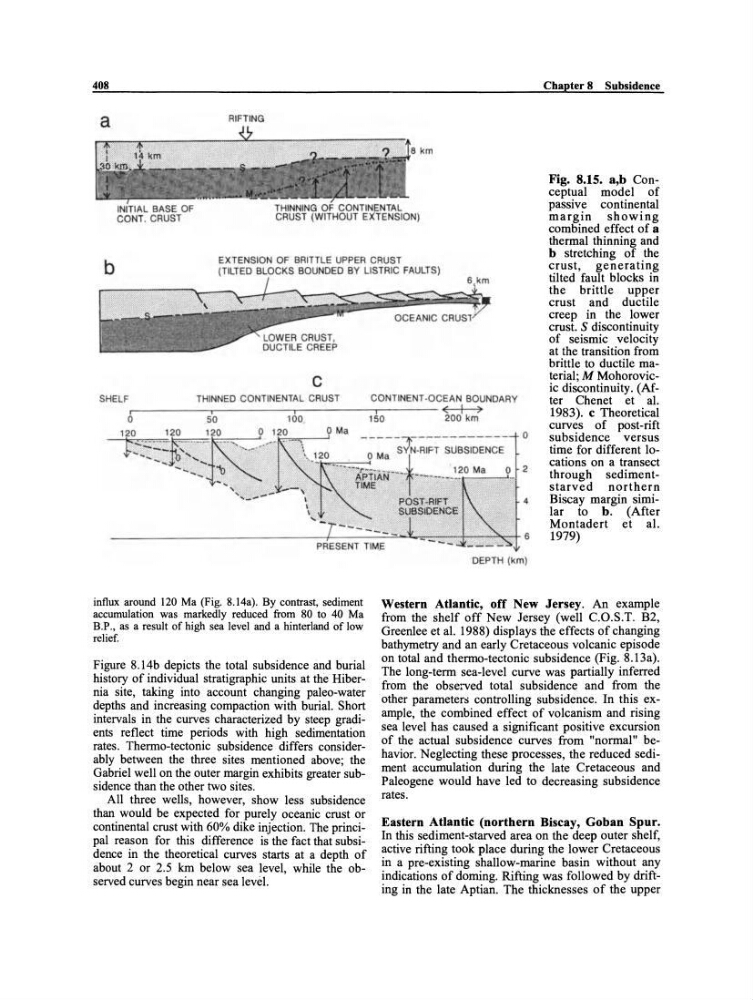
Fig. 8.15. a,b Coneeptual model of
passive continental
margin showing
eombined effect of a
thermal thinning and
b stretching of the
crust, generating
tilted fault blocks in
the brittle upper
erust and ductile
ereep in the lower
crust. S discontinuity
of seismic velocity
at the transition from
brittle to ductile material; M Mohorovicic discontinuity. (After Chenet et al.
1983). c Theoretical
curves of post-rift
subsidence versus
time for different 10cations on a transect
through sedimentstarved northern
Biscay margin similar to b. (After
Montadert et al.
1979)
(TILTEO BLOCKS BOUNOEO BY LlSTRIC FAULTS)
OCEANIC
C
SHELF
THINNEO CONTINENTAL CRUST
CONTINENT ·OCEAN BOUNDARY
0 " - - -- - - , ' , - -- - - -1'0· -0. - - - -- -.-1 - - - - (
I )
50
150
200 km
influx aro~nd 120 Ma (Fig. 8.14a). By contrast, sediment
accumulatlOn was markedly reduced from 80 to 40 Ma
B.P., as a result of high sea level and a hinterland of low
relief.
Figure 8.l4b depiets the total subsidenee and burial
history of individual stratigraphie units at the Hibernia site, taking into aeeount changing paleo-water
depths and inereasing eompaetion with burial. Short
intervals in th.e eurve~ eharacterized by steep gradients refleet time penods with high sedimentation
rates. Thermo-teetonie subsidenee differs eonsiderably between the three sites mentioned above' the
~abriel weIl on the outer rnargin exhibits greater' subsldenee than the other two sites.
All three wells, however, show less subsidence
than. would be expeeted for purely oeeanic erust or
contmental erust with 60% dike injection. The prineipal reason for this difference is the fact that subsidence in the theoretical eurves starts at a depth of
about 2 or 2.5 km below sea level, while the observed eurves begin near sea level.
OEPTH (km)
Western Atlantic, off New Jersey. An example
from the shelf off New Jersey (weIl C.O.S.T. B2,
Greenlee et al. 1988) displays the effeets of changing
bathymetry and an early Cretaeeous volcanie episode
on total and thermo-teetonie subsidenee (Fig. 8.13a).
The long-term sea-level eurve was partially inferred
from the observed total subsidenee and from the
other parameters controlling subsidence. In this example, the eombined effeet of volcanism and rising
sea level has eaused a signifieant positive exeursion
of the aetual subsidenee eurves from "normal" behavior. Negleeting these processes, the redueed sediment aeeumulation during the late Cretaeeous and
Paleogene would have led to deereasing subsidenee
rates.
Eastern Atlantic (northern Biscay Goban Spur.
In this sediment-starved area on the deep outer shelf
aetive rifting took plaee during the lower Cretaeeou~
~n ~ p~e-existing shallow-rnarine basin without any
~ndl~atlOns of doming. Rifting was followed by driftmg m the late Aptian. The thieknesses of the upper
Chapter 8 Subsidence
RIFTING
b
EXTENSION OF BRITTLE UPPER CRUST
Fig. 8.15. a,b Coneeptual model of
passive continental
margin showing
eombined effect of a
thermal thinning and
b stretching of the
crust, generating
tilted fault blocks in
the brittle upper
erust and ductile
ereep in the lower
crust. S discontinuity
of seismic velocity
at the transition from
brittle to ductile material; M Mohorovicic discontinuity. (After Chenet et al.
1983). c Theoretical
curves of post-rift
subsidence versus
time for different 10cations on a transect
through sedimentstarved northern
Biscay margin similar to b. (After
Montadert et al.
1979)
(TILTEO BLOCKS BOUNOEO BY LlSTRIC FAULTS)
OCEANIC
C
SHELF
THINNEO CONTINENTAL CRUST
CONTINENT ·OCEAN BOUNDARY
0 " - - -- - - , ' , - -- - - -1'0· -0. - - - -- -.-1 - - - - (
I )
50
150
200 km
influx aro~nd 120 Ma (Fig. 8.14a). By contrast, sediment
accumulatlOn was markedly reduced from 80 to 40 Ma
B.P., as a result of high sea level and a hinterland of low
relief.
Figure 8.l4b depiets the total subsidenee and burial
history of individual stratigraphie units at the Hibernia site, taking into aeeount changing paleo-water
depths and inereasing eompaetion with burial. Short
intervals in th.e eurve~ eharacterized by steep gradients refleet time penods with high sedimentation
rates. Thermo-teetonie subsidenee differs eonsiderably between the three sites mentioned above' the
~abriel weIl on the outer rnargin exhibits greater' subsldenee than the other two sites.
All three wells, however, show less subsidence
than. would be expeeted for purely oeeanic erust or
contmental erust with 60% dike injection. The prineipal reason for this difference is the fact that subsidence in the theoretical eurves starts at a depth of
about 2 or 2.5 km below sea level, while the observed eurves begin near sea level.
OEPTH (km)
Western Atlantic, off New Jersey. An example
from the shelf off New Jersey (weIl C.O.S.T. B2,
Greenlee et al. 1988) displays the effeets of changing
bathymetry and an early Cretaeeous volcanie episode
on total and thermo-teetonie subsidenee (Fig. 8.13a).
The long-term sea-level eurve was partially inferred
from the observed total subsidenee and from the
other parameters controlling subsidence. In this example, the eombined effeet of volcanism and rising
sea level has eaused a signifieant positive exeursion
of the aetual subsidenee eurves from "normal" behavior. Negleeting these processes, the redueed sediment aeeumulation during the late Cretaeeous and
Paleogene would have led to deereasing subsidenee
rates.
Eastern Atlantic (northern Biscay Goban Spur.
In this sediment-starved area on the deep outer shelf
aetive rifting took plaee during the lower Cretaeeou~
~n ~ p~e-existing shallow-rnarine basin without any
~ndl~atlOns of doming. Rifting was followed by driftmg m the late Aptian. The thieknesses of the upper