

2.2 Fluvial Sediments
consist predominantly of overbank fines or, in humid
climates, of backswamp and lacustrine muds.
Some authors also separate gravel-dominated systems
from sandy fluvial systems, because grain size is an
important indicator of relief (that is, tectonic activity)
as well as climate in the source area. High relief and
arid or periglacial/paraglacial conditions favor the
production of coarse-grained materials and the primary
input into the different fluvial transport systems. In
addition, the resistivity of source rocks exposed to
weathering and erosion processes also plays an important role (cf. Sect. 9.3).
In ancient fluvial sediments, it is usually very difficult to
reconstruct the former paleo-channel systems and their
sinuosity from outcrops in the field, unless many large
exposures can be studied. Today, 3 D seismic records can
reveal ancient channel systems. If these means are not
available, it is of some use to analyse the proportions of
bedload and suspended load in the channel fills and in the
total flood basin to determine the mode of sediment transport.
However, this method has its !imitations, and consequently
many workers have attempted to improve the facies analysis
of ancient fluvial environments through other means.
The simplest approach is to subdivide the sedimentary fill
of a fluvial basin into channel sediments and finer-grained
overbank or floodplain deposits. This can be done in systems
where the difference in grain sizes between these two
subenvironments is sufficiently large. A general trend in the
relationship between these two principal facies types is
shown in Fig, 2.7. Thus, for example different types of
31
sandstone reservoir geometries can be distinguished (Fig.
2.8a). One should use caution. however, when deducing
subsurface channel distribution and geometry from the
present-day, active channel type (Fig. 2.8b).
2.2.3 Minor Bed Forms and Sedimentary
Structures
Based on direct observations in present-day streams
and on experimental studies in flumes, the relationship
between hydrodynarnic regime, erosion, sediment
transport, and accumulation is fairly well established.
This allows the prediction of the behavior of particles
of different size, density, and shape, as well as the formation of minor bed forms and their internal
sedimentary structures. The latter are controlled bythe
so-called flow regime (Fig. 2.9).
Erosion at the river bed and particle transport begin
at a certain critical current velocity. In the lower flow
regime, mud is carried rapidly away in suspension,
while fine to medium sand migrates slowly along the
river bed forrning ripples or a plane bed. Gravel is
transported only ifthe current reaches velocities higher
than 70 to 120 crnls (upper flow regime). Then, sand
and gravel can move simultaneously. The resulting
deposits are either horizontally stratified or planar
cross-bedded gravelly sands or, if most of the sand has
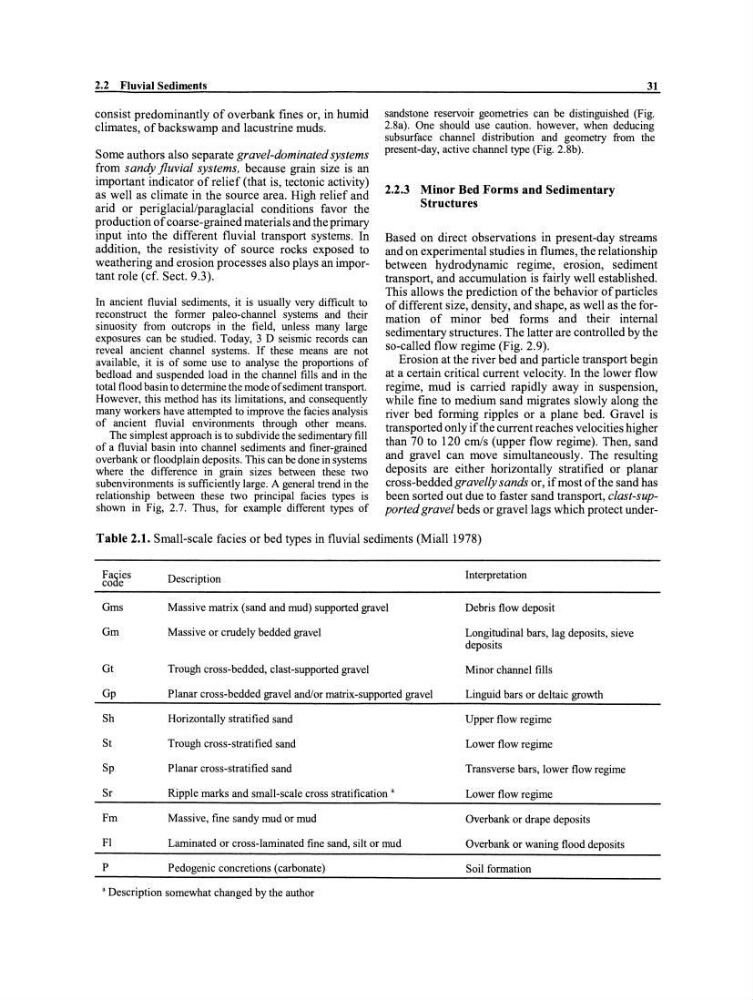
been sorted out due to faster sand transport, clast-supported gravel beds or gravellags which protect underTable 2.1. Small-scale facies or bed types in fluvial sediments (Miall 1978)
Facies
code
Gms
Gm
Gt
Gp
Sh
St
Sp
Sr
Fm
Fl
P
Description
Massive matrix (sand and mud) supported gravel
Massive or crudely bedded gravel
Trough cross-bedded, clast-supported gravel
Planar cross-bedded gravel and/or matrix-supported gravel
Horizontally stratified sand
Trough cross-stratified sand
Planar cross-stratified sand
Ripple marks and small-scale cross stratification a
Massive, fine sandy mud or mud
Laminated or cross-laminated fine sand, silt or mud
Pedogenic concretions (carbonate)
a Description somewhat changed by the author
Interpretation
Debris flow deposit
Longitudinal bars, lag deposits, sieve
deposits
Minor channel fills
Linguid bars or deltaic growth
Upper flow regime
Lower flow regime
Transverse bars, lower flow regime
Lower flow regime
Overbank or drape deposits
Overbank or waning flood deposits
Soil formation
consist predominantly of overbank fines or, in humid
climates, of backswamp and lacustrine muds.
Some authors also separate gravel-dominated systems
from sandy fluvial systems, because grain size is an
important indicator of relief (that is, tectonic activity)
as well as climate in the source area. High relief and
arid or periglacial/paraglacial conditions favor the
production of coarse-grained materials and the primary
input into the different fluvial transport systems. In
addition, the resistivity of source rocks exposed to
weathering and erosion processes also plays an important role (cf. Sect. 9.3).
In ancient fluvial sediments, it is usually very difficult to
reconstruct the former paleo-channel systems and their
sinuosity from outcrops in the field, unless many large
exposures can be studied. Today, 3 D seismic records can
reveal ancient channel systems. If these means are not
available, it is of some use to analyse the proportions of
bedload and suspended load in the channel fills and in the
total flood basin to determine the mode of sediment transport.
However, this method has its !imitations, and consequently
many workers have attempted to improve the facies analysis
of ancient fluvial environments through other means.
The simplest approach is to subdivide the sedimentary fill
of a fluvial basin into channel sediments and finer-grained
overbank or floodplain deposits. This can be done in systems
where the difference in grain sizes between these two
subenvironments is sufficiently large. A general trend in the
relationship between these two principal facies types is
shown in Fig, 2.7. Thus, for example different types of
31
sandstone reservoir geometries can be distinguished (Fig.
2.8a). One should use caution. however, when deducing
subsurface channel distribution and geometry from the
present-day, active channel type (Fig. 2.8b).
2.2.3 Minor Bed Forms and Sedimentary
Structures
Based on direct observations in present-day streams
and on experimental studies in flumes, the relationship
between hydrodynarnic regime, erosion, sediment
transport, and accumulation is fairly well established.
This allows the prediction of the behavior of particles
of different size, density, and shape, as well as the formation of minor bed forms and their internal
sedimentary structures. The latter are controlled bythe
so-called flow regime (Fig. 2.9).
Erosion at the river bed and particle transport begin
at a certain critical current velocity. In the lower flow
regime, mud is carried rapidly away in suspension,
while fine to medium sand migrates slowly along the
river bed forrning ripples or a plane bed. Gravel is
transported only ifthe current reaches velocities higher
than 70 to 120 crnls (upper flow regime). Then, sand
and gravel can move simultaneously. The resulting
deposits are either horizontally stratified or planar
cross-bedded gravelly sands or, if most of the sand has
been sorted out due to faster sand transport, clast-supported gravel beds or gravellags which protect underTable 2.1. Small-scale facies or bed types in fluvial sediments (Miall 1978)
Facies
code
Gms
Gm
Gt
Gp
Sh
St
Sp
Sr
Fm
Fl
P
Description
Massive matrix (sand and mud) supported gravel
Massive or crudely bedded gravel
Trough cross-bedded, clast-supported gravel
Planar cross-bedded gravel and/or matrix-supported gravel
Horizontally stratified sand
Trough cross-stratified sand
Planar cross-stratified sand
Ripple marks and small-scale cross stratification a
Massive, fine sandy mud or mud
Laminated or cross-laminated fine sand, silt or mud
Pedogenic concretions (carbonate)
a Description somewhat changed by the author
Interpretation
Debris flow deposit
Longitudinal bars, lag deposits, sieve
deposits
Minor channel fills
Linguid bars or deltaic growth
Upper flow regime
Lower flow regime
Transverse bars, lower flow regime
Lower flow regime
Overbank or drape deposits
Overbank or waning flood deposits
Soil formation