

8.1 General Mechanisms
~- ~~~~~~~~~~~~~~~~~~.
I
I
z
I
I
~~O
TEMPERATURE
1350 0 C
- - - - r-----+----:~
DEPTH
391
LATERAL LOSS OF HEAT
ß· b - - -
plate thickness, he, is relatively thin during or shortly after
a major thermal event, but increases substantially with age
after this event. The mechanical properties of both oceanic
and continentallithospheres appear to be similar.
Furthermore, the vertical displacement of the bending
crust from its original elevation is affected by the densities
of the underlying viscous mantle material and, if present,
the overlying water body or sediments (see, e.g., Bott 1982;
Watts et al. 1982). The resultant of these two effects is an
upward pressure or an additional buoyant resistance of the
asthenosphere to the bending. The mathematical treatment
ofthese combined mechanisms for locations at various horizontal distances away from the load is rather complicate.
Therefore, only some results of such calculations can be
discussed here.
" """
--~:_ _ ~_L
"J..
DEPTH
. . ..... ~
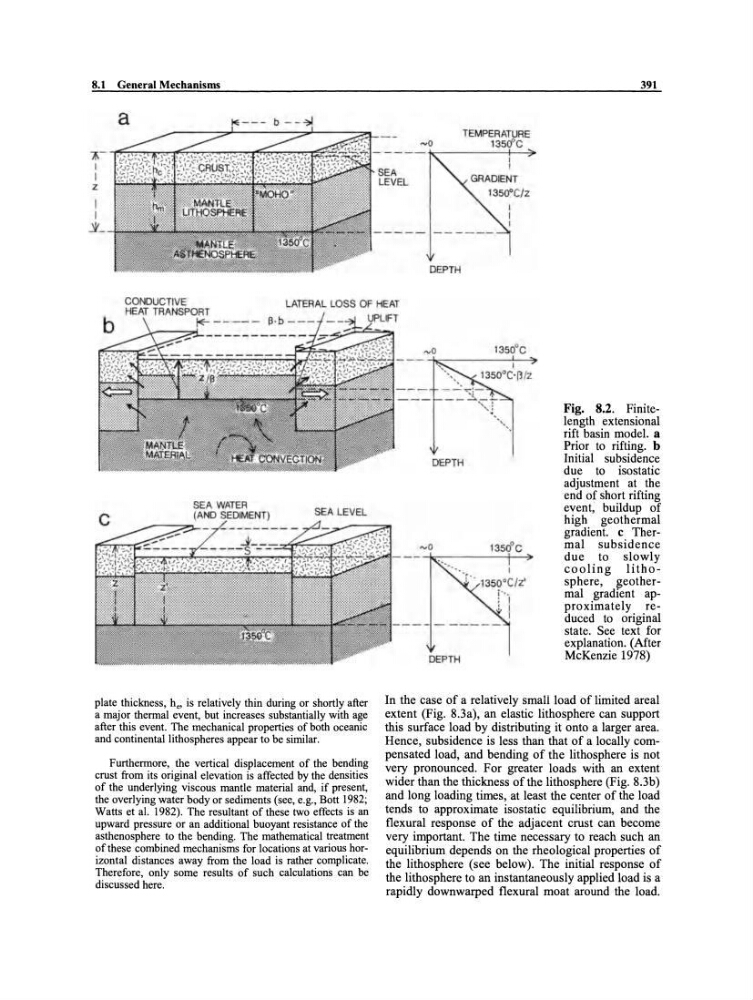
Fig. 8.2. Finitelength extensional
rift basin model. a
Prior to rifting. b
Initial subsidence
due to isostatic
adjustment at the
end of short rifting
event, buildup of
high geothermal
gradient. c Thermal subsidence
due to slowly
cooling lithosphere, geothermal gradient approximately reduced to original
state. See text for
explanation. (After
McKenzie 1978)
In the case of a relatively small load of limited areal
extent (Fig. 8.3a), an elastic lithosphere can support
this surface load by distributing it onto a larger area.
Hence, subsidence is less than that of a locally compensated load, and bending of the lithosphere is not
very pronounced. For greater loads with an extent
wider than the thickness ofthe lithosphere (Fig. 8.3b)
and long loading times,at least the center of the load
tends to approximate isostatic equilibrium, and the
flexural response of the adjacent crnst can become
very important. The time necessary to reach such an
equilibrium depends on the rheological properties of
the lithosphere (see below). The initial response of
the lithosphere to an instantaneously applied load is a
rapidly downwarped flexural moat around the load.
~- ~~~~~~~~~~~~~~~~~~.
I
I
z
I
I
~~O
TEMPERATURE
1350 0 C
- - - - r-----+----:~
DEPTH
391
LATERAL LOSS OF HEAT
ß· b - - -
plate thickness, he, is relatively thin during or shortly after
a major thermal event, but increases substantially with age
after this event. The mechanical properties of both oceanic
and continentallithospheres appear to be similar.
Furthermore, the vertical displacement of the bending
crust from its original elevation is affected by the densities
of the underlying viscous mantle material and, if present,
the overlying water body or sediments (see, e.g., Bott 1982;
Watts et al. 1982). The resultant of these two effects is an
upward pressure or an additional buoyant resistance of the
asthenosphere to the bending. The mathematical treatment
ofthese combined mechanisms for locations at various horizontal distances away from the load is rather complicate.
Therefore, only some results of such calculations can be
discussed here.
" """
--~:_ _ ~_L
"J..
DEPTH
. . ..... ~
Fig. 8.2. Finitelength extensional
rift basin model. a
Prior to rifting. b
Initial subsidence
due to isostatic
adjustment at the
end of short rifting
event, buildup of
high geothermal
gradient. c Thermal subsidence
due to slowly
cooling lithosphere, geothermal gradient approximately reduced to original
state. See text for
explanation. (After
McKenzie 1978)
In the case of a relatively small load of limited areal
extent (Fig. 8.3a), an elastic lithosphere can support
this surface load by distributing it onto a larger area.
Hence, subsidence is less than that of a locally compensated load, and bending of the lithosphere is not
very pronounced. For greater loads with an extent
wider than the thickness ofthe lithosphere (Fig. 8.3b)
and long loading times,at least the center of the load
tends to approximate isostatic equilibrium, and the
flexural response of the adjacent crnst can become
very important. The time necessary to reach such an
equilibrium depends on the rheological properties of
the lithosphere (see below). The initial response of
the lithosphere to an instantaneously applied load is a
rapidly downwarped flexural moat around the load.