

332
Chapter 7 Sequences, Minor Cycles, and Event Stratigraphy
CARBONATE RAMPS
b HUMID
-DEEP RAMP
FACIES
- - -.
SEDIMENT
RATE
-- __
EXPOSED RAMP
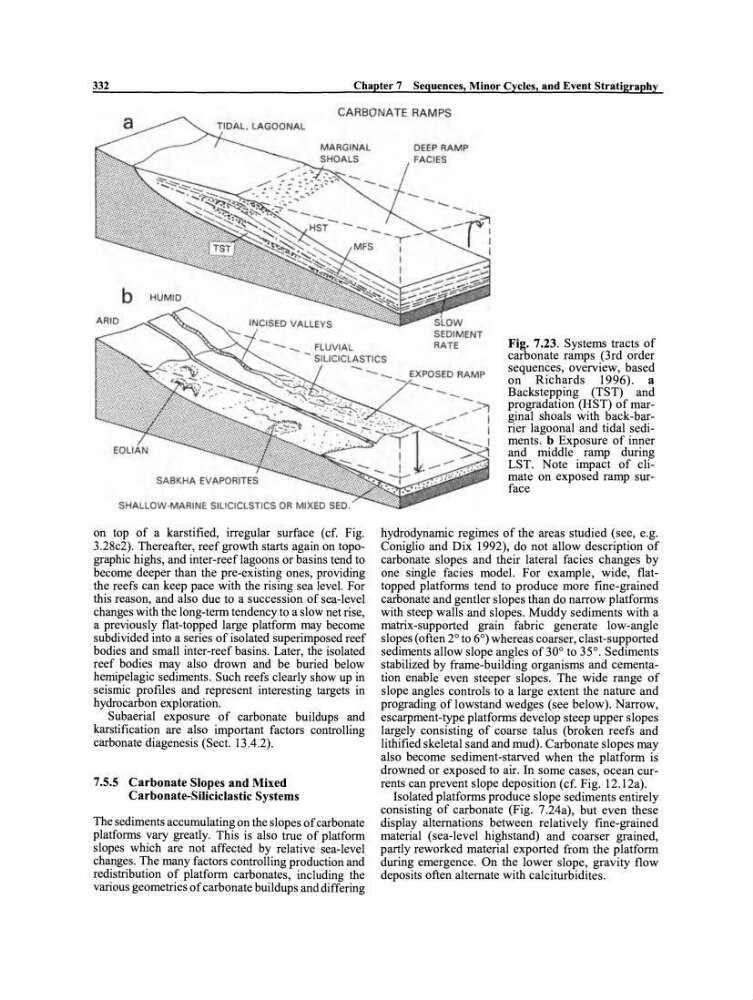
Fig. 7.23. Systems tracts of
carbonate ramps (3rd order
sequences, overview, based
on Richards 1996). a
Backstepping (TST) and
progradation (RST) of marginal shoals with back-barrier lagoonal and tidal sediments. b Exposure of inner
and middle ramp during
LST. Note impact of cJimate on exposed ramp surface
SHALLOW-MARINE $ILlCICLSTICS OR MIXED SED.
on top of a karstified, irregular surface (cf. Fig.
3.28c2). Thereafter, reef growth starts again on topographic highs, and inter-reef lagoons or basins tend to
become deeper than the pre-existing ones, providing
the reefs can keep pace with the rising sea level. For
this reason, and also due to a succession of sea-level
changes with the long-term tendency to a slow net rise,
a previously flat-topped large platform may become
subdivided into aseries of isolated superimposed reef
bodies and small inter-reef basins. Later, the isolated
reef bodies mayaiso drown and be buried below
hemipelagic sediments. Such reefs clearly show up in
seismic profiles and represent interesting targets in
hydrocarbon exploration.
Subaerial exposure of carbonate buildups and
karstification are also important factors controlling
carbonate diagenesis (Sect. l3.4.2).
7.5.5 Carbonate Siopes and Mixed
Carbonate-Siliciclastic Systems
The sediments accumulating on the slopes of carbonate
platforms vary greatly. This is also true of platform
slopes which are not affected by relative sea-level
changes. The many factors controlling production and
redistribution of platform carbonates, including the
various geometries of carbonate buildups and differing
-- -. ..... ~
I
I
hydrodynamic regimes of the areas studied (see, e.g.
Coniglio and Dix 1992), do not allow description of
carbonate slopes and their lateral facies changes by
one single facies model. For example, wide, flattopped platforms tend to produce more fine-grained
carbonate and gentIer slopes than do narrow platforms
with steep walls and slopes. Muddy sediments with a
matrix-supported grain fabric generate low-angle
slopes (often 2° to 6°) whereas coarser, cJast-supported
sediments allow slope angles of30° to 35°. Sediments
stabilized by fraine-building organisms and cementation enable even steeper slopes. The wide range of
slope angles controls to a large extent the nature and
prograding of lowstand wedges (see below). Narrow,
escarpment-type platforms develop steep upper slopes
largely consisting of coarse talus (broken reefs and
lithified skeletal sand and mud). Carbonate slopes may
also become sediment-starved when the platform is
drowned or exposed to air. In some cases, ocean currents can prevent slope deposition (cf. Fig. 12.12a).
Isolated platforms produce slope sediments entirely
consisting of carbonate (Fig. 7.24a), but even these
displayalternations between relatively fine-grained
material (sea-Ievel highstand) and coarser grained,
partly reworked material exported from the platform
during emergence. On the lower slope, gravity flow
deposits often alternate with calciturbidites.
Chapter 7 Sequences, Minor Cycles, and Event Stratigraphy
CARBONATE RAMPS
b HUMID
-DEEP RAMP
FACIES
- - -.
SEDIMENT
RATE
-- __
EXPOSED RAMP
Fig. 7.23. Systems tracts of
carbonate ramps (3rd order
sequences, overview, based
on Richards 1996). a
Backstepping (TST) and
progradation (RST) of marginal shoals with back-barrier lagoonal and tidal sediments. b Exposure of inner
and middle ramp during
LST. Note impact of cJimate on exposed ramp surface
SHALLOW-MARINE $ILlCICLSTICS OR MIXED SED.
on top of a karstified, irregular surface (cf. Fig.
3.28c2). Thereafter, reef growth starts again on topographic highs, and inter-reef lagoons or basins tend to
become deeper than the pre-existing ones, providing
the reefs can keep pace with the rising sea level. For
this reason, and also due to a succession of sea-level
changes with the long-term tendency to a slow net rise,
a previously flat-topped large platform may become
subdivided into aseries of isolated superimposed reef
bodies and small inter-reef basins. Later, the isolated
reef bodies mayaiso drown and be buried below
hemipelagic sediments. Such reefs clearly show up in
seismic profiles and represent interesting targets in
hydrocarbon exploration.
Subaerial exposure of carbonate buildups and
karstification are also important factors controlling
carbonate diagenesis (Sect. l3.4.2).
7.5.5 Carbonate Siopes and Mixed
Carbonate-Siliciclastic Systems
The sediments accumulating on the slopes of carbonate
platforms vary greatly. This is also true of platform
slopes which are not affected by relative sea-level
changes. The many factors controlling production and
redistribution of platform carbonates, including the
various geometries of carbonate buildups and differing
-- -. ..... ~
I
I
hydrodynamic regimes of the areas studied (see, e.g.
Coniglio and Dix 1992), do not allow description of
carbonate slopes and their lateral facies changes by
one single facies model. For example, wide, flattopped platforms tend to produce more fine-grained
carbonate and gentIer slopes than do narrow platforms
with steep walls and slopes. Muddy sediments with a
matrix-supported grain fabric generate low-angle
slopes (often 2° to 6°) whereas coarser, cJast-supported
sediments allow slope angles of30° to 35°. Sediments
stabilized by fraine-building organisms and cementation enable even steeper slopes. The wide range of
slope angles controls to a large extent the nature and
prograding of lowstand wedges (see below). Narrow,
escarpment-type platforms develop steep upper slopes
largely consisting of coarse talus (broken reefs and
lithified skeletal sand and mud). Carbonate slopes may
also become sediment-starved when the platform is
drowned or exposed to air. In some cases, ocean currents can prevent slope deposition (cf. Fig. 12.12a).
Isolated platforms produce slope sediments entirely
consisting of carbonate (Fig. 7.24a), but even these
displayalternations between relatively fine-grained
material (sea-Ievel highstand) and coarser grained,
partly reworked material exported from the platform
during emergence. On the lower slope, gravity flow
deposits often alternate with calciturbidites.