

330
Chapter 7 Sequences, Minor Cycles, and Event StratigraphY
a
BASIC GEOMETRIES OF
CARBONATE BUILDUPS
GRlAG < GRAIM
GR = RATE OF CARBONATE GROWTH
ACC =; RATE OF CHANGE IN ACCOMMODATION
c
CARBONATE ESCARPMENT
(NO PROGRADING)
AND TIDAL
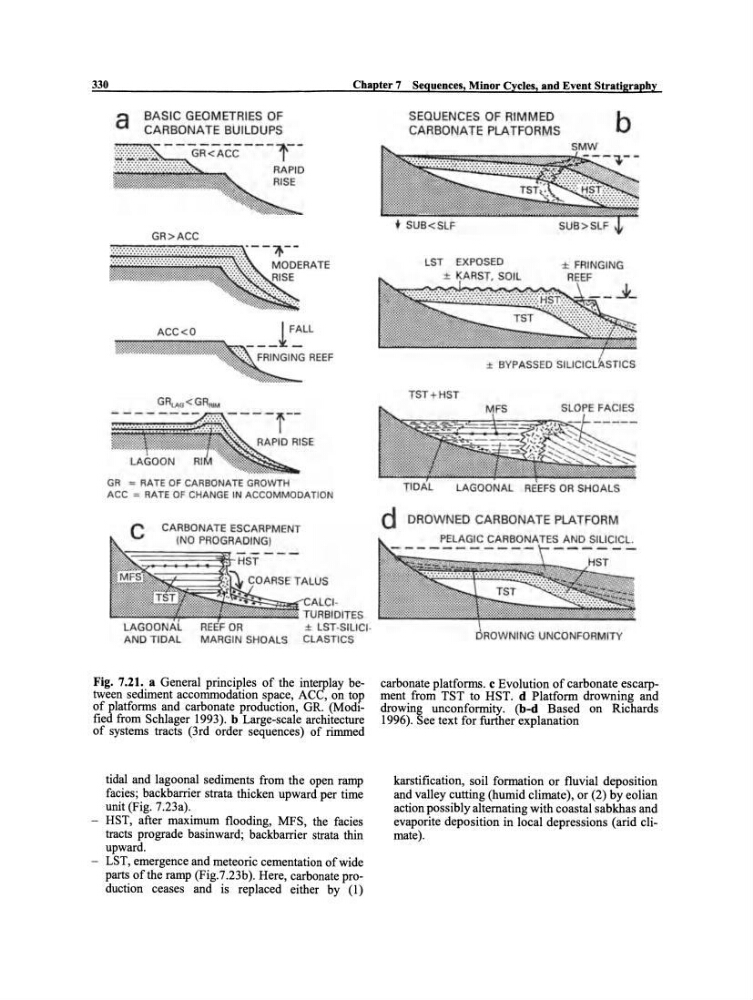
Fig. 7.21. a General principles of the interplay between sediment accommodation space, ACC, on top
of platforms and carbonate production, GR. (Modlfied from Schlager 1993). b Large-scale architecture
of systems tracts (3rd order sequences) of rimmed
tidal and lagoonal sediments from the open ramp
facies; backbarrier strata thicken upward per time
unit (Fig. 7.23a).
- HST, after maximum flooding, MFS, the facies
tracts prograde basinward; backbarrier strata thin
upward.
- LST, emergence and meteoric cementation ofwide
parts ofthe ramp (Fig.7.23b). Here, carbonate production ceases and is replaced either by (1)
SEQUENCES OF RIMMED
CARBONATE PLA TFORMS
TST+HST
b
± FRINGING
d DROWNED CARBONATE PLA TFORM
carbonate platforms. c Evolution of carbonate escarpment from TST to HST. d Platform drowning and
drowing unconformity. (b-d Based on Richards
1996). See text for further explanation
karstification, soil formation or fluvial deposition
and valley cutting (humid clirnate), or (2) by eolian
action possibly altemating with coastal sabkhas and
evaporite deposition in local depressions (arid climate).
Chapter 7 Sequences, Minor Cycles, and Event StratigraphY
a
BASIC GEOMETRIES OF
CARBONATE BUILDUPS
GRlAG < GRAIM
GR = RATE OF CARBONATE GROWTH
ACC =; RATE OF CHANGE IN ACCOMMODATION
c
CARBONATE ESCARPMENT
(NO PROGRADING)
AND TIDAL
Fig. 7.21. a General principles of the interplay between sediment accommodation space, ACC, on top
of platforms and carbonate production, GR. (Modlfied from Schlager 1993). b Large-scale architecture
of systems tracts (3rd order sequences) of rimmed
tidal and lagoonal sediments from the open ramp
facies; backbarrier strata thicken upward per time
unit (Fig. 7.23a).
- HST, after maximum flooding, MFS, the facies
tracts prograde basinward; backbarrier strata thin
upward.
- LST, emergence and meteoric cementation ofwide
parts ofthe ramp (Fig.7.23b). Here, carbonate production ceases and is replaced either by (1)
SEQUENCES OF RIMMED
CARBONATE PLA TFORMS
TST+HST
b
± FRINGING
d DROWNED CARBONATE PLA TFORM
carbonate platforms. c Evolution of carbonate escarpment from TST to HST. d Platform drowning and
drowing unconformity. (b-d Based on Richards
1996). See text for further explanation
karstification, soil formation or fluvial deposition
and valley cutting (humid clirnate), or (2) by eolian
action possibly altemating with coastal sabkhas and
evaporite deposition in local depressions (arid climate).