

7.4 Marine Deltas, Deep-Sea Fans, and Oceanic Sediments
327
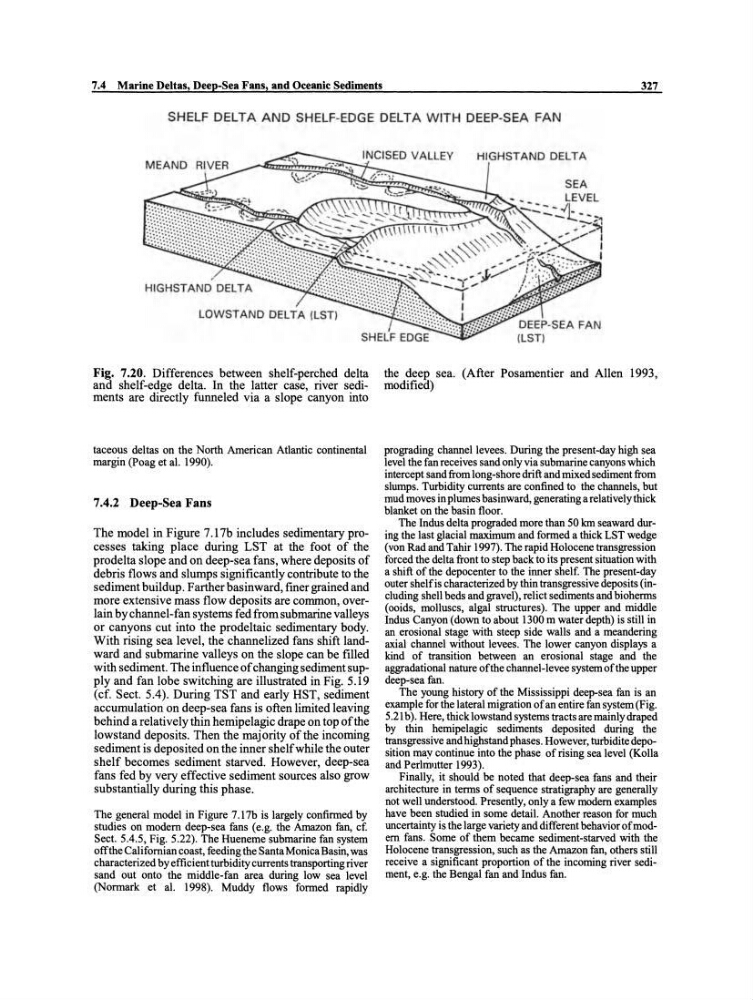
SHELF DELTA AND SHELF-EDGE DELTA WITH DEEP-SEA FAN
Fig. 7.20. Differences between shelf-perched delta
and shelf-edge delta. In the latter case, river sediments are directly funneled via a slope canyon into
taeeous deltas on the North Ameriean Atlantie eontinental
margin (Poag et al. 1990).
7.4.2 Deep-Sea Fans
The model in Figure 7.17b includes sedimentary processes taking place during LST at the foot of the
pro delta slope and on deep-sea fans, where deposits of
debris flows and slumps significantly contribute to the
sediment buildup. Farther basinward, finer grained and
more extensive mass flow deposits are common, overlain by channel-fan systems fed from submarine valleys
or canyons cut into the prodeltaic sedimentary body.
With rising sea level, the channelized fans shift landward and submarine valleys on the slope can be filled
with sediment. The influence of changing sediment supply and fan lobe switching are illustrated in Fig. 5.19
(cf. Sect. 5.4). During TST and early HST, sediment
accumulation on deep-sea fans is often limited leaving
behind a relatively thin hemipelagic drape on top ofthe
lowstand deposits. Then the rnajority ofthe incoming
sediment is deposited on the inner shelfwhile the outer
shelf becomes sediment starved. However, deep-sea
fans fed by very effective sediment sources also grow
substantially during this phase.
The general model in Figure 7.l7b is largely eonfirmed by
studies on modem deep-sea fans (e.g. the Amazon fan, cf.
Seet. 5.4.5, Fig. 5.22). The Hueneme submarine fan system
offthe Califomian eoast, feeding the Santa MonieaBasin, was
eharaeterized by effieient turbidity eurrents transporting river
sand out onto the middle-fan area during low sea level
(Normark et al. 1998). Muddy flows formed rapidly
the deep sea. (After Posamentier and Allen 1993,
modified)
prograding ehannellevees. During the present-day high sea
level the fan reeeives sand only via submarine eanyons whieh
intereept sand from long-shore drift and mixed sediment from
slumps. Turbidity eurrents are eonfined to the ehannels, but
mud moves in plumes basinward, generating a relatively thiek
blanket on the basin floor.
The Indus delta prograded more than 50 km seaward during the last glacial maximum and formed a thick LST wedge
(von Rad and Tahir 1997). The rapid Holocene transgression
foreed the delta front to step back to its present situation with
a shift of the depocenter to the inner shelf. The present-day
outer shelf is eharaeterized by thin transgressive deposits (inc1uding shell beds and gravel), rehet sediments and bioherms
(ooids, molluses, algal structures). The upper and middle
Indus Canyon (down to about 1300 m water depth) is still in
an erosional stage with steep side walls and a meandering
axial ehannel without levees. The lower eanyon displays a
kind of transition between an erosional stage and the
aggradational nature ofthe ehannel-Ievee system ofthe upper
deep-sea fan.
The young history of the Mississippi deep-sea fan is an
example for the lateral migration of an entire fan system (Fig.
5.21 b). Here, thiek lowstand systems tracts are mainly draped
by thin hemipelagie sediments deposited during the
transgressive andhighstand phases. However, turbidite deposition may continue into the phase of rising sea level (Kolla
and Perlmutter 1993).
Finally, it should be noted that deep-sea fans and their
architecture in terms of sequenee stratigraphy are generally
not weil understood. Presently, onlya few modem examples
have been studied in some detail. Another reason for mueh
uncertainty is the large variety and different behavior of modern fans. Some of them became sediment-starved with the
Holocene transgression, such as the Amazon fan, others still
reeeive a signifieant proportion of the incoming river sediment, e.g. the Bengal fan and lndus fan.
327
SHELF DELTA AND SHELF-EDGE DELTA WITH DEEP-SEA FAN
Fig. 7.20. Differences between shelf-perched delta
and shelf-edge delta. In the latter case, river sediments are directly funneled via a slope canyon into
taeeous deltas on the North Ameriean Atlantie eontinental
margin (Poag et al. 1990).
7.4.2 Deep-Sea Fans
The model in Figure 7.17b includes sedimentary processes taking place during LST at the foot of the
pro delta slope and on deep-sea fans, where deposits of
debris flows and slumps significantly contribute to the
sediment buildup. Farther basinward, finer grained and
more extensive mass flow deposits are common, overlain by channel-fan systems fed from submarine valleys
or canyons cut into the prodeltaic sedimentary body.
With rising sea level, the channelized fans shift landward and submarine valleys on the slope can be filled
with sediment. The influence of changing sediment supply and fan lobe switching are illustrated in Fig. 5.19
(cf. Sect. 5.4). During TST and early HST, sediment
accumulation on deep-sea fans is often limited leaving
behind a relatively thin hemipelagic drape on top ofthe
lowstand deposits. Then the rnajority ofthe incoming
sediment is deposited on the inner shelfwhile the outer
shelf becomes sediment starved. However, deep-sea
fans fed by very effective sediment sources also grow
substantially during this phase.
The general model in Figure 7.l7b is largely eonfirmed by
studies on modem deep-sea fans (e.g. the Amazon fan, cf.
Seet. 5.4.5, Fig. 5.22). The Hueneme submarine fan system
offthe Califomian eoast, feeding the Santa MonieaBasin, was
eharaeterized by effieient turbidity eurrents transporting river
sand out onto the middle-fan area during low sea level
(Normark et al. 1998). Muddy flows formed rapidly
the deep sea. (After Posamentier and Allen 1993,
modified)
prograding ehannellevees. During the present-day high sea
level the fan reeeives sand only via submarine eanyons whieh
intereept sand from long-shore drift and mixed sediment from
slumps. Turbidity eurrents are eonfined to the ehannels, but
mud moves in plumes basinward, generating a relatively thiek
blanket on the basin floor.
The Indus delta prograded more than 50 km seaward during the last glacial maximum and formed a thick LST wedge
(von Rad and Tahir 1997). The rapid Holocene transgression
foreed the delta front to step back to its present situation with
a shift of the depocenter to the inner shelf. The present-day
outer shelf is eharaeterized by thin transgressive deposits (inc1uding shell beds and gravel), rehet sediments and bioherms
(ooids, molluses, algal structures). The upper and middle
Indus Canyon (down to about 1300 m water depth) is still in
an erosional stage with steep side walls and a meandering
axial ehannel without levees. The lower eanyon displays a
kind of transition between an erosional stage and the
aggradational nature ofthe ehannel-Ievee system ofthe upper
deep-sea fan.
The young history of the Mississippi deep-sea fan is an
example for the lateral migration of an entire fan system (Fig.
5.21 b). Here, thiek lowstand systems tracts are mainly draped
by thin hemipelagie sediments deposited during the
transgressive andhighstand phases. However, turbidite deposition may continue into the phase of rising sea level (Kolla
and Perlmutter 1993).
Finally, it should be noted that deep-sea fans and their
architecture in terms of sequenee stratigraphy are generally
not weil understood. Presently, onlya few modem examples
have been studied in some detail. Another reason for mueh
uncertainty is the large variety and different behavior of modern fans. Some of them became sediment-starved with the
Holocene transgression, such as the Amazon fan, others still
reeeive a signifieant proportion of the incoming river sediment, e.g. the Bengal fan and lndus fan.