

326
Chapter 7 Sequences, Minor Cydes, and Event Stratigraphy
MODelS OF DELTA EVOLUTION IN SHALLOW BASIN
(IN RELATION TO SEA-LEVEL CHANGE AND SEDIMENT SUPPLY, SS)
LST TST+ HST
- 1 0 rL ~\~
___
I
TIME
LOW S5
HIGH FREOUENCY ,
- .
LARGE AMPLITUDE
HIGH SS
HIGH FREOUENCY,
--...;~~
SMALL AMPLITUDE
-2 - 1 02
~SEDIMENT MA55
TST + HST
PER TIME UNIT
LOW FREOUENCY, LARGE AMPLITUDE
- - - ; .
MEDIUM SS
tracts (Somoza et al. 1998). Simultaneously, the area is subsiding (1.75 mlka) and delta-lobe switching also plays a role.
Furthermore, it makes a significant difference whether
a delta migrates into shallow water or towards the deep
sea. Rapid prograding during relative sea-level fall may
end on the shelf and thus lead to more or less isolated,
shelf-perched lowstand deltas (Fig. 7.20). By contrast,
if a delta has reached the shelf-break and upper continental slope already during the previous highstand, then
the falling sea-level and the steepening river gradient
generate the incision of a deep valley on the delta plain
and a submarine canyon on the upper slope.
Shelf-edge deltas provide the scenarios in which
large amounts of sediment are funneled by suspension
currents into the deep sea. This process is accompanied
by gravity mass flows triggered by oversteepened slopes
and draining of the upper slope as a result of sea-Ievel
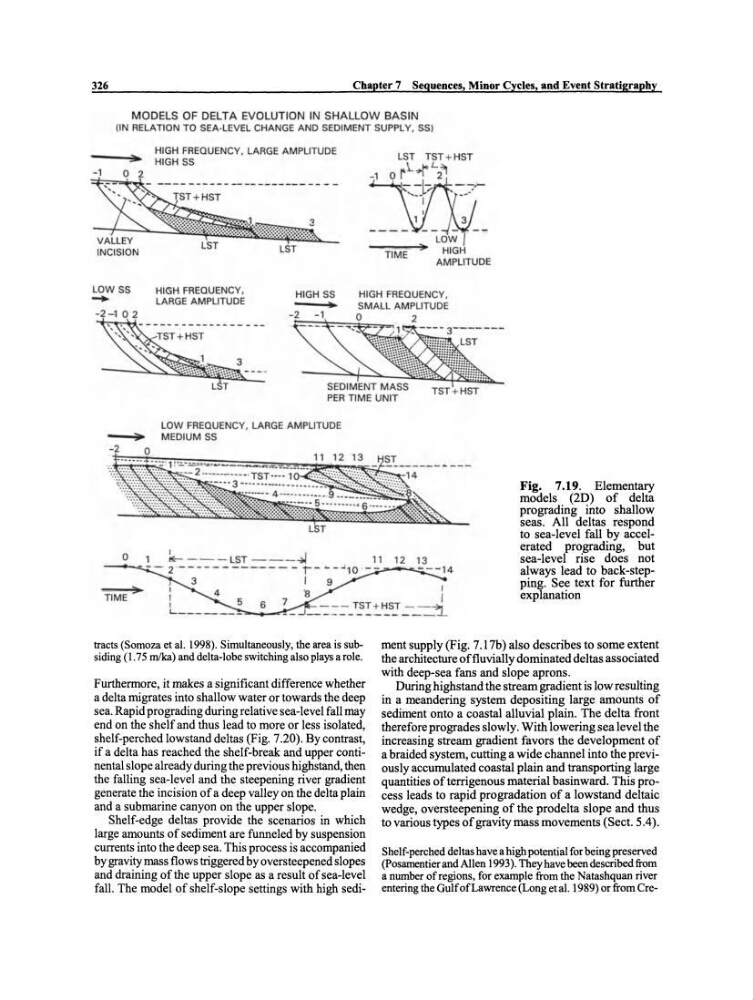
fall. The model of shelf-slope settings with high sediFig. 7.19. Elementary
models (2D) of delta
prograding into shallow
seas. All deltas respond
to sea-level fall by accelerated prograding, but
sea-level rise does not
always lead to back-stepping. Se~ text for further
explanatIOn
ment supply(Fig. 7.l7b) also describes to some extent
the architecture offluvially dominated deltas associated
with deep-sea fans and slope aprons.
During highstand the stream gradient is low resulting
in a meandering system depositing large amounts of
sediment onto a coastal alluvial plain. The delta front
therefore progrades slowly. With lowering sea level the
increasing stream gradient favors the development of
a braided system, cutting a wide channel into the previously accumulated coastal plain and transporting large
quantities of terrigenous material basinward. This process leads to rapid pro gradation of a lowstand deltaic
wedge, oversteepening of the prodelta slope and thus
to various types of gravity mass movements (Sect. 5.4).
Shelf-perched deltas have a high potential for being preserved
(posamentier and Allen 1993). They have been described from
a number ofregions, for example from the Natashquan river
entering the Gulf ofLawrence (Long et al. 1989) or from Cre-
Chapter 7 Sequences, Minor Cydes, and Event Stratigraphy
MODelS OF DELTA EVOLUTION IN SHALLOW BASIN
(IN RELATION TO SEA-LEVEL CHANGE AND SEDIMENT SUPPLY, SS)
LST TST+ HST
- 1 0 rL ~\~
___
I
TIME
LOW S5
HIGH FREOUENCY ,
- .
LARGE AMPLITUDE
HIGH SS
HIGH FREOUENCY,
--...;~~
SMALL AMPLITUDE
-2 - 1 02
~SEDIMENT MA55
TST + HST
PER TIME UNIT
LOW FREOUENCY, LARGE AMPLITUDE
- - - ; .
MEDIUM SS
tracts (Somoza et al. 1998). Simultaneously, the area is subsiding (1.75 mlka) and delta-lobe switching also plays a role.
Furthermore, it makes a significant difference whether
a delta migrates into shallow water or towards the deep
sea. Rapid prograding during relative sea-level fall may
end on the shelf and thus lead to more or less isolated,
shelf-perched lowstand deltas (Fig. 7.20). By contrast,
if a delta has reached the shelf-break and upper continental slope already during the previous highstand, then
the falling sea-level and the steepening river gradient
generate the incision of a deep valley on the delta plain
and a submarine canyon on the upper slope.
Shelf-edge deltas provide the scenarios in which
large amounts of sediment are funneled by suspension
currents into the deep sea. This process is accompanied
by gravity mass flows triggered by oversteepened slopes
and draining of the upper slope as a result of sea-Ievel
fall. The model of shelf-slope settings with high sediFig. 7.19. Elementary
models (2D) of delta
prograding into shallow
seas. All deltas respond
to sea-level fall by accelerated prograding, but
sea-level rise does not
always lead to back-stepping. Se~ text for further
explanatIOn
ment supply(Fig. 7.l7b) also describes to some extent
the architecture offluvially dominated deltas associated
with deep-sea fans and slope aprons.
During highstand the stream gradient is low resulting
in a meandering system depositing large amounts of
sediment onto a coastal alluvial plain. The delta front
therefore progrades slowly. With lowering sea level the
increasing stream gradient favors the development of
a braided system, cutting a wide channel into the previously accumulated coastal plain and transporting large
quantities of terrigenous material basinward. This process leads to rapid pro gradation of a lowstand deltaic
wedge, oversteepening of the prodelta slope and thus
to various types of gravity mass movements (Sect. 5.4).
Shelf-perched deltas have a high potential for being preserved
(posamentier and Allen 1993). They have been described from
a number ofregions, for example from the Natashquan river
entering the Gulf ofLawrence (Long et al. 1989) or from Cre-