

324
Chapter 7 Sequences, Minor Cycles, and Event Stratigraphy
c PARASEOUENCES OF LATE HIGHSTAND SYSTEMS TRACT
b
PARASEOUENCES OF TRANSGRESSIVE
AND EARL Y HIGHSTAND SYSTEMS TRACT
FS = FLOODING SURFACE
TL = TRANSGRESSIVE LAG
TS = TRANSGRESSIVE SURFACE MFS = MAXIMUM FLDDDING SURFACE
(RAVINEMENT SURFACE)
a TRANSGRESSIVE SYSTEMS TRACT (OVERVIEW)
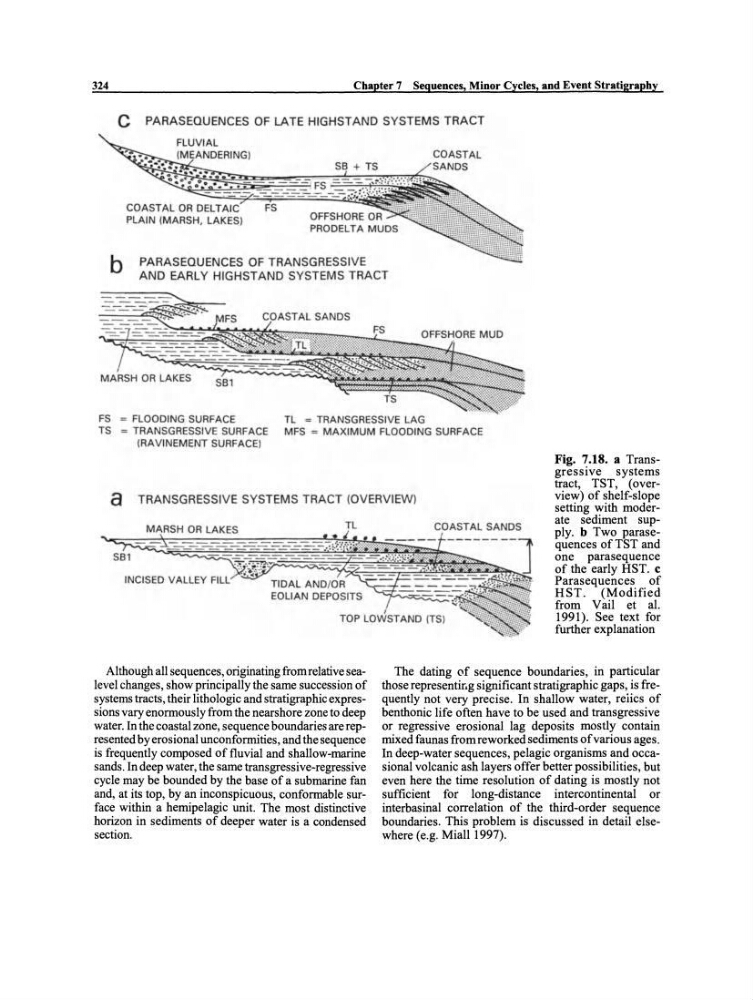
Fig. 7.18. a Transgressive systems
traet, TST, (overview) of shelf-slope
setting with moderate sediment supply. b Two parasequenees ofTST and
one parasequenee
of the early HST. c
Parasequenees of
HST. (Modified
from Vail et al.
1991). See text for
further explanation
MARSH DR LAKES
TL
INCISED VALLEY FILL
Although all sequenees, originating fromrelative sealevel ehanges, show prineipally the same sueeession of
systems traets, their lithologie and stratigraphie expressions vary enormously from the nearshore zone to deep
water. In the coastal zone, sequenee boundaries are represented by erosional uneonformities, and the sequenee
is frequently eomposed of fluvial and shallow-marine
sands. In deep water, the same transgressive-regressive
eycle may be bounded by the base of a submarine fan
and, at its top, by an ineonspieuous, eonformable surfaee within a hemipelagie unit. The most distinetive
horizon in sediments of deeper water is a eondensed
seetion.
COAST AL SANDS
The dating of sequenee boundaries, in partieular
those representir,g signifieant stratigraphie gaps, is frequently not very preeise. In shallow water, reHes of
benthonie life often have to be used and transgressive
or regressive erosional lag deposits mostly eontain
mixed faunas fromreworked sediments ofvarious ages.
In deep-water sequenees, pe1agie organisms and oeeasional volcanie ash layers offer better possibilities, but
even here the time resolution of dating is mostly not
suffieient for long-distanee intercontinental or
interbasinal correlation of the third-order sequenee
boundaries. This problem is diseussed in detail elsewhere (e.g. Miall 1997).
Chapter 7 Sequences, Minor Cycles, and Event Stratigraphy
c PARASEOUENCES OF LATE HIGHSTAND SYSTEMS TRACT
b
PARASEOUENCES OF TRANSGRESSIVE
AND EARL Y HIGHSTAND SYSTEMS TRACT
FS = FLOODING SURFACE
TL = TRANSGRESSIVE LAG
TS = TRANSGRESSIVE SURFACE MFS = MAXIMUM FLDDDING SURFACE
(RAVINEMENT SURFACE)
a TRANSGRESSIVE SYSTEMS TRACT (OVERVIEW)
Fig. 7.18. a Transgressive systems
traet, TST, (overview) of shelf-slope
setting with moderate sediment supply. b Two parasequenees ofTST and
one parasequenee
of the early HST. c
Parasequenees of
HST. (Modified
from Vail et al.
1991). See text for
further explanation
MARSH DR LAKES
TL
INCISED VALLEY FILL
Although all sequenees, originating fromrelative sealevel ehanges, show prineipally the same sueeession of
systems traets, their lithologie and stratigraphie expressions vary enormously from the nearshore zone to deep
water. In the coastal zone, sequenee boundaries are represented by erosional uneonformities, and the sequenee
is frequently eomposed of fluvial and shallow-marine
sands. In deep water, the same transgressive-regressive
eycle may be bounded by the base of a submarine fan
and, at its top, by an ineonspieuous, eonformable surfaee within a hemipelagie unit. The most distinetive
horizon in sediments of deeper water is a eondensed
seetion.
COAST AL SANDS
The dating of sequenee boundaries, in partieular
those representir,g signifieant stratigraphie gaps, is frequently not very preeise. In shallow water, reHes of
benthonie life often have to be used and transgressive
or regressive erosional lag deposits mostly eontain
mixed faunas fromreworked sediments ofvarious ages.
In deep-water sequenees, pe1agie organisms and oeeasional volcanie ash layers offer better possibilities, but
even here the time resolution of dating is mostly not
suffieient for long-distanee intercontinental or
interbasinal correlation of the third-order sequenee
boundaries. This problem is diseussed in detail elsewhere (e.g. Miall 1997).