

7.3 Coastal and Shallow-Marine Siliciclastic Systems
ACCRETIONARY SYSTEMS
a
NORMAL REGRESSION (NRl
(STEADY OR SLOWL Y RISING SU
315
_______ :"<_ ~_ ~_~ _~~~~~~;,;;_-___11 NON-ACCRETIONARY SYSTEMS
,
C
FORCED REGRESSION
~
b
d
TRANSGRESSION
e
f PROGRADING
COMPOSlTE PATTERNS
BACKSTEPPING
9
CONT. AND TRANSITIONAL SED.
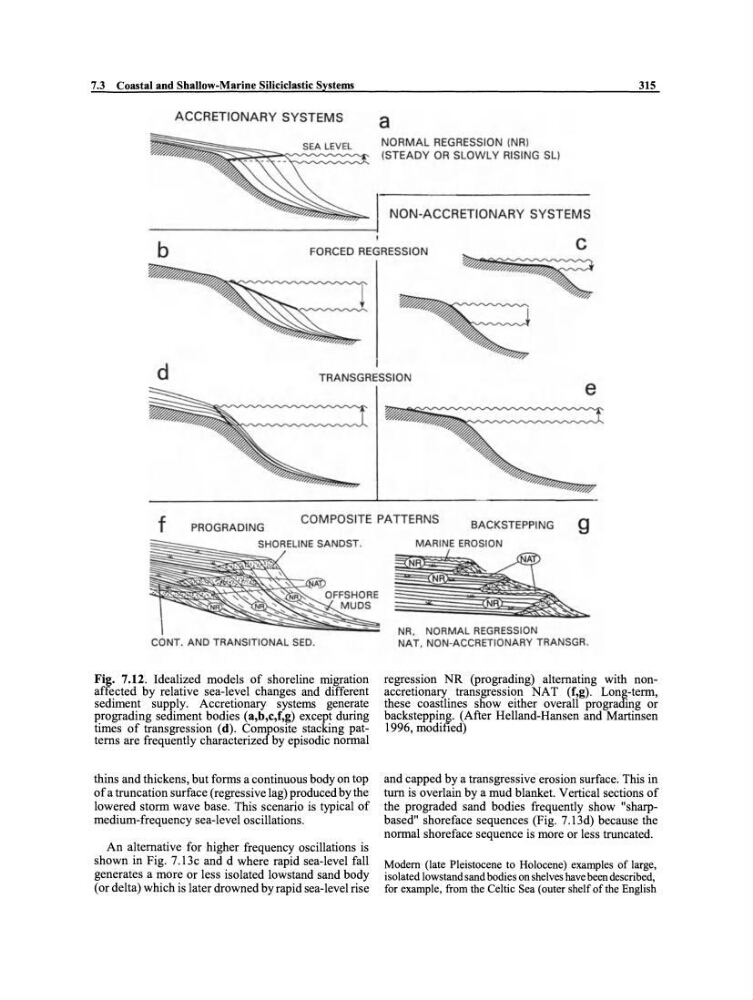
Fig. 7.12. Idealized models of shoreline migration
affected by relative sea-Ievel changes and different
sediment supply. Accretionary systems generate
prograding sediment bodies (a,b,c,f,g) except during
times of transgression (d). Composite stacking patterns are frequently characterized by episodic normal
thins and thickens, but forms a continuous body on top
of a truncation surface (regressive lag) produced by the
lowered storm wave base. This scenario is typical of
medium-frequency sea-Ievel oscillations.
An alternative for higher frequency oscillations is
shown in Fig. 7.13c and d where rapid sea-level fall
generates a more or less isolated lowstand sand body
( or delta) which is later drowned by rapid sea-level rise
MARINE EROSION
NR, NORMAL REGRESSION
NAT. NON-ACCRETIONARY TRANSGR .
regression NR (prograding) alternating with nonaccretionary transgression NA T (f,g). Long-term,
these coastlines show either overall prograding or
backstepping. (After Helland-Hansen and Martinsen
1996, modified)
and capped by a transgressive erosion surface. This in
turn is overlain by a mud blanket. Vertical sections of
the prograded sand bodies frequently show "sharpbased" shoreface sequences (Fig. 7.l3d) because the
normal shoreface sequence is more or less truncated.
Modern (late Pleistocene to Holocene) examples of large,
isolated lowstand sand bodies on shelves have been described,
for example, from the Celtic Sea (outer shelf of the English
ACCRETIONARY SYSTEMS
a
NORMAL REGRESSION (NRl
(STEADY OR SLOWL Y RISING SU
315
_______ :"<_ ~_ ~_~ _~~~~~~;,;;_-___11 NON-ACCRETIONARY SYSTEMS
,
C
FORCED REGRESSION
~
b
d
TRANSGRESSION
e
f PROGRADING
COMPOSlTE PATTERNS
BACKSTEPPING
9
CONT. AND TRANSITIONAL SED.
Fig. 7.12. Idealized models of shoreline migration
affected by relative sea-Ievel changes and different
sediment supply. Accretionary systems generate
prograding sediment bodies (a,b,c,f,g) except during
times of transgression (d). Composite stacking patterns are frequently characterized by episodic normal
thins and thickens, but forms a continuous body on top
of a truncation surface (regressive lag) produced by the
lowered storm wave base. This scenario is typical of
medium-frequency sea-Ievel oscillations.
An alternative for higher frequency oscillations is
shown in Fig. 7.13c and d where rapid sea-level fall
generates a more or less isolated lowstand sand body
( or delta) which is later drowned by rapid sea-level rise
MARINE EROSION
NR, NORMAL REGRESSION
NAT. NON-ACCRETIONARY TRANSGR .
regression NR (prograding) alternating with nonaccretionary transgression NA T (f,g). Long-term,
these coastlines show either overall prograding or
backstepping. (After Helland-Hansen and Martinsen
1996, modified)
and capped by a transgressive erosion surface. This in
turn is overlain by a mud blanket. Vertical sections of
the prograded sand bodies frequently show "sharpbased" shoreface sequences (Fig. 7.l3d) because the
normal shoreface sequence is more or less truncated.
Modern (late Pleistocene to Holocene) examples of large,
isolated lowstand sand bodies on shelves have been described,
for example, from the Celtic Sea (outer shelf of the English