

314
Chapter 7 Sequences, Minor Cycles, and Event Stratigraphy
a Sea-Ievel changes _ _ _ __ -,
Highstand
- E
~
.c .... c.
Q)
o
0+
ltI
~ 5 r-----+"!~""'"I
Q)
E 1 0 t--"-....::::-'+...-,~.,
j.::
15
o
so
100
1 SO
200
250
300
Amplitude
Horizontal distance (km)
b Cyclic change in sediment supply
_ o. O~~ij.Ii~~~~~====ls,
Maximum
sediment supply
0+
E 0.21 [
.::.t:
.c 0.4
.... C.
Q)
o
0.8
No down ward shift of onlap
durin g regression
100
200
Basin position (km)
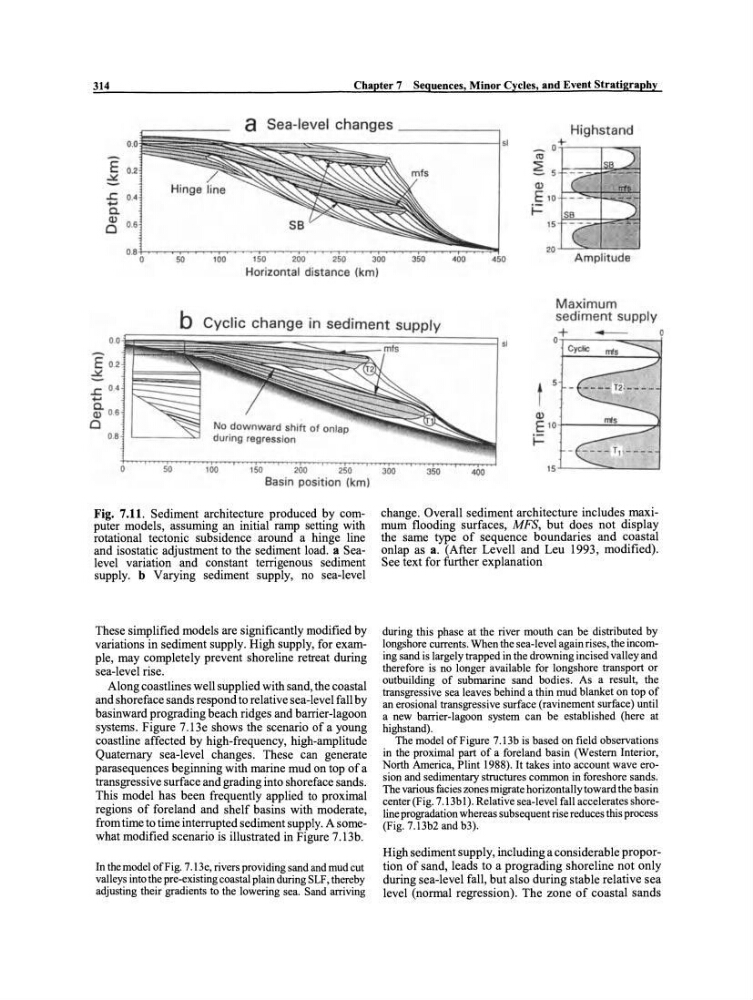
Fig. 7.11. Sediment architecture produced by computer models, assuming an initial ramp setting with
rotational tectonic subsidence around a hinge line
and isostatic adjustment to the sediment load. a Sealevel variation and constant terrigenous sediment
supply. b Varying sediment supply, no sea-Ievel
These simplified models are significantly modified by
variations in sediment supply. High supply, for exampIe, may completely prevent shoreline retreat during
sea-Ievel rise.
Along coastlines weIl supplied with sand, the coastal
and shoreface sands respond to relative sea-Ievel fall by
basinward prograding beach ridges and barrier-Iagoon
systems. Figure 7.l3e shows the scenario of a young
coastline affected by high-frequency, high-amplitude
Quaternary sea-Ievel changes. These can generate
parasequences beginning with marine mud on top of a
transgressive surface and grading into shoreface sands.
This model has been frequently applied to proximal
regions of fore land and shelf basins with moderate,
from time to time interrupted sediment supply. A somewhat modified scenario is illustrated in Figure 7.13b.
In the model ofFig. 7.13e, rivers providing sand andmud cut
valleys into the pre-existing coastal plain during SLF, thereby
adjusting their gradients to the lowering sea. Sand arriving
Q)
E l0+--~~--~~
i=
15 -'---~--_.....J
change. Overall sediment architecture includes maximum flooding surfaces, MFS, but does not display
the same type of sequence boundaries and coastal
onlap as a. (After Levell and Leu 1993, modified).
See text for further explanation
during this phase at the river mouth can be distributed by
longshore currents. When the sea-Ievel again rises, the incoming sand is largely trapped in the drowning incised vaUey and
therefore is no longer available for longshore transport or
outbuilding of submarine sand bodies. As a result, the
transgressive sea leaves behind a thin mud blanket on top of
an erosional transgressive surface (ravinement surface) until
a new barrier-Iagoon system can be established (here at
highstand).
The model of Figure 7 .13b is based on field observations
in the proximal part of a foreland basin (Western Interior,
North America, Plint 1988). It takes into account wave erosion and sedimentary structures common in foreshore sands.
The various facies zones migrate horizontally toward the basin
center (Fig. 7.13b I). Relative sea-Ievel fall acce1erates shoreline progradation whereas subsequent rise reduces this process
(Fig. 7.l3b2 and b3).
High sediment supply, including a considerable proportion of sand, leads to a prograding shoreline not only
during sea-level fall, but also during stable relative sea
level (normal regression). The zone of coastal sands
Chapter 7 Sequences, Minor Cycles, and Event Stratigraphy
a Sea-Ievel changes _ _ _ __ -,
Highstand
- E
~
.c .... c.
Q)
o
0+
ltI
~ 5 r-----+"!~""'"I
Q)
E 1 0 t--"-....::::-'+...-,~.,
j.::
15
o
so
100
1 SO
200
250
300
Amplitude
Horizontal distance (km)
b Cyclic change in sediment supply
_ o. O~~ij.Ii~~~~~====ls,
Maximum
sediment supply
0+
E 0.21 [
.::.t:
.c 0.4
.... C.
Q)
o
0.8
No down ward shift of onlap
durin g regression
100
200
Basin position (km)
Fig. 7.11. Sediment architecture produced by computer models, assuming an initial ramp setting with
rotational tectonic subsidence around a hinge line
and isostatic adjustment to the sediment load. a Sealevel variation and constant terrigenous sediment
supply. b Varying sediment supply, no sea-Ievel
These simplified models are significantly modified by
variations in sediment supply. High supply, for exampIe, may completely prevent shoreline retreat during
sea-Ievel rise.
Along coastlines weIl supplied with sand, the coastal
and shoreface sands respond to relative sea-Ievel fall by
basinward prograding beach ridges and barrier-Iagoon
systems. Figure 7.l3e shows the scenario of a young
coastline affected by high-frequency, high-amplitude
Quaternary sea-Ievel changes. These can generate
parasequences beginning with marine mud on top of a
transgressive surface and grading into shoreface sands.
This model has been frequently applied to proximal
regions of fore land and shelf basins with moderate,
from time to time interrupted sediment supply. A somewhat modified scenario is illustrated in Figure 7.13b.
In the model ofFig. 7.13e, rivers providing sand andmud cut
valleys into the pre-existing coastal plain during SLF, thereby
adjusting their gradients to the lowering sea. Sand arriving
Q)
E l0+--~~--~~
i=
15 -'---~--_.....J
change. Overall sediment architecture includes maximum flooding surfaces, MFS, but does not display
the same type of sequence boundaries and coastal
onlap as a. (After Levell and Leu 1993, modified).
See text for further explanation
during this phase at the river mouth can be distributed by
longshore currents. When the sea-Ievel again rises, the incoming sand is largely trapped in the drowning incised vaUey and
therefore is no longer available for longshore transport or
outbuilding of submarine sand bodies. As a result, the
transgressive sea leaves behind a thin mud blanket on top of
an erosional transgressive surface (ravinement surface) until
a new barrier-Iagoon system can be established (here at
highstand).
The model of Figure 7 .13b is based on field observations
in the proximal part of a foreland basin (Western Interior,
North America, Plint 1988). It takes into account wave erosion and sedimentary structures common in foreshore sands.
The various facies zones migrate horizontally toward the basin
center (Fig. 7.13b I). Relative sea-Ievel fall acce1erates shoreline progradation whereas subsequent rise reduces this process
(Fig. 7.l3b2 and b3).
High sediment supply, including a considerable proportion of sand, leads to a prograding shoreline not only
during sea-level fall, but also during stable relative sea
level (normal regression). The zone of coastal sands