

6.4 Marine Evaporites
c MIDDLE SLOPE SALT
MOVEMENT
BASE OF SALT
SEDIMENT MOVEMENT
d SHELF PROGRADING
SHALLOW· WATER SANDS
DEPOCENTER
281
b FINAL STAGE SECONDARY GRABEN
LOW·RELIEF
EXTENSIONAL
ON HIGH·RELIEF ANTICLlNE
SALT PILLOW FAULT PATTERN
SLOW SALT MOVEMENT
AT PERIPHERAL
SALT RIDGE
a EARLY STAGE
PRIM ARY
EARLY MOVEMENT
GRABEN ~ OF SALT
SEA LEVEL
~~,
<
8111111111 n Iml i iii 11111 i! 11111 i! 11,,"" i 1100 1lifuF, ~ ~~:~~,jNG OF OVERLV ING sm
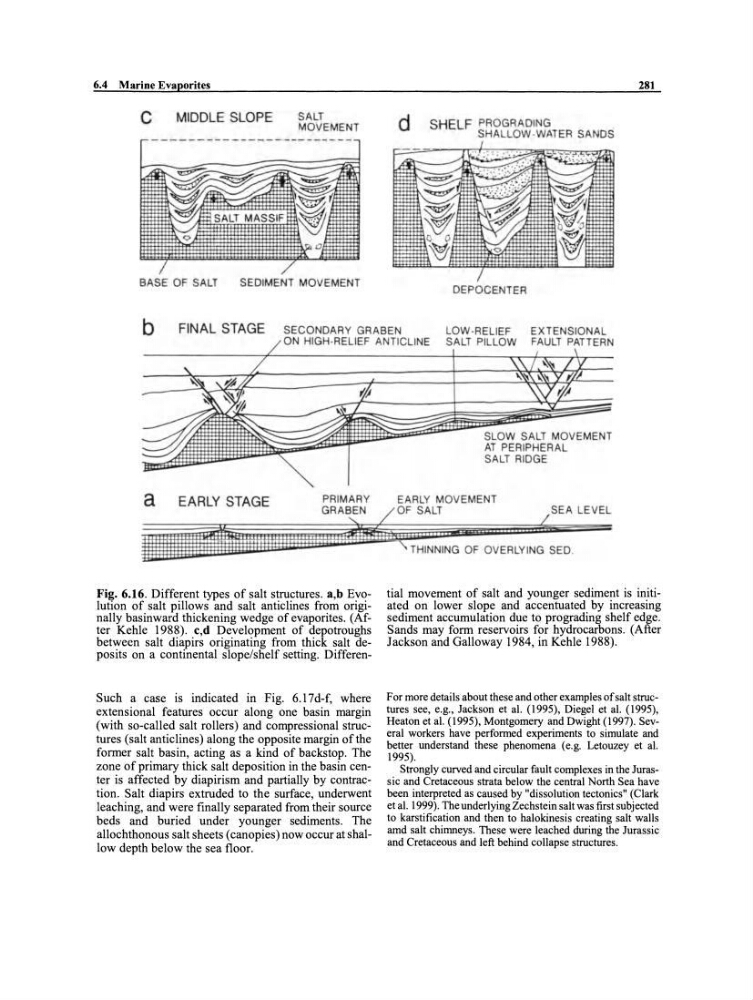
Fig. 6.16. Different types of salt structures. a,b Evolution of salt pillows and salt anticlines from originally basinward thickening wedge of evaporites. (After Kehle 1988). c,d Development of depotroughs
between salt diapirs originating from thick salt deposits on a continental slope/shelf setting. DifferenSuch a case is indicated in Fig. 6.l7d-f, where
extensional features occur along one basin margin
(with so-called salt rollers) and compressional structures (salt anticlines) along the opposite margin ofthe
former salt basin, acting as a kind of backs top. The
zone of primary thick salt deposition in the basin center is affected by diapirism and partially by contraction. Salt diapirs extruded to the surface, underwent
leaching, and were finally separated from their source
beds and buried under younger sediments. The
allochthonous salt sheets (canopies) now occur at shallow depth below the sea floor.
tial movement of salt and younger sediment is initiated on lower slope and accentuated by increasing
sediment accumulation due to prograding shelf edge.
Sands may form reservoirs for hydrocarbons. (After
J ackson and Galloway 1984, in Kehle 1988).
For more details about these and other examples ofsalt structures see, e.g., Jackson et al. (1995), Diegel et al. (1995),
Heaton et al. (1995), Montgomery and Dwight (1997). Several workers have performed experiments to simulate and
better understand these phenomena (e.g. Letouzey et al.
1995).
Strongly curved and circular fault complexes in the Jurassic and Cretaceous strata below the central North Sea have
been interpreted as caused by "dissolution tectonics" (Clark
et al. 1999). The underlying Zechstein salt was first subjected
to karstification and then to halokinesis creating salt walls
amd salt chimneys. These were leached during the Jurassic
and Cretaceous and left behind collapse structures.
c MIDDLE SLOPE SALT
MOVEMENT
BASE OF SALT
SEDIMENT MOVEMENT
d SHELF PROGRADING
SHALLOW· WATER SANDS
DEPOCENTER
281
b FINAL STAGE SECONDARY GRABEN
LOW·RELIEF
EXTENSIONAL
ON HIGH·RELIEF ANTICLlNE
SALT PILLOW FAULT PATTERN
SLOW SALT MOVEMENT
AT PERIPHERAL
SALT RIDGE
a EARLY STAGE
PRIM ARY
EARLY MOVEMENT
GRABEN ~ OF SALT
SEA LEVEL
~~,
<
8111111111 n Iml i iii 11111 i! 11111 i! 11,,"" i 1100 1lifuF, ~ ~~:~~,jNG OF OVERLV ING sm
Fig. 6.16. Different types of salt structures. a,b Evolution of salt pillows and salt anticlines from originally basinward thickening wedge of evaporites. (After Kehle 1988). c,d Development of depotroughs
between salt diapirs originating from thick salt deposits on a continental slope/shelf setting. DifferenSuch a case is indicated in Fig. 6.l7d-f, where
extensional features occur along one basin margin
(with so-called salt rollers) and compressional structures (salt anticlines) along the opposite margin ofthe
former salt basin, acting as a kind of backs top. The
zone of primary thick salt deposition in the basin center is affected by diapirism and partially by contraction. Salt diapirs extruded to the surface, underwent
leaching, and were finally separated from their source
beds and buried under younger sediments. The
allochthonous salt sheets (canopies) now occur at shallow depth below the sea floor.
tial movement of salt and younger sediment is initiated on lower slope and accentuated by increasing
sediment accumulation due to prograding shelf edge.
Sands may form reservoirs for hydrocarbons. (After
J ackson and Galloway 1984, in Kehle 1988).
For more details about these and other examples ofsalt structures see, e.g., Jackson et al. (1995), Diegel et al. (1995),
Heaton et al. (1995), Montgomery and Dwight (1997). Several workers have performed experiments to simulate and
better understand these phenomena (e.g. Letouzey et al.
1995).
Strongly curved and circular fault complexes in the Jurassic and Cretaceous strata below the central North Sea have
been interpreted as caused by "dissolution tectonics" (Clark
et al. 1999). The underlying Zechstein salt was first subjected
to karstification and then to halokinesis creating salt walls
amd salt chimneys. These were leached during the Jurassic
and Cretaceous and left behind collapse structures.