

278
Chapter 6 Special Depositional Environments
SALT PILLOW
INTRUSIVE, ~
HIGH AMPLITUDE
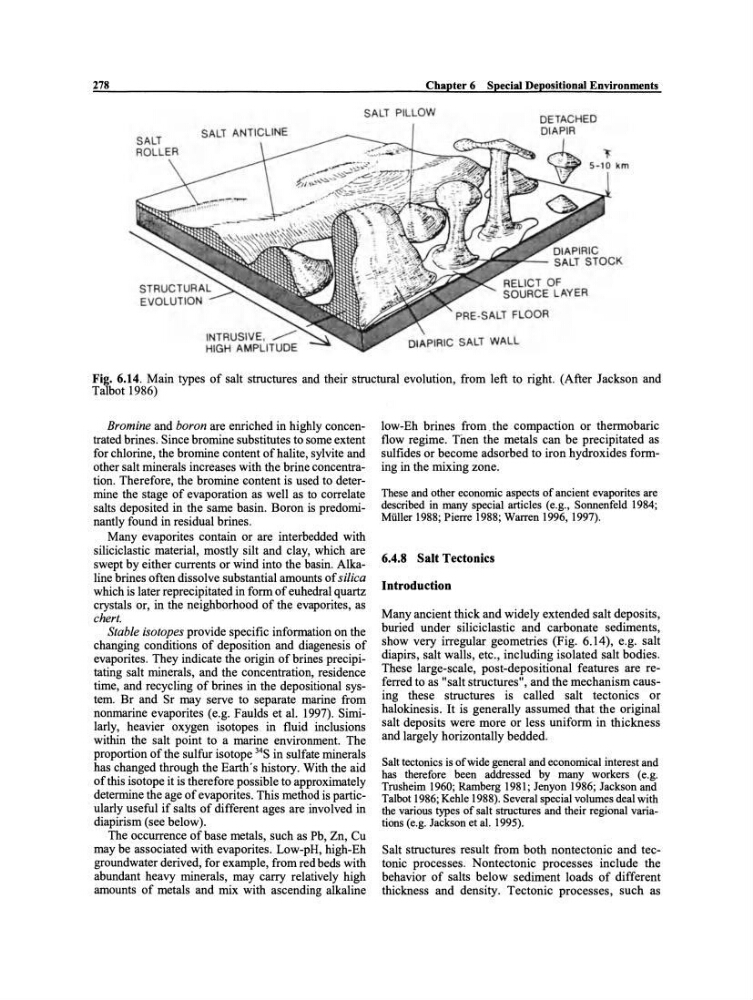
Fig. 6.14. Main types of salt structures and their structural evolution, from left to right. (After Jackson and
Talbot 1986)
Bromine and boron are enriched in highly concentrated brines. Since bromine substitutes to some extent
for chlorine, the bromine content ofhalite, sylvite and
other salt minerals increases with the brine concentration. Therefore, the bromine content is used to determine the stage of evaporation as well as to correlate
salts deposited in the same basin. Boron is predominantly found in residual brines.
Many evaporites contain or are interbedded with
siliciclastic material, mostly silt and clay, which are
swept by either currents or wind into the basin. Alkaline brines often dissolve substantial amounts of siliea
which is later reprecipitated in form of euhedral quartz
crystals or, in the neighborhood of the evaporites, as
ehert.
Stable isotopes provide specific information on the
changing conditions of deposition and diagenesis of
evaporites. They indicate the origin of brines precipitating salt minerals, and the concentration, residence
time, and recycling of brines in the depositional system. Br and Sr may serve to separate marine from
nonmarine evaporites (e.g. Faulds et al. 1997). Similady, heavier oxygen isotopes in fluid inclusions
within the salt point to a marine environment. The
proportion of the sulfur isotope 34S in sulfate minerals
has changed through the Earth' s history. With the aid
ofthis isotope it is therefore possible to approximately
determine the age of evaporites. This method is particularly useful ifsalts of different ages are involved in
diapirism (see below).
The occurrence of base metals, such as Pb, Zn, Cu
may be associated with evaporites. Low-pH, high-Eh
groundwater derived, for example, from red beds with
abundant heavy minerals, may carry relatively high
amounts of metals and mix with ascending alkaline
low-Eh brines from. the compaction or thermobaric
flow regime. Tnen the metals can be precipitated as
sulfides or become adsorbed to iron hydroxides forming in the mixing zone.
These and other economic aspects of ancient evaporites are
described in many special articles (e.g., Sonnenfeld 1984;
Müller 1988; Pierre 1988; Warren 1996, 1997).
6.4.8 Salt Tectonics
Introduction
Many ancient thick and widely extended salt deposits,
buried under siliciclastic and carbonate sediments,
show very irregular geometries (Fig. 6.14), e.g. salt
diapirs, salt walls, etc., including isolated salt bodies.
These large-scale, post-depositional features are referred to as "salt structures", and the mechanism causing these structures is called salt tectonics or
halokinesis. It is generally assumed that the original
salt deposits were more or less uniform in thickness
and largely horizontally bedded.
Salt tectonics is ofwide general and economical interest and
has therefore been addressed by many workers (e.g.
Trusheim 1960; Ramberg 1981; Jenyon 1986; Jackson and
Talbot 1986; Kehle 1988). Several special volumes deal with
the various types of salt structures and their regional variations (e.g. Jackson et al. 1995).
Salt structures result from both nontectonic and tectonic processes. Nontectonic processes include the
behavior of salts below sediment loads of different
thickness and density. Tectonic processes, such as
Chapter 6 Special Depositional Environments
SALT PILLOW
INTRUSIVE, ~
HIGH AMPLITUDE
Fig. 6.14. Main types of salt structures and their structural evolution, from left to right. (After Jackson and
Talbot 1986)
Bromine and boron are enriched in highly concentrated brines. Since bromine substitutes to some extent
for chlorine, the bromine content ofhalite, sylvite and
other salt minerals increases with the brine concentration. Therefore, the bromine content is used to determine the stage of evaporation as well as to correlate
salts deposited in the same basin. Boron is predominantly found in residual brines.
Many evaporites contain or are interbedded with
siliciclastic material, mostly silt and clay, which are
swept by either currents or wind into the basin. Alkaline brines often dissolve substantial amounts of siliea
which is later reprecipitated in form of euhedral quartz
crystals or, in the neighborhood of the evaporites, as
ehert.
Stable isotopes provide specific information on the
changing conditions of deposition and diagenesis of
evaporites. They indicate the origin of brines precipitating salt minerals, and the concentration, residence
time, and recycling of brines in the depositional system. Br and Sr may serve to separate marine from
nonmarine evaporites (e.g. Faulds et al. 1997). Similady, heavier oxygen isotopes in fluid inclusions
within the salt point to a marine environment. The
proportion of the sulfur isotope 34S in sulfate minerals
has changed through the Earth' s history. With the aid
ofthis isotope it is therefore possible to approximately
determine the age of evaporites. This method is particularly useful ifsalts of different ages are involved in
diapirism (see below).
The occurrence of base metals, such as Pb, Zn, Cu
may be associated with evaporites. Low-pH, high-Eh
groundwater derived, for example, from red beds with
abundant heavy minerals, may carry relatively high
amounts of metals and mix with ascending alkaline
low-Eh brines from. the compaction or thermobaric
flow regime. Tnen the metals can be precipitated as
sulfides or become adsorbed to iron hydroxides forming in the mixing zone.
These and other economic aspects of ancient evaporites are
described in many special articles (e.g., Sonnenfeld 1984;
Müller 1988; Pierre 1988; Warren 1996, 1997).
6.4.8 Salt Tectonics
Introduction
Many ancient thick and widely extended salt deposits,
buried under siliciclastic and carbonate sediments,
show very irregular geometries (Fig. 6.14), e.g. salt
diapirs, salt walls, etc., including isolated salt bodies.
These large-scale, post-depositional features are referred to as "salt structures", and the mechanism causing these structures is called salt tectonics or
halokinesis. It is generally assumed that the original
salt deposits were more or less uniform in thickness
and largely horizontally bedded.
Salt tectonics is ofwide general and economical interest and
has therefore been addressed by many workers (e.g.
Trusheim 1960; Ramberg 1981; Jenyon 1986; Jackson and
Talbot 1986; Kehle 1988). Several special volumes deal with
the various types of salt structures and their regional variations (e.g. Jackson et al. 1995).
Salt structures result from both nontectonic and tectonic processes. Nontectonic processes include the
behavior of salts below sediment loads of different
thickness and density. Tectonic processes, such as