

6.4 Marine Evaporites
277
b
EFFECTS OF SUBSURFACE SALT SOLUTION
INCREASE IN THICKNESS DUE TO
"SUBSOLUTION" AND DIAGENESIS
---- - - - - -
-------'
- - - -
-----=-..------ --I I I
I I
APPARENT OFFLAP
DUE TO DISSOLUTION
1\ 1\ /\
/\ /\
1 \ / ' \ / ' \ / \ - " / ' \
SYLVITE ETC.
a
CARBONATE
FUTURE DISSOLUTION FRONT
CARNALLITE
-",
I
\
\
1
1"\ I I I 1 / 1
1
, \' 1 1 .\1 I
1
I
I
I
I
1
1
I
1
1
1
1
1
I
IL U
~
O~
I>
~
/'\/1\ /'\
/'\
/\
/\
/\
A
/'\
/\
/'\
/\.
A
HAllTE
-r-------- /E--'
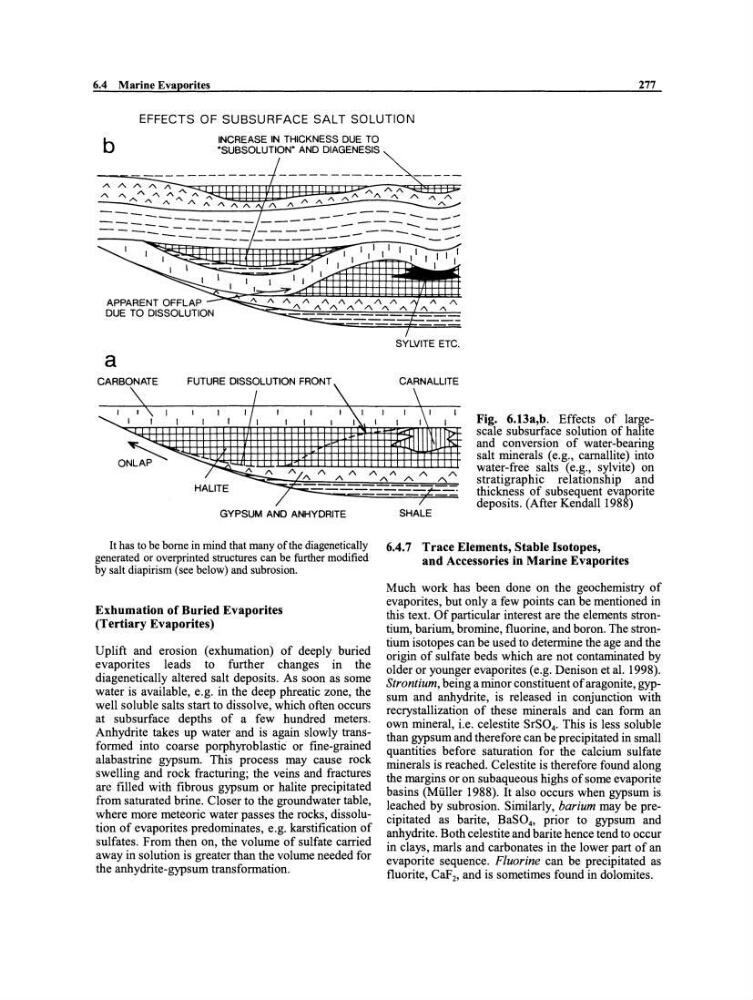
Fig. 6.13a,b. Effects of largescale subsurface solution of halite
and conversion of water-bearing
salt minerals (e.g., camallite) into
water-free salts (e.g., sylvite) on
stratigraphie relationship aJ?d
thickness of subsequent evaponte
deposits. (After Kendall1988)
GYPSUM AND ANHYDRITE
It has to be borne in mind that many ofthe diageneticalIy
generated or overprinted structures can ?e further modified
by salt diapirism (see below) and subroslOn.
Exhumation of Buried Evaporites
(Tertiary Evaporites)
Uplift and erosion (exhumation) of deeply. buried
evaporites leads to further changes m the
diagenetically altered salt deposits. As soon as some
water is available, e.g. in the deep phreatic zone, the
well soluble salts start to dissolve, which often occurs
at subsurface depths of a few hundred meters.
Anhydrite takes up water and is a~ain slowly tr~nsformed into coarse porphyroblastlc or fine-gramed
alabastrine gypsum. This process may cause rock
swelling and rock fracturing; the veins and fractures
are filled with fibrous gypsum or halite precipitated
from saturated brine. Closer to the groundwater table,
where more meteoric water passes the rocks, dissolution of evaporites predominates, e.g. karstification of
sulfates. From then on, the volume of sulfate carried
away in solution is greater than the volume needed for
the anhydrite-gypsum transformation.
SHALE
6.4.7 Trace Elements, Stable Isotopes,
and Accessories in Marine Evaporites
Much work has been done on the geochemistry of
evaporites, but only a few points can be mentioned in
this text. Of particular interest are the elements strontium, barium, bromine, fluorine, and boron. The strontium isotopes can be used to determine the age and the
origin of sulfate beds which are not contarninated by
older or younger evaporites (e.g. Denison et al: 1998).
Strontium, being a minor constituent of aragomte, gypsum and anhydrite, is released in conjunction with
recrystallization of these minerals and can form an
own mineral, i.e. ce1estite SrS0 4 • This is less soluble
than gypsum and therefore can be precipitated in small
quantities before saturation for the calcium sulfate
minerals is reached. Celestite is therefore found along
the rnargins or on subaqueous highs of some evapori~e
basins (Müller 1988). It also occurs when gypsum 1S
leached by subrosion. Similarly, barium may be precipitated as barite, BaS0 4 , prior to gypsum and
anhydrite. Both celestite and barite hence tend to occur
in clays, marls and carbonates in the lower part of an
evaporite sequence. Fluorine can be precipitated as
fluorite, CaF2, and is sometimes found in dolomites.
277
b
EFFECTS OF SUBSURFACE SALT SOLUTION
INCREASE IN THICKNESS DUE TO
"SUBSOLUTION" AND DIAGENESIS
---- - - - - -
-------'
- - - -
-----=-..------ --I I I
I I
APPARENT OFFLAP
DUE TO DISSOLUTION
1\ 1\ /\
/\ /\
1 \ / ' \ / ' \ / \ - " / ' \
SYLVITE ETC.
a
CARBONATE
FUTURE DISSOLUTION FRONT
CARNALLITE
-",
I
\
\
1
1"\ I I I 1 / 1
1
, \' 1 1 .\1 I
1
I
I
I
I
1
1
I
1
1
1
1
1
I
IL U
~
O~
I>
~
/'\/1\ /'\
/'\
/\
/\
/\
A
/'\
/\
/'\
/\.
A
HAllTE
-r-------- /E--'
Fig. 6.13a,b. Effects of largescale subsurface solution of halite
and conversion of water-bearing
salt minerals (e.g., camallite) into
water-free salts (e.g., sylvite) on
stratigraphie relationship aJ?d
thickness of subsequent evaponte
deposits. (After Kendall1988)
GYPSUM AND ANHYDRITE
It has to be borne in mind that many ofthe diageneticalIy
generated or overprinted structures can ?e further modified
by salt diapirism (see below) and subroslOn.
Exhumation of Buried Evaporites
(Tertiary Evaporites)
Uplift and erosion (exhumation) of deeply. buried
evaporites leads to further changes m the
diagenetically altered salt deposits. As soon as some
water is available, e.g. in the deep phreatic zone, the
well soluble salts start to dissolve, which often occurs
at subsurface depths of a few hundred meters.
Anhydrite takes up water and is a~ain slowly tr~nsformed into coarse porphyroblastlc or fine-gramed
alabastrine gypsum. This process may cause rock
swelling and rock fracturing; the veins and fractures
are filled with fibrous gypsum or halite precipitated
from saturated brine. Closer to the groundwater table,
where more meteoric water passes the rocks, dissolution of evaporites predominates, e.g. karstification of
sulfates. From then on, the volume of sulfate carried
away in solution is greater than the volume needed for
the anhydrite-gypsum transformation.
SHALE
6.4.7 Trace Elements, Stable Isotopes,
and Accessories in Marine Evaporites
Much work has been done on the geochemistry of
evaporites, but only a few points can be mentioned in
this text. Of particular interest are the elements strontium, barium, bromine, fluorine, and boron. The strontium isotopes can be used to determine the age and the
origin of sulfate beds which are not contarninated by
older or younger evaporites (e.g. Denison et al: 1998).
Strontium, being a minor constituent of aragomte, gypsum and anhydrite, is released in conjunction with
recrystallization of these minerals and can form an
own mineral, i.e. ce1estite SrS0 4 • This is less soluble
than gypsum and therefore can be precipitated in small
quantities before saturation for the calcium sulfate
minerals is reached. Celestite is therefore found along
the rnargins or on subaqueous highs of some evapori~e
basins (Müller 1988). It also occurs when gypsum 1S
leached by subrosion. Similarly, barium may be precipitated as barite, BaS0 4 , prior to gypsum and
anhydrite. Both celestite and barite hence tend to occur
in clays, marls and carbonates in the lower part of an
evaporite sequence. Fluorine can be precipitated as
fluorite, CaF2, and is sometimes found in dolomites.