

204
Chapter 5 Oceanic Sediments
INCREASING INTENSITY
OF WINNOWING AND
REWORKING
SECONDARY ENRICHMENT OF PHOSPHORITE
SEDIMENT RICH
IN C-ORG OR
,.,., ... ,.",.,.,., ....... FISH BONES ETC.
MULTI-EVENT
PHOSPHORITE
DEPOSIT, ±PHOSPHATE-CEMENTED
• ~I~IIIIIII~l PARTIALLY
AUTOCHTHONOUS
PHOSPHORITE
~
a!.~~:'$a~
c
b
a
SEDIMENT
BUILDUP
EROSION AND
WINNOWING
IN SITU-GENERATED
PHOSPHATIC LAYER
OR PARTICL
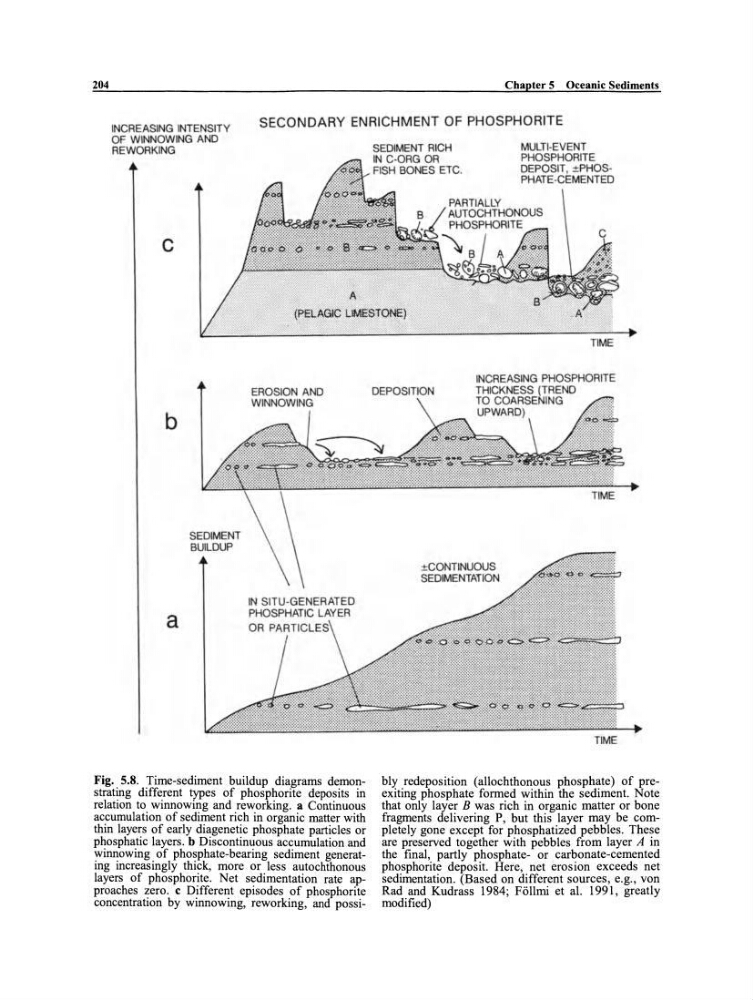
Fig. 5.8. Time-sediment buildup diagrams demonstrating different types of phosphorite deposits in
relation to winnowing and reworking. a Continuous
accumulation of sediment rich in organic matter with
thin layers of early diagenetic phosphate particles or
phosphatic layers. b Discontinuous accumulation and
winnowing of phosphate-bearing sediment generating increasingly thick, more or less autochthonous
layers of phosphorite. Net sedimentation rate approaches zero. c Different episodes of phosphorite
concentration by winnowing, reworking, and possiDEPOSITION
INCREASING PHOSPHORITE
THICKNESS (TREND
TO COARSENING
UPWARD)
±CONTINUOUS
SEDIMENTATION
TIME
TIME
bly redeposition (allochthonous phosphate) of preexiting phosphate formed within the sediment. Note
that only layer B was rich in organic matter or bone
fragments delivering P, but this layer may be completely gone except for phosphatized pebbles. These
are preserved together with pebbles from layer A in
the final, partly phosphate- or carbonate-cemented
phosphorite deposit. Here, net erosion exceeds net
sedimentation. (Based on different sourees, e.g., von
Rad and Kudrass 1984; Föllmi et al. 1991, greatly
modified)
Chapter 5 Oceanic Sediments
INCREASING INTENSITY
OF WINNOWING AND
REWORKING
SECONDARY ENRICHMENT OF PHOSPHORITE
SEDIMENT RICH
IN C-ORG OR
,.,., ... ,.",.,.,., ....... FISH BONES ETC.
MULTI-EVENT
PHOSPHORITE
DEPOSIT, ±PHOSPHATE-CEMENTED
• ~I~IIIIIII~l PARTIALLY
AUTOCHTHONOUS
PHOSPHORITE
~
a!.~~:'$a~
c
b
a
SEDIMENT
BUILDUP
EROSION AND
WINNOWING
IN SITU-GENERATED
PHOSPHATIC LAYER
OR PARTICL
Fig. 5.8. Time-sediment buildup diagrams demonstrating different types of phosphorite deposits in
relation to winnowing and reworking. a Continuous
accumulation of sediment rich in organic matter with
thin layers of early diagenetic phosphate particles or
phosphatic layers. b Discontinuous accumulation and
winnowing of phosphate-bearing sediment generating increasingly thick, more or less autochthonous
layers of phosphorite. Net sedimentation rate approaches zero. c Different episodes of phosphorite
concentration by winnowing, reworking, and possiDEPOSITION
INCREASING PHOSPHORITE
THICKNESS (TREND
TO COARSENING
UPWARD)
±CONTINUOUS
SEDIMENTATION
TIME
TIME
bly redeposition (allochthonous phosphate) of preexiting phosphate formed within the sediment. Note
that only layer B was rich in organic matter or bone
fragments delivering P, but this layer may be completely gone except for phosphatized pebbles. These
are preserved together with pebbles from layer A in
the final, partly phosphate- or carbonate-cemented
phosphorite deposit. Here, net erosion exceeds net
sedimentation. (Based on different sourees, e.g., von
Rad and Kudrass 1984; Föllmi et al. 1991, greatly
modified)