

5.3 Hemipelagic and Pelagic Sediments
SE~LEV~ _______ ___ _ ~ __________ _
BENTHOS,
BIOTURBATlON,
INTENSIVE
DECOMPOSITION
OF ORGANIC
MATTER AND
RELEASE OF
~ .. / /
. ...
ANOXIC, NO BENTHOS,
RELATIVE
LAMINA TED, LlMITED
(ANAEROBIC) DECOM·
POSITION OF ORG. M.
AND PRECIPITATION OF P
CONCENTRATIONS
b
(:OXIC, IN CERTAIN
SEA WATEA
TIMES AND PLACES
ALSO ANOXIC)
,
:"F
,
PARTIAL DECOM·
POSITION OF ORG.
MATTER, MAIN
ZONE OF
PHOSPHOGENESIS
AUTHIGENIC
MINERALS
WEAKLY
REDUCING
(PARTLY
Fe+++ - Fe ++)
P AND OTHER
NUTRIENTS
INTO SEA WATER
PHOSPHOGENESIS
PHOSPHORITE
(CARBONATE FLUOR·
APATITE) IN PELLETS,
NODULtS, COATINGS,
ETC. OR REPLACING
CARBONATE
PYRITE
INTERSTITIAL
WATER OF
ORGANIC·RICH
SEDIMENT
STRONGER
REDUCING
(SULFATE·
REDUCTION,
METHANE·
PRODUCTION )
IN PLACES CARBONATE
V NODULES, DOLOMITE,
1II
CHERT
DEPTH
SEDIMENT
BUILDUP
C
VERTICALLY MIGRATING ZONE
OF PHOSPHOGENESIS (::: GLAUCONITE)
NEW SEDIMENT
AND NEW PREClp·
ITATION OF
PHOSPHATE
• •
•
CARBONATE
REPLACEMENT
203
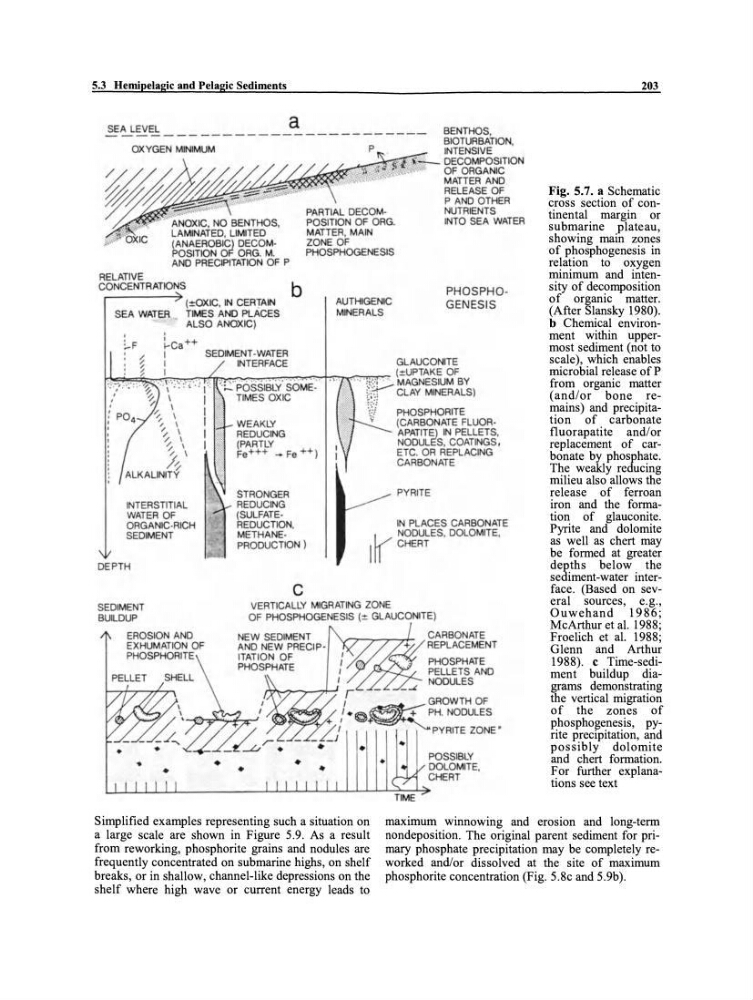
Fig. 5.7. a Schematic
cross section of continental margin or
submarine plateau,
showing main zones
of phosphogenesis in
relation to oxygen
minimum and intensity of decomposition
of organic matter.
(After Slansky 1980).
b Chemical environment within uppermost sediment (not to
scale), which enables
microbial release of P
from organic matter
(and/or bone remains) and precipitation of carbonate
fluorapatite and/or
replacement of carbonate by phosphate.
The weakly reducing
milieu also allows the
release of ferroan
iron and the formation of glauconite.
Pyrite and dolomite
as weil as chert may
be formed at greater
depths below the
sediment-water interface. (Based on several sources, e.g.,
Ouwehand 1986;
McArthur et al. 1988;
Froelich et al. 1988;
G lenn and Arthur
1988). c Time-sediment buildup diagrams demonstrating
the vertical migration
of the zones of
phosphogenesis, pyrite precipitation, and
possibly dolomite
and chert formation .
For further explanations see text
Simplified examples representing such a situation on
a large scale are shown in Figure 5.9. As a result
from reworking, phosphorite grains and nodules are
frequently concentrated on submarine highs, on shelf
breaks, or in shallow, channel-like depressions on the
shelf where high wave or current energy leads to
maximum winnowing and erosion and long-term
nondeposition. The original parent sediment for primary phosphate precipitation may be completely reworked andlor dissolved at the site of maximum
phosphorite concentration (Fig. 5.8c and 5.9b).
SE~LEV~ _______ ___ _ ~ __________ _
BENTHOS,
BIOTURBATlON,
INTENSIVE
DECOMPOSITION
OF ORGANIC
MATTER AND
RELEASE OF
~ .. / /
. ...
ANOXIC, NO BENTHOS,
RELATIVE
LAMINA TED, LlMITED
(ANAEROBIC) DECOM·
POSITION OF ORG. M.
AND PRECIPITATION OF P
CONCENTRATIONS
b
(:OXIC, IN CERTAIN
SEA WATEA
TIMES AND PLACES
ALSO ANOXIC)
,
:"F
,
PARTIAL DECOM·
POSITION OF ORG.
MATTER, MAIN
ZONE OF
PHOSPHOGENESIS
AUTHIGENIC
MINERALS
WEAKLY
REDUCING
(PARTLY
Fe+++ - Fe ++)
P AND OTHER
NUTRIENTS
INTO SEA WATER
PHOSPHOGENESIS
PHOSPHORITE
(CARBONATE FLUOR·
APATITE) IN PELLETS,
NODULtS, COATINGS,
ETC. OR REPLACING
CARBONATE
PYRITE
INTERSTITIAL
WATER OF
ORGANIC·RICH
SEDIMENT
STRONGER
REDUCING
(SULFATE·
REDUCTION,
METHANE·
PRODUCTION )
IN PLACES CARBONATE
V NODULES, DOLOMITE,
1II
CHERT
DEPTH
SEDIMENT
BUILDUP
C
VERTICALLY MIGRATING ZONE
OF PHOSPHOGENESIS (::: GLAUCONITE)
NEW SEDIMENT
AND NEW PREClp·
ITATION OF
PHOSPHATE
• •
•
CARBONATE
REPLACEMENT
203
Fig. 5.7. a Schematic
cross section of continental margin or
submarine plateau,
showing main zones
of phosphogenesis in
relation to oxygen
minimum and intensity of decomposition
of organic matter.
(After Slansky 1980).
b Chemical environment within uppermost sediment (not to
scale), which enables
microbial release of P
from organic matter
(and/or bone remains) and precipitation of carbonate
fluorapatite and/or
replacement of carbonate by phosphate.
The weakly reducing
milieu also allows the
release of ferroan
iron and the formation of glauconite.
Pyrite and dolomite
as weil as chert may
be formed at greater
depths below the
sediment-water interface. (Based on several sources, e.g.,
Ouwehand 1986;
McArthur et al. 1988;
Froelich et al. 1988;
G lenn and Arthur
1988). c Time-sediment buildup diagrams demonstrating
the vertical migration
of the zones of
phosphogenesis, pyrite precipitation, and
possibly dolomite
and chert formation .
For further explanations see text
Simplified examples representing such a situation on
a large scale are shown in Figure 5.9. As a result
from reworking, phosphorite grains and nodules are
frequently concentrated on submarine highs, on shelf
breaks, or in shallow, channel-like depressions on the
shelf where high wave or current energy leads to
maximum winnowing and erosion and long-term
nondeposition. The original parent sediment for primary phosphate precipitation may be completely reworked andlor dissolved at the site of maximum
phosphorite concentration (Fig. 5.8c and 5.9b).