

1.2 Tectonic Basin Classification
9
c
POST -DEPOSITIONAL BASIN
-- -. .. ...... ' .... ,
- --.....
"
FLUVIAL
ERODED
LAKE
...-~SEDIMENT ..... ...-"'--_
...(
UTTLE LATEAAL CHANGE
IN FACIES AND THICKNESS
PALEO·CUAAENT
DIRECTION
b
SYN-DEPOSITIONAL BASIN
PALEO·CUAAENT
DIAECTION
. : .... ~ . . ~ . . . ;~:- .. -"' .. ' -. . . 0: ~_ ...... :: .. ~ . . . . .
• .. ·· ·.o·~·-o- __ it-· • • • o .• ~ · . . .
,
•• _a .fII·OOG"". · · ..
( SIGNIFICANT LATEAAL CHANGE
)
IN THICKNESS, SOME CHANGE IN FACIES
UTTLE VEA TICAL
FACIES CHANGE
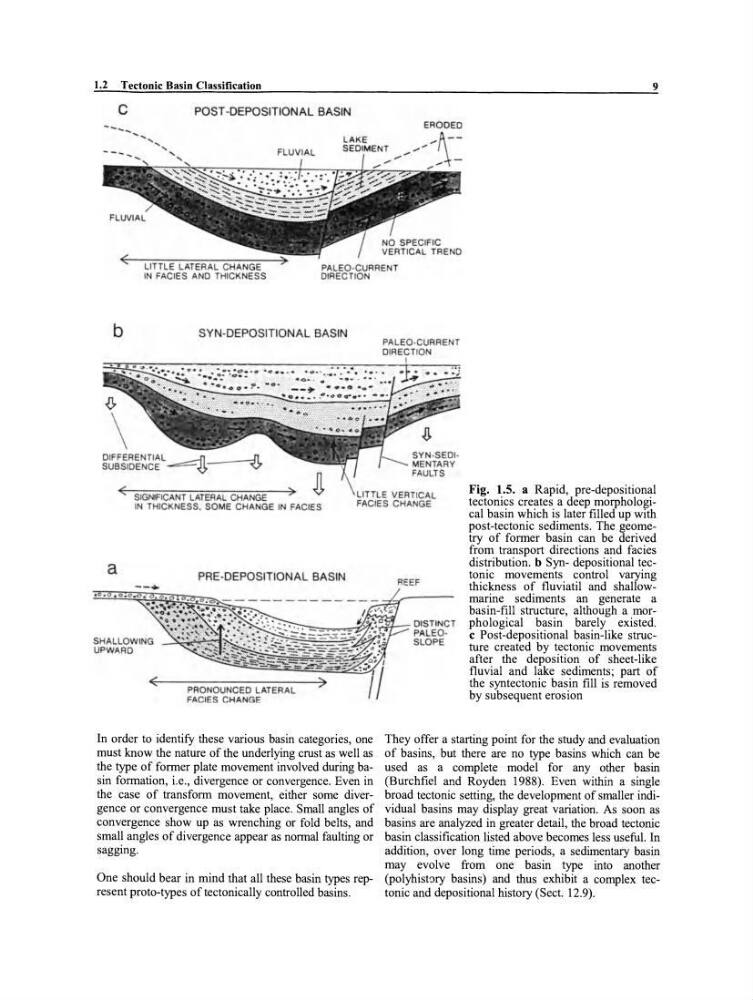
Fig. 1.5. a Rapid, pre-depositional
tectonies creates a deep morphological basin which is later filled up with
post-teetonic sediments. The geometry of former basin can be derived
from transport directions and facies
distribution. b Syn- depositional tectonic movements control varying
thickness of fluviatil and shallowmarine sediments an generate a
basin-fill strueture, although a morphological basin barely existed.
c Post-depositional basin-like structure ereated by teetonic movements
after the deposition of sheet-like
fluvial and lake sediments; part of
the syntectonic basin fill is removed
by subsequent erosion
a
SHALLOWING
UPWARD
<
PRE-DEPOSITIONAL BASIN
In order to identify these various basin eategories, one
must know the nature of the underlying erust as weil as
the type of former plate movement involved during basin formation, i.e., divergence or eonvergence. Even in
the ease of transform movement, either some divergence or convergence must take place. Small angles of
convergence show up as wrenching or fold belts, and
small angles of divergence appear as normal faulting or
sagging.
One should bear in mind that all these basin types represent proto-types of tectonically controlled basins.
AEEF
DISTINCT
PALEO·
SLOPE
They offer a starting point for the study and evaluation
of basins, but there are no type basins which can be
used as a complete model for any other basin
(Burchfiel and Royden 1988). Even within a single
broad tectonic setting, the development of smaller individual basins may display great variation. As soon as
basins are analyzed in greater detail, the broad tectonic
basin classification listed above becomes less useful. In
addition, over long time periods, a sedimentary basin
may evolve from one basin type into another
(polyhist'Jry basins) and thus exhibit a complex tectonic and depositional history (Sect. 12.9).
9
c
POST -DEPOSITIONAL BASIN
-- -. .. ...... ' .... ,
- --.....
"
FLUVIAL
ERODED
LAKE
...-~SEDIMENT ..... ...-"'--_
...(
UTTLE LATEAAL CHANGE
IN FACIES AND THICKNESS
PALEO·CUAAENT
DIRECTION
b
SYN-DEPOSITIONAL BASIN
PALEO·CUAAENT
DIAECTION
. : .... ~ . . ~ . . . ;~:- .. -"' .. ' -. . . 0: ~_ ...... :: .. ~ . . . . .
• .. ·· ·.o·~·-o- __ it-· • • • o .• ~ · . . .
,
•• _a .fII·OOG"". · · ..
( SIGNIFICANT LATEAAL CHANGE
)
IN THICKNESS, SOME CHANGE IN FACIES
UTTLE VEA TICAL
FACIES CHANGE
Fig. 1.5. a Rapid, pre-depositional
tectonies creates a deep morphological basin which is later filled up with
post-teetonic sediments. The geometry of former basin can be derived
from transport directions and facies
distribution. b Syn- depositional tectonic movements control varying
thickness of fluviatil and shallowmarine sediments an generate a
basin-fill strueture, although a morphological basin barely existed.
c Post-depositional basin-like structure ereated by teetonic movements
after the deposition of sheet-like
fluvial and lake sediments; part of
the syntectonic basin fill is removed
by subsequent erosion
a
SHALLOWING
UPWARD
<
PRE-DEPOSITIONAL BASIN
In order to identify these various basin eategories, one
must know the nature of the underlying erust as weil as
the type of former plate movement involved during basin formation, i.e., divergence or eonvergence. Even in
the ease of transform movement, either some divergence or convergence must take place. Small angles of
convergence show up as wrenching or fold belts, and
small angles of divergence appear as normal faulting or
sagging.
One should bear in mind that all these basin types represent proto-types of tectonically controlled basins.
AEEF
DISTINCT
PALEO·
SLOPE
They offer a starting point for the study and evaluation
of basins, but there are no type basins which can be
used as a complete model for any other basin
(Burchfiel and Royden 1988). Even within a single
broad tectonic setting, the development of smaller individual basins may display great variation. As soon as
basins are analyzed in greater detail, the broad tectonic
basin classification listed above becomes less useful. In
addition, over long time periods, a sedimentary basin
may evolve from one basin type into another
(polyhist'Jry basins) and thus exhibit a complex tectonic and depositional history (Sect. 12.9).