

8
a STRIKE -SLIP /WRENCH BASINS
b
Chapter 1 Basin Classification
DEXTRAL (RIGHT -LATERAL)
MOVEMENT
/\..
CONTINENTAL
OR OCEANIC
CRUST
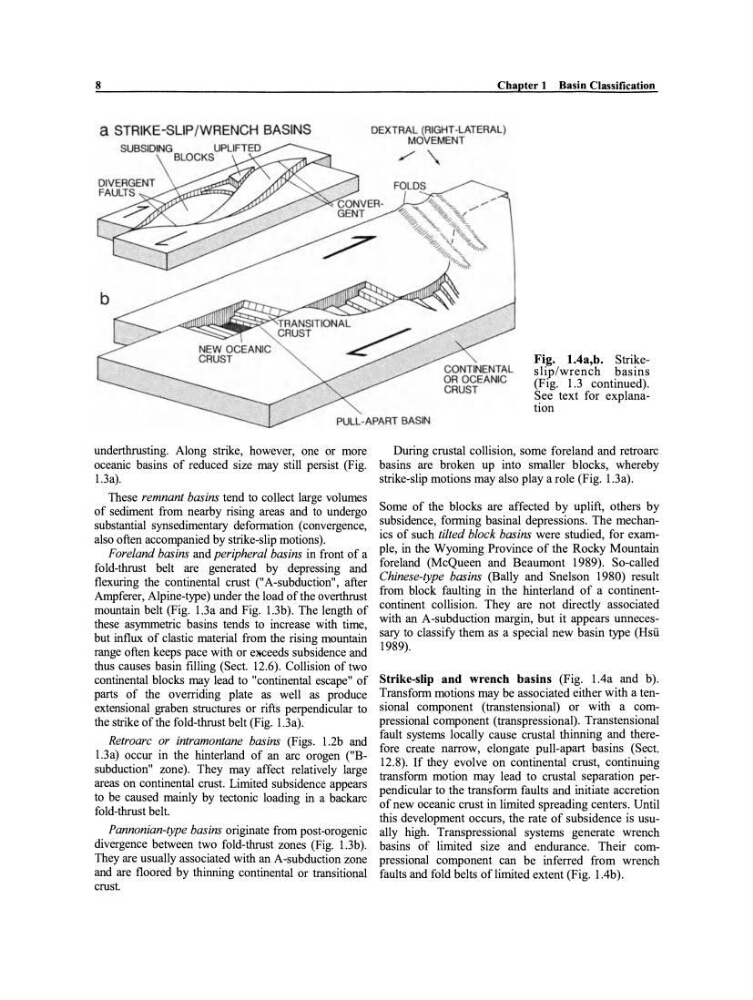
Fig. 1.4a,b. Strikeslip/wrench basins
(Fig. 1.3 continued).
See text for explanation
PULL-APART BASIN
underthrusting. Along strike, however, one or more
During crustal collision, some foreland and retroarc
oceanic basins of reduced size rnay still persist (Fig. basins are broken up into srnaller blocks, whereby
1.3a).
strike-slip motions mayaiso playa role (Fig. l.3a).
These remnant basins tend to collect large volurnes
of sediment from nearby rising areas and to undergo
substantial synsedimentary deformation (convergence,
also often accompanied by strike-slip motions).
Foreland basins and peripheral basins in front of a
fold-thrust belt are generated by depressing and
flexuring the continental crust ("A-subduction", after
Ampferer, Alpine-type) under the load ofthe overthrust
mountain belt (Fig. 1.3a and Fig. 1.3b). The length of
these asymmetric basins tends to increase with time,
but influx of c1astic material from the rising mountain
range often keeps pace with or eJiceeds subsidence and
thus causes basin filling (Sect. 12.6). Collision of two
continental blocks rnay lead to "continental escape" of
parts of the overriding plate as weH as produce
extensional graben structures or rifts perpendicular to
the strike ofthe fold-thrust belt (Fig. 1.3a).
Retroarc or intramontane basins (Figs. 1.2b and
1.3a) occur in the hinterland of an arc orogen ("Bsubduction" zone). They rnay affect relatively large
areas on continental crust. Limited subsidence appears
to be caused rnainly by tectonic loading in a backarc
fold-thrust belt.
Pannonian-type basins originate from post-orogenic
divergence between two fold-thrust zones (Fig. l.3b).
They are usuaHy associated with an A-subduetion zone
and are floored by thinning continental or transitional
erust.
Some of the blocks are affected by uplift, others by
subsidence, forrning basinal depressions. The mechanics of such tilted block basins were studied, for exampIe, in the Wyoming Province of the Rocky Mountain
fore land (McQueen and Beaumont 1989). So-called
Chinese-type basins (Bally and Snelson 1980) result
from block faulting in the hinterland of a continenteontinent collision. They are not directly associated
with an A-subduction margin, but it appears unnecessary to c1assify them as a special new basin type (Hsü
1989).
Strike-slip and wrench basins (Fig. 1.4a and b).
Transform motions may be associated either with a tensional eomponent (transtensional) or with a compressional component (transpressional). Transtensional
fault systems locally cause crustal thinning and therefore create narrow, elongate pull-apart basins (Sect.
12.8). If they evolve on continental crust, continuing
transform motion rnay lead to crustal separation perpendicular to the transform faults and initiate accretion
of new oceanic crust in limited spreading centers. Until
this development occurs, the rate of subsidence is usually high. Transpressional systems generate wrench
basins of lirnited size and endurance. Their compressional component can be inferred from wrench
faults and fold belts oflirnited extent (Fig. lAb).
a STRIKE -SLIP /WRENCH BASINS
b
Chapter 1 Basin Classification
DEXTRAL (RIGHT -LATERAL)
MOVEMENT
/\..
CONTINENTAL
OR OCEANIC
CRUST
Fig. 1.4a,b. Strikeslip/wrench basins
(Fig. 1.3 continued).
See text for explanation
PULL-APART BASIN
underthrusting. Along strike, however, one or more
During crustal collision, some foreland and retroarc
oceanic basins of reduced size rnay still persist (Fig. basins are broken up into srnaller blocks, whereby
1.3a).
strike-slip motions mayaiso playa role (Fig. l.3a).
These remnant basins tend to collect large volurnes
of sediment from nearby rising areas and to undergo
substantial synsedimentary deformation (convergence,
also often accompanied by strike-slip motions).
Foreland basins and peripheral basins in front of a
fold-thrust belt are generated by depressing and
flexuring the continental crust ("A-subduction", after
Ampferer, Alpine-type) under the load ofthe overthrust
mountain belt (Fig. 1.3a and Fig. 1.3b). The length of
these asymmetric basins tends to increase with time,
but influx of c1astic material from the rising mountain
range often keeps pace with or eJiceeds subsidence and
thus causes basin filling (Sect. 12.6). Collision of two
continental blocks rnay lead to "continental escape" of
parts of the overriding plate as weH as produce
extensional graben structures or rifts perpendicular to
the strike ofthe fold-thrust belt (Fig. 1.3a).
Retroarc or intramontane basins (Figs. 1.2b and
1.3a) occur in the hinterland of an arc orogen ("Bsubduction" zone). They rnay affect relatively large
areas on continental crust. Limited subsidence appears
to be caused rnainly by tectonic loading in a backarc
fold-thrust belt.
Pannonian-type basins originate from post-orogenic
divergence between two fold-thrust zones (Fig. l.3b).
They are usuaHy associated with an A-subduetion zone
and are floored by thinning continental or transitional
erust.
Some of the blocks are affected by uplift, others by
subsidence, forrning basinal depressions. The mechanics of such tilted block basins were studied, for exampIe, in the Wyoming Province of the Rocky Mountain
fore land (McQueen and Beaumont 1989). So-called
Chinese-type basins (Bally and Snelson 1980) result
from block faulting in the hinterland of a continenteontinent collision. They are not directly associated
with an A-subduction margin, but it appears unnecessary to c1assify them as a special new basin type (Hsü
1989).
Strike-slip and wrench basins (Fig. 1.4a and b).
Transform motions may be associated either with a tensional eomponent (transtensional) or with a compressional component (transpressional). Transtensional
fault systems locally cause crustal thinning and therefore create narrow, elongate pull-apart basins (Sect.
12.8). If they evolve on continental crust, continuing
transform motion rnay lead to crustal separation perpendicular to the transform faults and initiate accretion
of new oceanic crust in limited spreading centers. Until
this development occurs, the rate of subsidence is usually high. Transpressional systems generate wrench
basins of lirnited size and endurance. Their compressional component can be inferred from wrench
faults and fold belts oflirnited extent (Fig. lAb).